
Quick answer. You can write a useful notice without narrating a health concern, family conflict, or private financial situation. A personal-reasons resignation is a communications problem: disclose the departure and last day clearly without turning private circumstances into workplace documentation. A useful personal-reasons resignation letter should make the decision, the actual final work date, and the handoff commitments unmistakable.
Decide What the Message Must Accomplish
A personal-reasons message can be precise about work while deliberately unspecific about life outside work. Write down the facts the supervisor needs to act on: your role, the intended last working day, and the appropriate point of contact for the remaining assignments. Place household circumstances, names of relatives, private appointments and financial worries on a separate private sheet if you need them for your own planning. Do not paste that private sheet into a corporate email merely to make the resignation sound credible.
Before drafting, decide whether you are notifying a departure or requesting a conversation about alternatives. Mixing the two creates unnecessary ambiguity and can result in a manager acting on the wrong interpretation. “I need to discuss a personal issue” is not the same as “I resign, with my last working day on [Date].” Put the choice into a small decision worksheet: is the departure fixed, which date must be communicated, and which separate questions still need a response?
You do not have to invent a detailed reason to make a letter polite. A simple “for personal reasons” can preserve space between a supervisor’s staffing needs and the employee’s personal life. If you choose to share a reason, keep the description to information you actively wish to put in a workplace record. Avoid listing diagnoses, family disputes, addresses or other third-party private details. Can that reader accurately schedule coverage? If not, revise the workday line and remove extra background.
Set the Final Date and Recipient Correctly
When you have not decided whether resignation is the right next action, draft a question rather than a notice. An employee may want to ask about schedule changes, time away or other options without committing to leave. A message that definitively says “I resign” does a very different job from a request to review those possibilities. Keep the documents separate. This is a communication distinction, not a prediction about anyone’s eligibility for a specific form of leave or accommodation.
“I need to discuss a personal issue” is not the same as “I resign, with my last working day on [Date].” Name the position exactly as it appears in your employer’s records and identify the person who should receive notice.
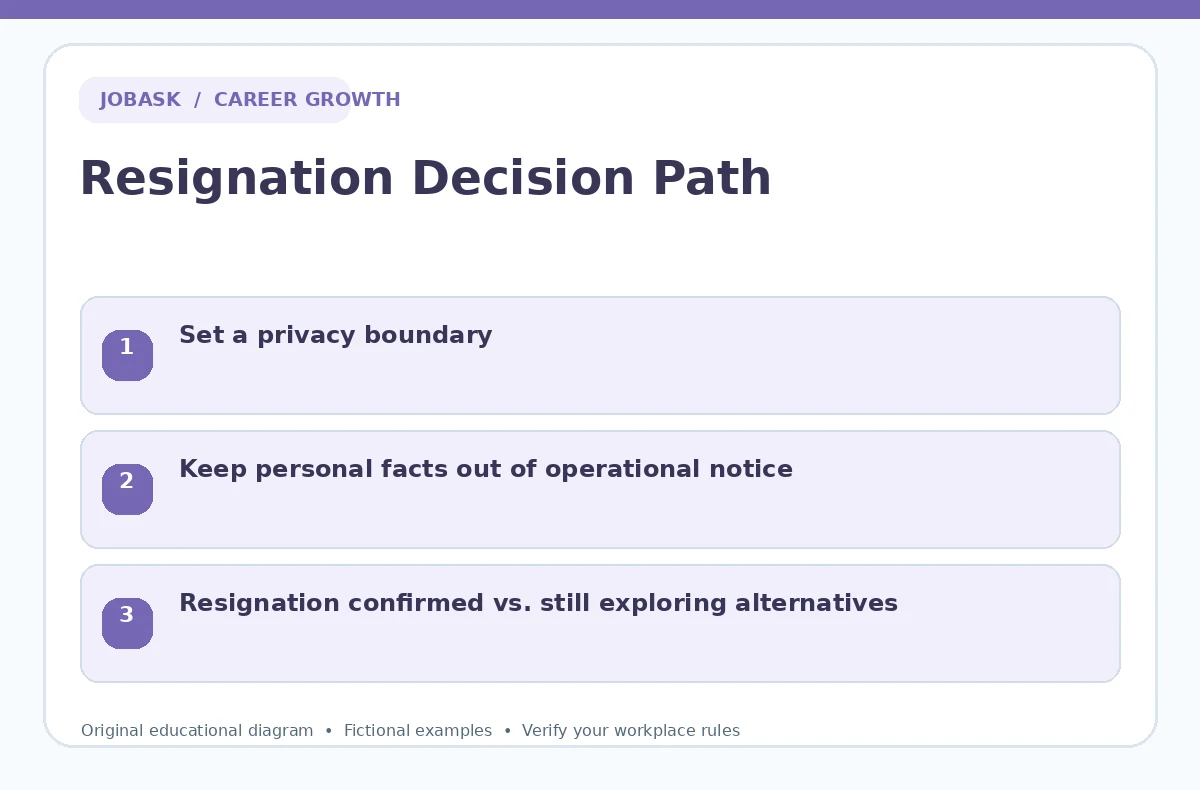
Use a Three-Part Departure Decision Matrix
A personal-reasons notice has two audiences with different needs. The manager needs scheduling and task ownership; the employee decides how much private context to reveal. HR may have a separate role if a leave request or other question is involved. Distinguishing those audiences helps prevent the formal departure letter from becoming a file of family details that coworkers or future record reviewers never needed.
| Decision point | Action to verify |
|---|---|
| Decision | Resignation confirmed vs. still exploring alternatives |
| Reason detail | Neutral wording vs. optional voluntarily shared context |
| Handoff | Only work you are authorized and able to transfer |
Only send facts that are already accurate.
Adapt This Clearly Hypothetical Resignation Example
Imagine that a supervisor asks why the resignation is happening. One fictional answer could be: “The decision involves a private matter, and I would prefer not to discuss the details. I can provide the outstanding-project list today.” This redirects the conversation without insulting the listener or inventing a justification. It also does not promise that every workplace rule will excuse every omitted fact. Anyone unsure about obligations in a particular setting should check the correct official resources before deciding what to disclose.
Fictional example — not a real employer, employee, or outcome: Dear [Manager Name], Please accept this message as notice that I am resigning from my role as [Position] for personal reasons. My intended last working day is [Date]. I appreciate the experience of working with the team. Before that date, I can document my current assignments and discuss an appropriate handoff. Thank you for your understanding. Best regards, [Name]. If you want the full process, read how to resign from a remote job with a clear digital handoff.
This fictional letter does not claim that the writer has a medical condition, is legally required to disclose a reason or qualifies for a particular type of leave.
Compare the two. You can write a useful notice without narrating a health concern, family conflict, or private financial situation.

Keep Sensitive Details and Unsupported Claims Out
If a supervisor asks a personal question, a calm response might be: “I prefer to keep the details private, but I can confirm the work and timing needed for the handoff.” Your situation may involve additional rules; verify them independently. Ask whether the notice recipient actually needs that information. Confidentiality and accuracy remain relevant even during a departure. Our guide “Resignation Due to Relocation” goes into more detail.
Avoid opening negotiations about unrelated grievances in the formal notice when the practical purpose is to record a departure. Keep separate discussions, complaints or requests in the appropriate channel.
Document the Work Handoff Without Overpromising
Consider how a coworker will find unfinished work after your final day. A neutral status sheet might contain three columns: assignment, latest approved status, and who should receive the next update. The sheet should not explain your personal situation; it should explain the work. If a case file contains protected information, link its authorized internal location rather than copying it into a departure email. That distinction protects both the departing employee and people whose details appear in the records.
Offer one bounded, concrete step: make a list of outstanding tasks, explain the status of a shared project or introduce an approved colleague to recurring contacts. Do not hand over private records or promise access after the final day.
Hypothetical handoff scenario. A hypothetical program assistant needs to leave to manage a private personal matter. Their message gives a date without identifying any relative, diagnosis, or personal address; a separate list records two unfinished assignments.

Check the Final Draft Against Reality
A final privacy review should identify facts the reader could repeat later. A line about caring for a relative, for example, might appear harmless now but may disclose another person’s situation without their permission. Delete anything unnecessary to the employment decision. Keep the courteous closing in your own voice and choose only assistance that you can realistically offer. The resulting notice may be brief, but it will be more coherent than a longer letter that blends personal explanations with operational promises. For the fuller picture, see our guide “A Personal-Reasons Notice That Respects Privacy”.
Before sending, delete details that a future reader does not need to see. Ensure the date is precise, the sentiment is sincere, and any available help stays within your real capacity.
When proofreading a privacy-sensitive letter, look for accidental disclosures that slipped in while trying to sound sincere. Personal contact details, diagnoses, the names of relatives, and narratives about private disagreements may distract from the workday information. Confirm that the transition offer concerns actual assignments and does not imply access to protected records after leaving. A person considering leave instead should clarify that separate possibility before giving definitive notice.
How We Research These Departure Scenarios
The Indeed personal-reasons guide supports concise wording that need not give a detailed private explanation. UNLV’s professional correspondence page supports a respectful statement of departure and date. Reviewed October 20, 2026, these writing sources do not settle individual disclosure or leave obligations, which may require different guidance.
Read the site-wide affiliate disclosure. This guide contains no affiliate links.
Explore Related Career Guides
- Short Notice Resignation Letter With a Realistic Handover Plan
- Resignation Letter Due to Relocation: Dates and Handover Example
- Resignation Letter: Clear Templates and a Professional Handoff Plan
- Retirement Resignation Letter: Last Day, Handoff, and Benefits
- Formal Resignation Letter Format: Write, Sign, and Deliver It Clearly
The notice can state a personal reason without a narrative. Particular employment or leave rules vary, so use appropriate official or professional guidance for individual obligations.
Yes, and it may be important if the decision is not final. Keep a leave or accommodation inquiry separate from a definitive resignation notice.
You can politely restate what you are comfortable sharing and redirect to the departure logistics, subject to any applicable workplace requirements.
A brief courteous acknowledgment may suit your situation, but an elaborate apology can obscure the decision and should not replace an exact final date.
A concise professional email can provide a clear written record where the employer accepts that channel. Check the organization’s process for recipient and documentation.