
For a teaching interview, ask how instructional decisions are made, how students receive support, and what resources a new teacher can actually use. A useful question leads to a specific example of the school’s routines—not a vague promise that the staff is supportive. Choose three or four questions according to what the job posting and interview have already answered.
Public-school teacher certification requirements differ by state. The questions below are about the working conditions of a particular teaching role, not a substitute for checking state credential rules or district contracts. A middle-school art teacher, a high-school science teacher, and an elementary teacher will need different follow-up details.
Choose questions that reveal how this job actually works
Before the interview, highlight three unclear responsibilities in the job posting. Decide which interviewer can answer each one: a recruiter can often confirm the process, while a hiring manager or future teammate may explain the day-to-day workflow. Begin with a specific detail you observed and then ask an open question. A yes-or-no question such as “Do you offer training?” usually produces less usable information than asking how training is organized.
Avoid treating every answer as a promise. Clarify whether the speaker describes a usual practice, a written policy, or a plan that has not yet been implemented. If the interviewer already covered one of your prepared questions, acknowledge it and choose another. A short list used thoughtfully is better than reciting a long sequence without listening.
Ask about the work and the support available
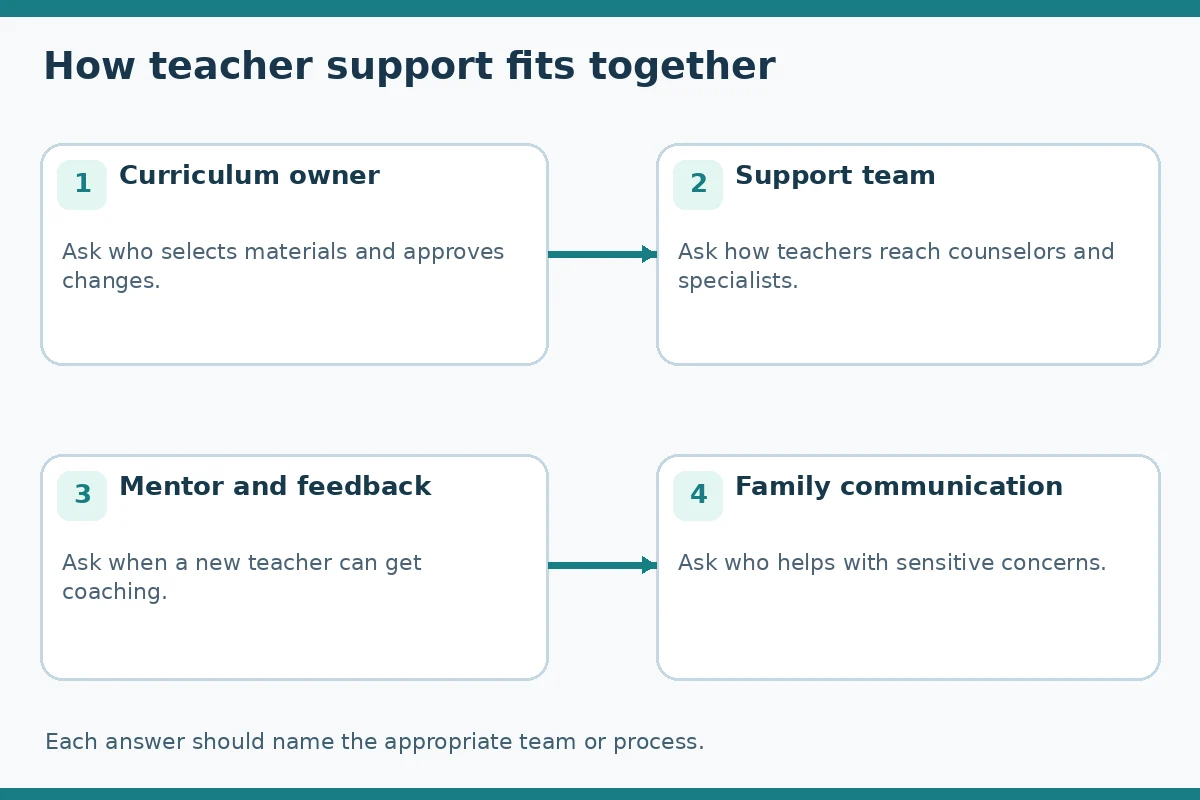
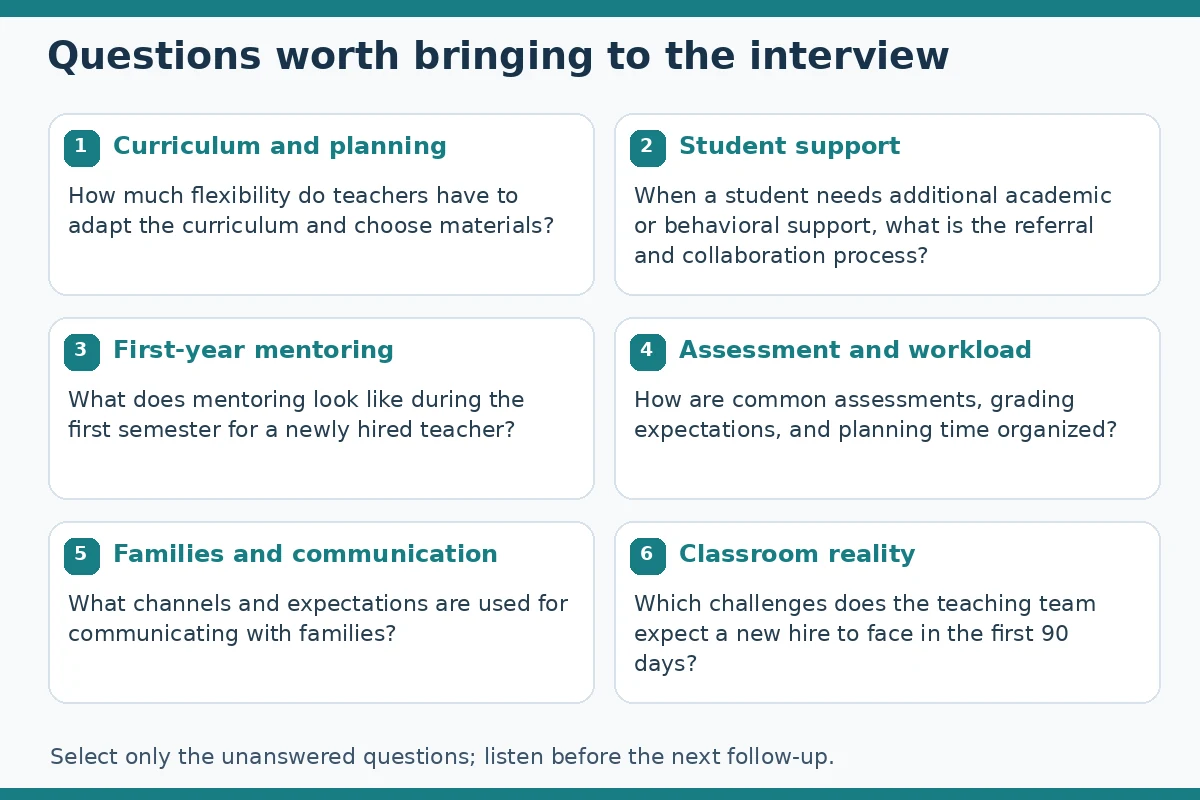
Curriculum and planning — Ask: “How much flexibility do teachers have to adapt the curriculum and choose materials?” This distinguishes required instructional standards from the teacher’s actual room to select examples, assessments, and pacing. The answer should identify the curriculum owner, available material and approval process, not just say the school welcomes creativity. Follow-up: “Would I plan alone, with a grade-level team, or with a department lead?”
Student support — Ask: “When a student needs additional academic or behavioral support, what is the referral and collaboration process?” You want to understand the school’s process for connecting with counselors, specialists, administrators, and families while respecting student privacy. Look for a defined contact, documentation expectations, and a realistic response time. Follow-up: “Who helps coordinate support when the classroom strategy is not enough?”
First-year mentoring — Ask: “What does mentoring look like during the first semester for a newly hired teacher?” A supportive answer gives the mentor’s role, observation and feedback rhythm, protected time if offered, and an avenue for urgent questions. A label such as “open-door policy” is less useful unless someone can describe how it works on a crowded school day. Follow-up: “How does a new teacher receive feedback without confusing coaching with formal evaluation?”
Clarify ownership, boundaries, and evaluation
Assessment and workload — Ask: “How are common assessments, grading expectations, and planning time organized?” The school may use departmental common assessments, schoolwide grade policies, or teacher-designed tasks. Understanding the structure helps you estimate the preparation and reporting work outside instruction without assuming every school provides the same preparation period. Follow-up: “Which reports or assessments are coordinated across the team?”
Families and communication — Ask: “What channels and expectations are used for communicating with families?” Ask how communication tools, translation support, records, and escalation work rather than requesting information about individual children. A clear process can help you identify whether the role includes family conferences and what administrative assistance exists. Follow-up: “Who should a teacher contact when a family issue needs additional support?”
Classroom reality — Ask: “Which challenges does the teaching team expect a new hire to face in the first 90 days?” The best answer is candid about classroom resources, teacher collaboration, scheduling, attendance or competing duties, without exposing student information. Listen for a concrete plan to address the challenge and an owner who can help. Follow-up: “Which of those challenges is something the new teacher can influence right away?”
Read the answers as evidence, not as guarantees
Suppose the principal says that teachers have “a lot of freedom.” Ask what that means for lesson materials, grading and student interventions. Freedom to choose instructional examples does not necessarily mean freedom to override district policies. A thoughtful follow-up lets you understand the job without turning the interview into a debate about a hypothetical classroom problem.
If someone names a mentor, describes a review schedule, and explains where lesson resources are stored, you have a better starting picture than if they repeatedly say “you will figure it out.” A short interview cannot establish every detail; write down the unanswered points and verify essential working conditions through the appropriate school or district channel.

Use a short conversation script and record what remains unknown
A practical opening is: “I noticed this role includes several kinds of work. Could you walk me through how the team handles a proposed curriculum change?” Listen without interrupting, then ask one follow-up tied to the answer. If the question concerns confidential records, individual customers, or students, ask for a general process or an anonymized example. You do not need private cases to evaluate the work environment.
At the end you might say: “Thank you, that helps me understand the role. What are the next steps and the expected hiring timeline?” This asks for procedural clarity without implying that an offer has been made. After the interview, compare your notes with the written posting. Separate confirmed responsibilities from areas that require another conversation, and use that distinction if you are later evaluating an offer.
How We Research Interview Questions
We consulted University of Georgia interview questions, University of Minnesota interview guidance, BLS occupational duties on October 30, 2026. The university career services sources provide a basis for asking about role expectations and support. The occupation and safety sources describe relevant duties or constraints; the example questions and interpretation guidance are editorial applications, not quotations from those sources. Employer-specific schedules, permissions and policies must be verified directly.
The questions and example conversation are illustrative, not accounts of actual employers or guaranteed interview outcomes. We do not claim to know an employer’s internal rules, hiring decisions or training program. For website transparency, see our affiliate disclosure.
More Interview Preparation Guides
- Questions to Ask in a Sales Interview: Territory, Targets and Support
- Tell Me About Yourself in a Teacher Interview: Classroom Evidence First
- Elementary Teacher Interview Questions: Lessons and Classroom Decisions
- Questions to Ask in a Customer Service Interview: Escalation, Quality, and Coaching
- Teacher Interview Strengths and Weaknesses: Lesson Evidence and Reflection
Yes. Ask about the usual class assignment and support model for the advertised role. Do not assume the answer guarantees a fixed roster.
Yes. Ask what procedures teachers follow and who provides support, without requesting confidential student cases.
Yes. Request the typical schedule and distinguish protected planning periods from informal preparation expectations.
Ask about how the local team implements it, updates materials, and evaluates student progress.
Clarify pay scales, contract terms, and benefits through the district or hiring channel at the appropriate stage; do not treat a general interview answer as a contract.