
Decide whether you want a role change or to leave the employer
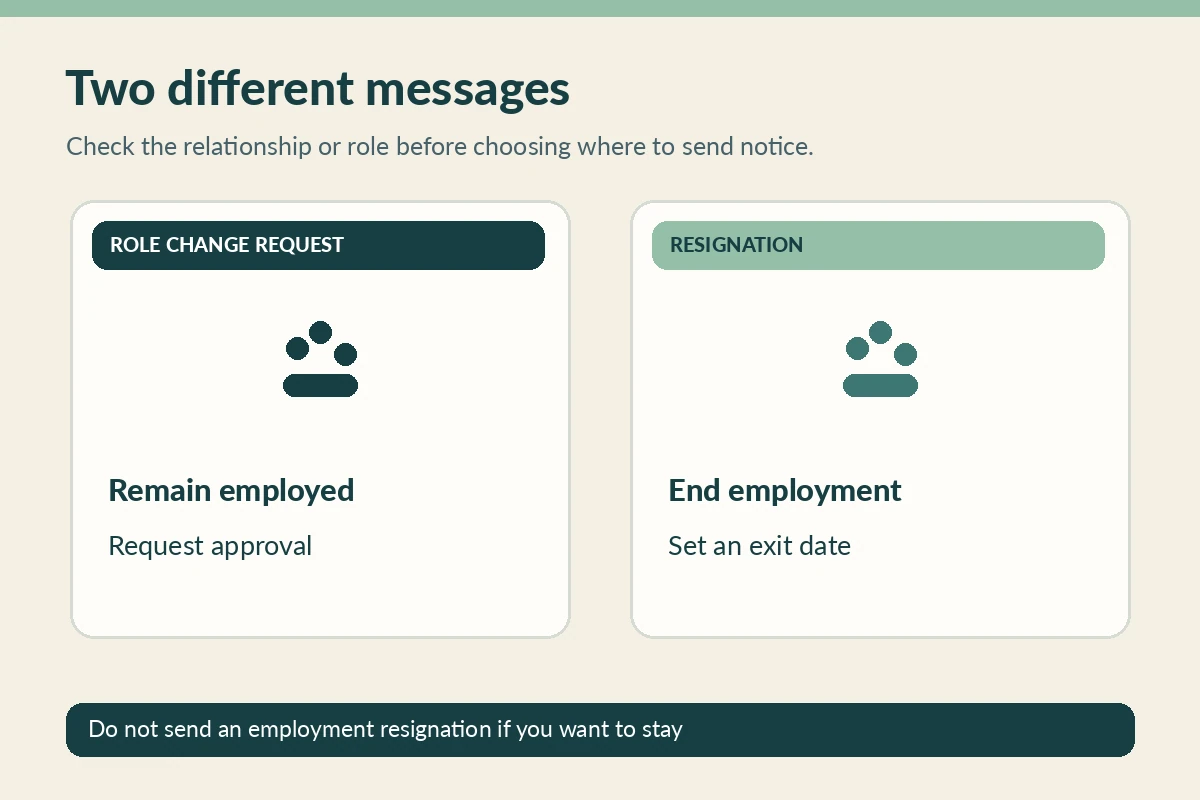
Stepping down from a supervisor role does not necessarily mean resigning from the company. You may want to stop managing people and return to an individual-contributor role, reduce responsibility, or move into another team. Begin by naming the outcome you seek: continued employment in a different approved position. A standard resignation letter says you are leaving employment and can create serious confusion. Instead, write a request to discuss a change of duties or position. You should not promise your team that you are stepping down until an authorized person confirms a feasible arrangement.
Identify the position you could perform next
A request is easier to evaluate when it names a realistic role rather than simply saying “I no longer want responsibility.” Consider the duties you want to retain, the reporting relationship, required qualifications, schedule, location, and any team openings. For example, a customer-support lead might propose returning to specialist case handling while another employee handles coaching and shift approvals. This is an illustrative pathway, not a vacancy announcement. Your employer may require a hiring process or may have no suitable role. A clear proposal invites discussion; it does not create an entitlement to a specific position.
Review implications before treating the change as approved
Changing out of people management can affect title, compensation, benefits eligibility, shift assignments, work location, performance expectations, and access rights. These are employer-specific questions, not results you can infer from the label “step down.” UW–Madison HR guidance illustrates how changes to supervision responsibilities can require a formal position-description process. Your employer’s policy may differ. Ask HR or the relevant manager to explain the proposed role in writing and confirm when any changes take effect. Do not assume that you can decline supervisory duties immediately while retaining every existing term.
Start with a private conversation instead of a team announcement
Request a short discussion with your manager or HR contact using the normal confidential channel. Explain what you are asking for, offer a reasonable transition process, and describe the work you can continue to do. Avoid broadcasting dissatisfaction with colleagues or identifying a successor without permission. A good first sentence is “I would like
to discuss moving from my supervisor responsibilities into an individual-contributor position if a suitable role can be approved.” That differs from “I resign effective Friday.” If the change is connected to a health, disability, or protected-workplace issue, seek appropriate case-specific help rather than including sensitive details in a broad email.
Use an email that requests approval instead of asserting it
Illustrative email: Subject: Request to Discuss a Role Change. “Hello Jordan, I would like to discuss stepping down from my Team Supervisor responsibilities while remaining with the organization, if an appropriate position is available. I am interested in continuing to contribute through customer escalations and process documentation without direct staff management. Could we meet to review feasible roles, timing, and any changes in duties or terms? I will continue my current responsibilities until a transition is agreed. Thank you, Alex.” This is a hypothetical request, not evidence that any employer must approve it.
Separate your preferences from the employer decision process
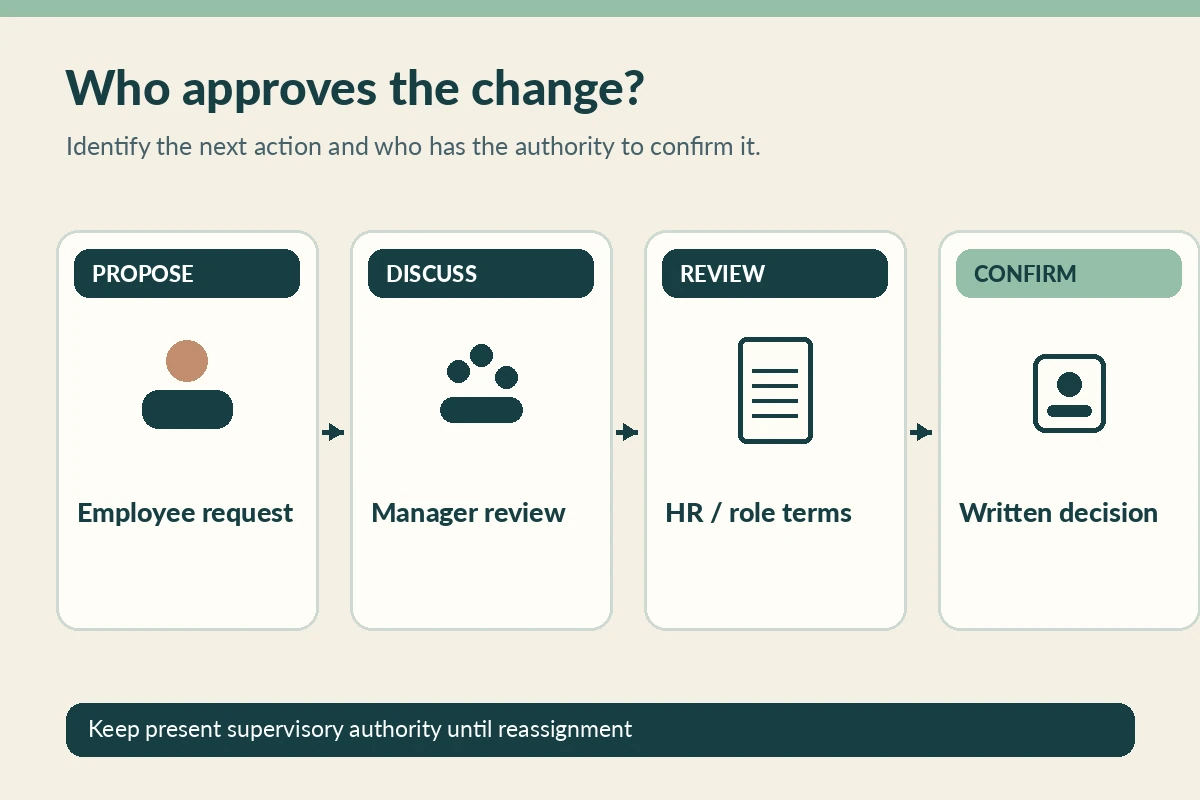
Your manager may need HR, department leadership, compensation, or budget approval before a new position can be confirmed. Ask who owns the decision and what documentation will be required. There might be a job posting, a formal transfer application, or a revised role description. If the initial answer is “not now,” ask whether you should discuss another role or a timeline for reconsideration, if appropriate. Do not represent a verbal expression of support as a final transfer. Keep performing existing duties until they are formally reassigned or you receive other authorized instructions.
Build a leadership transition that respects approval boundaries
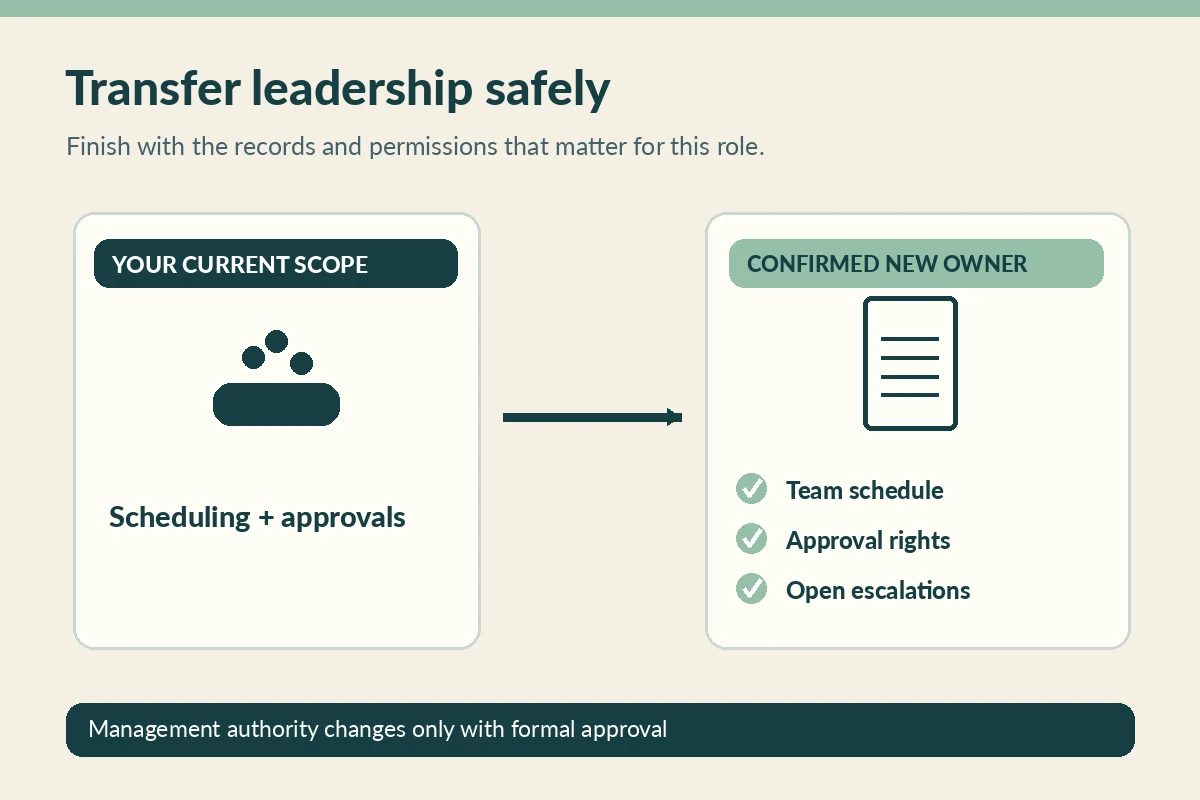
A supervisor may own schedules, performance check-ins, budget requests, vendor approvals, incident escalations, or access permissions. List the systems and decisions that need a new accountable owner. Rather than transferring your passwords or signing off on future work for someone else, ask leadership to assign the new approver and have administrators update rights. For sensitive personnel matters, provide only the information the successor is authorized to receive. Document unresolved questions without evaluating individual employees in a group message. A safe handoff changes responsibilities, not just a title on the organization chart.
Respond if the company suggests a different role or reduction
An employer may propose a lateral transfer, lower grade, different schedule, or no immediate alternative. Ask for the exact terms, whether you would remain an employee, and the effective date. You are allowed to request clarification without accepting in the same conversation. If you cannot accept the proposed terms, the next decision may involve continuing in your current role or considering a separate employment resignation. Do not confuse those options. Pay or contract disputes require individualized advice; the email examples here focus on clear professional communication, not legal outcomes.
Tell your team only after the change is authorized
Once a role change is approved, agree on who announces it and the wording the team will need. A simple message identifies when responsibilities move and who will handle scheduling, approvals, and escalations. It need not share private reasons. If the new supervisor has not yet been selected, leadership can provide an interim contact rather than an invented name. Continue to respect team privacy when explaining open work. A positive statement about returning to hands-on work can be truthful without implying you were demoted, promoted, or forced out if those facts were not established.
Confirm the new operating arrangement in writing
Request a written record of the approved role, reporting line, duties, access, schedule, compensation changes if any, and transition date. Check that HR systems, calendars, and escalation channels align with the effective date. If no change was approved, do not send a “final goodbye” to colleagues. This topic is not a resignation notice template: it is a negotiation and transition plan for staying employed while changing the work you do. Precision protects employees, managers, and teammates from contradictory expectations during the transition.
How We Research and Verify Resignation Advice
We reviewed the primary guidance linked below and focused on what the source actually covers rather than assuming one workplace has every employer’s rules. The sample messages above are hypothetical. Verify your agreement, handbook, program, supervisor instructions, and actual dates before using them. This article provides general communication guidance, not a legal, immigration, compensation, or academic determination.
Sources checked 2026-11-03: UW–Madison HR documents how changes in people-management duties may require position description and compensation reviews. Ohio State Engineering Career Services describes resignation correspondence and clear communication, contrasted here with role-change requests. Northeastern University provides general transition practices that apply to responsible handoffs. Additional disclosure: Affiliate disclosure. No paid partnership is assumed in this article.
Explore Related Career Guides
Not when you are asking to remain employed in another position. Use a role-change request, not a resignation letter, unless you intend to leave employment.
Do not assume an opening or approval. Ask the appropriate decision-makers about available positions and formal terms.
Yes, depending on the employer and approved position. Ask for exact written terms rather than assuming the present arrangement continues.
After authorized leadership confirms the plan and agrees on the communication route and effective date.
Ask about other options or timelines if appropriate. Continuing in the current role and resigning are separate decisions with different implications.