
When interviewing at a startup, ask what the team must deliver next, who can approve decisions, and what resources actually exist for your role. You do not need to demand private investor records or predict whether the company will survive. Start with concrete work questions, listen for specifics, and save detailed written terms about pay, equity, reporting lines, and working arrangements for the offer stage. These examples help you distinguish an exciting stretch role from a job description that leaves essential responsibilities undefined.
Start with the next milestone, not the company slogan
Ask, “What is the most important outcome this role should help deliver over the next quarter?” Then follow with, “What is already decided, and what still needs discovery?” A useful answer names a customer problem, product release, service goal, or internal operational need. A vague answer about “doing whatever it takes” can invite a respectful follow-up: “Could you describe a recent priority that changed and how the team adjusted?” The aim is to learn how work is selected rather than demand certainty in an uncertain business.
A startup might have a working product, an early prototype, a service with recurring customers, or a team still refining its business model. The label “startup” does not tell you which. Ask where the organization is in the work relevant to the job and what evidence the team uses to decide whether a milestone succeeded. Do not assume headcount, revenue, profit, or funding based on an online profile. If the interviewer is not the right person to discuss a topic, ask who can clarify it later.
Clarify decision rights and the people behind the work
Ask, “Who sets priorities when product, sales, and operations need different things?” and “What decisions could I make independently in the first month?” For a technical position, this might involve release approval, incident response, or access to customer data. For a customer-facing position, it might involve refunds, contract exceptions, or public commitments. The goal is a realistic authority map, not a promise of unlimited autonomy. Strong replies distinguish what the new hire can decide, what requires review, and what must be escalated.
A small team can be collaborative without every task being everyone’s responsibility. Follow with, “Who would review my work, and what support would be available when I reach a decision I am not authorized to make?” This is particularly important for regulated, financial, safety-critical, or privacy-sensitive work. A founder’s informal explanation may be useful context, but ask for the actual reporting arrangement and operating procedures before relying on it as a condition of employment.
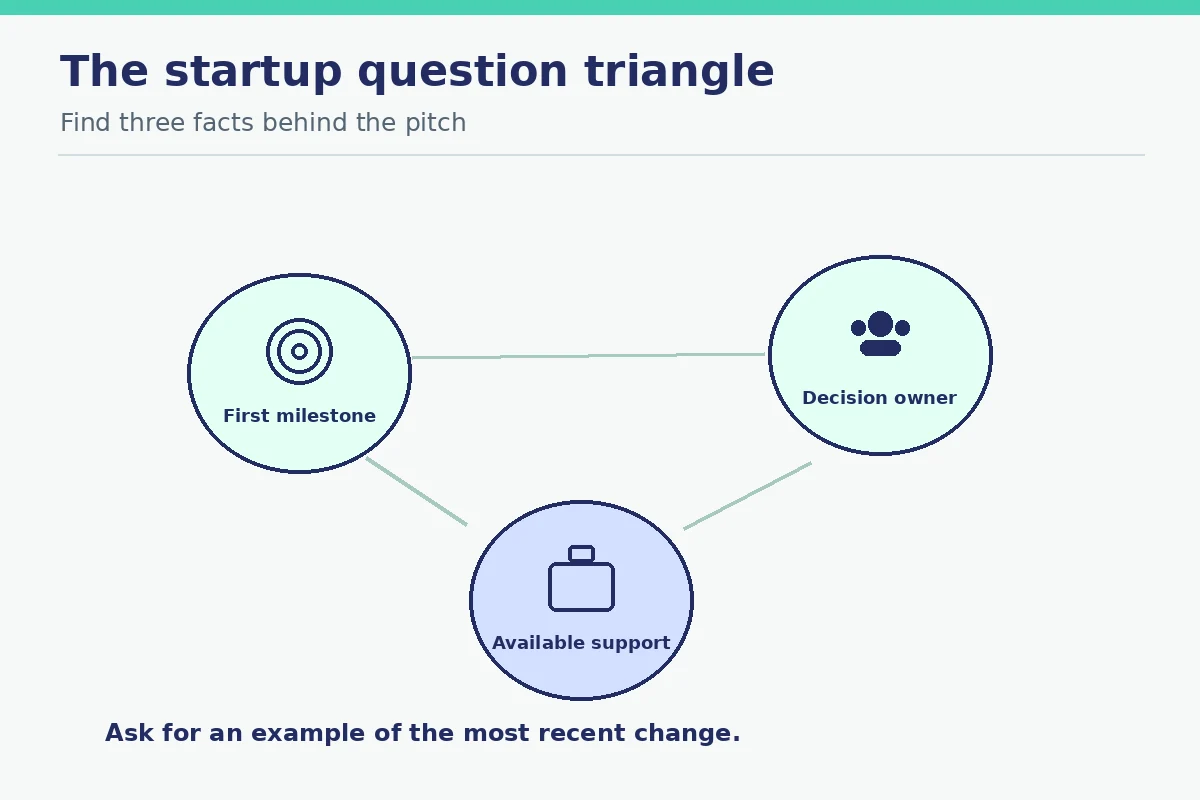
Turn broad role promises into a usable scope map
Many startup postings combine an ambitious mission with a short list of duties. Try, “Which three activities would take most of my time during a typical week?” Then distinguish work the company already performs from work it hopes to build. For example, “Will I maintain an existing support process, create the first workflow, or do some of both?” Each answer implies different training, tools, and success measures. Ask how urgent requests interrupt planned work so you can judge the real pace.
Illustrative exchange: “The posting says I will own customer onboarding. Does that include approving contractual changes?” A hiring manager might answer, “You coordinate onboarding; legal and account leadership approve contract terms.” The useful detail is the boundary. You can then ask who owns handoffs and where a new employee documents exceptions. This fictional exchange is a question pattern, not a report of any particular employer’s policies.
Ask about runway and stability without pretending to audit finances
A reasonable question is, “How are hiring plans connected to the current product and customer priorities?” For a more senior candidate, it may be appropriate to ask how the role is budgeted and what milestones would change staffing plans. Some organizations can share broad financial context; others cannot disclose private details during an initial interview. If an interviewer cannot discuss confidential information, you can still learn how priorities are funded, whether the position is newly created, and what happens when a plan changes.
Avoid treating a claimed funding round, projected valuation, or verbal equity explanation as proof of job security. If an offer includes ownership or variable pay, request the formal plan, grant terms, vesting conditions, and any exercise or tax implications through the proper channel; seek qualified financial or legal advice as appropriate. A job interview is an opportunity to ask informed questions, not to pressure a recruiter into disclosing private documents or give yourself an investment recommendation.
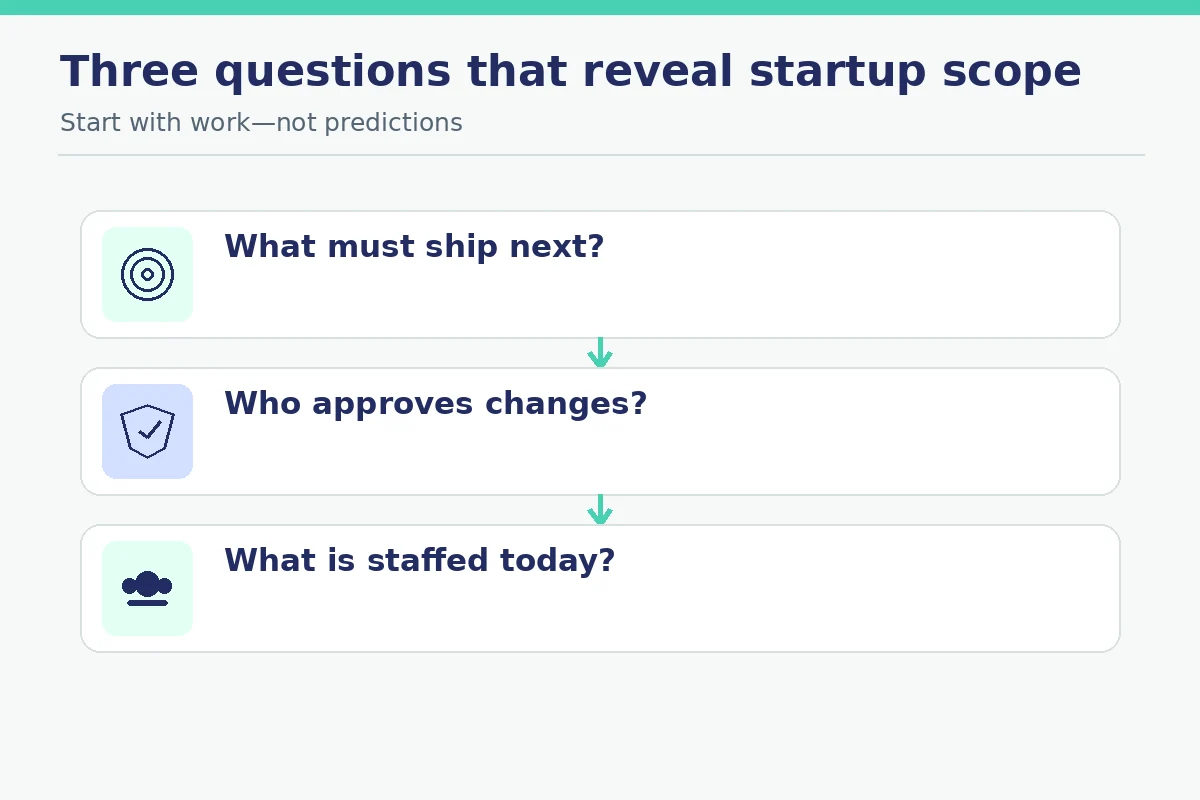
Match the question to the founder, manager, or teammate
A founder can usually explain strategic direction and trade-offs. The prospective manager is better placed to discuss deliverables, workload, review methods, and coaching. A future teammate can describe actual handoffs, interruptions, and collaboration practices. Ask each person a question they can reasonably answer rather than repeating a long script. If your interview is short, prioritize the single unanswered question that would materially affect your decision about the role.
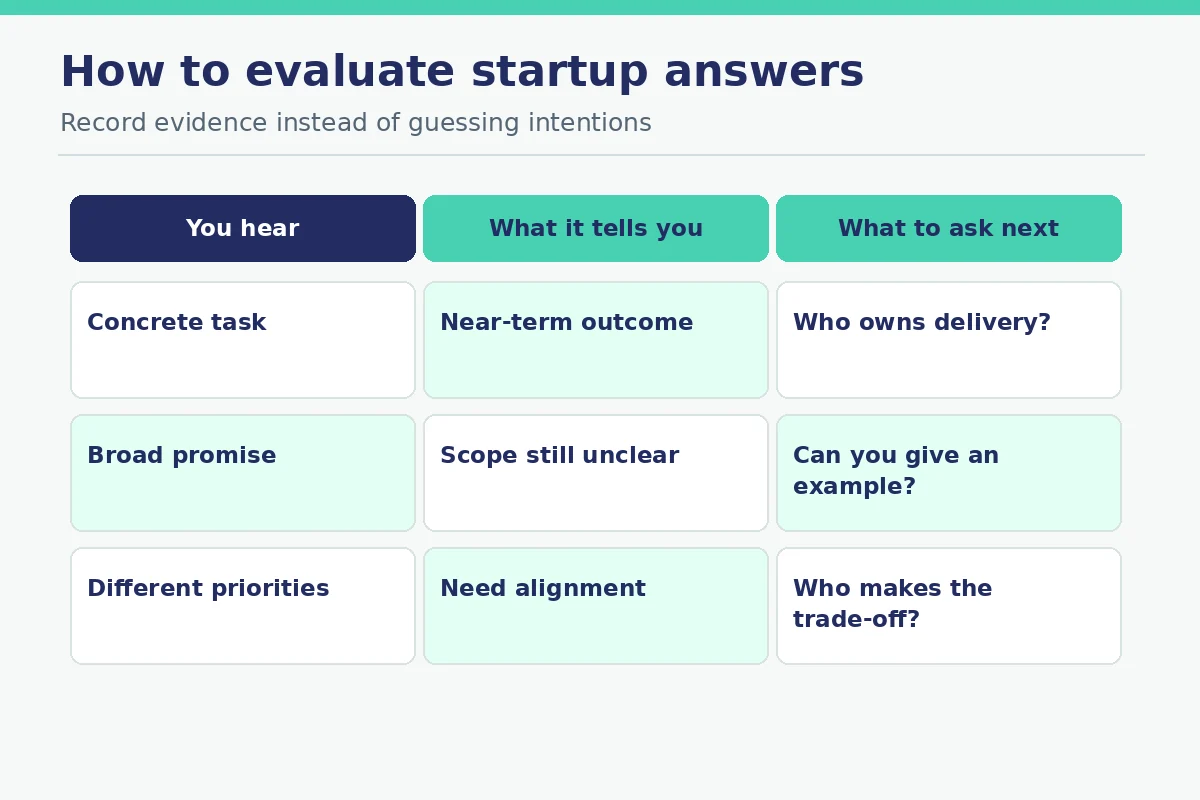
Use a three-line note after each conversation: “What was claimed?”, “What example supported it?”, and “What must be verified later?” This stops an inspiring discussion from becoming an unexamined assumption. If two interviewers describe different priorities, ask, “I heard two perspectives on the first milestone; how are those priorities reconciled?” Treat ordinary differences in perspective as a reason for clarification, not proof of dishonesty.
Read the quality of the answer, not just the words
A helpful answer provides ownership, timing, a recent example, or a process you can verify. An incomplete answer may simply reflect the interview stage or the speaker’s remit. Ask one neutral follow-up, such as, “Could you give an example of a recent decision?” Then decide what uncertainty remains. Be cautious when every answer redirects to vague claims about “hustle” without explaining who sets priorities, how safety is handled, or what adequate work looks like.
Before leaving, summarize one point: “My understanding is that the first priority is improving onboarding, while changes to billing require approval. Is that right?” A concise recap can reveal misunderstandings immediately. Keep confidential company information out of public notes or social media. When comparing employers, use the same core criteria—role clarity, support, work boundaries, and confirmed terms—instead of comparing personalities alone.
How We Research and Check These Examples
We cross-check interview advice against university career-office guidance and, when applicable, U.S. occupational sources. We separate what these sources describe generally from the policies of an individual employer. All question-and-answer scenarios on this page are illustrative; none represent a verified company interview, guaranteed outcome, or legal conclusion. A job posting, formal employer documents, and authorized staff are the primary sources for your specific opportunity. Review our affiliate disclosure; no relationship with the referenced organizations or services is implied.
Primary Sources and Further Reading
Institutional references reviewed November 4, 2026: Source 1 — University of Michigan recommends researching the organization, job responsibilities, training, and career path and preparing questions for employers. Source 2 — Berkeley frames interviewing as two-way role evaluation and recommends researching employers and recording practical fit considerations. Source 3 — Harvard explains which compensation, benefits, and organizational considerations should be confirmed when assessing an offer.
More Interview Preparation Guides
Yes. Ask proportionately about how the role is budgeted and how plans are prioritized. The company may decline to share confidential financial detail.
Ask for an example of a recent change, who approves priority shifts, and how the team prevents important work from being abandoned.
You can ask whether equity is part of compensation. Evaluate actual terms only after receiving a written offer and plan documents.
Not automatically. Ask for the first deliverables, typical work, reporting line, and decision limits before judging the fit.
Prepare several questions, then select the two or three most important unanswered ones for the actual time available.