
For an accounts payable clerk cover letter without professional experience, lead with an invoice-related task you actually completed: checking amounts, comparing purchase documents, entering practice transactions, or documenting a mismatch. Explain that the work came from coursework, a school project, a club budget, or another truthful setting. The employer needs evidence that you notice differences and follow review procedures, not a claim that you have already approved payments. A simple letter can work if it links one real activity to the exact entry-level duties in the posting.
Decide whether this accounts payable opening is entry-level
Look for words such as clerk, assistant, trainee, invoice entry, vendor record maintenance, and document matching. O*NET groups accounts payable clerks among bookkeeping and accounting clerks and describes checking postings, comparing invoices with order forms, and reporting discrepancies. A posting may also require particular software or independent payment processing. Treat those as separate qualifications: a practice spreadsheet shows familiarity with records but does not establish that you have used an employer’s accounting system.
Create a two-column match before writing. In one column copy only three relevant duties from the actual posting. In the other, place your verified evidence: a spreadsheet assignment, receipts you reconciled for a student organization, or a volunteer records task. If a duty has no honest match, do not invent one. You may explain readiness to learn under review. Some employers will require more experience; a carefully written cover letter cannot replace a mandatory prerequisite.
Build one credible invoice-check example
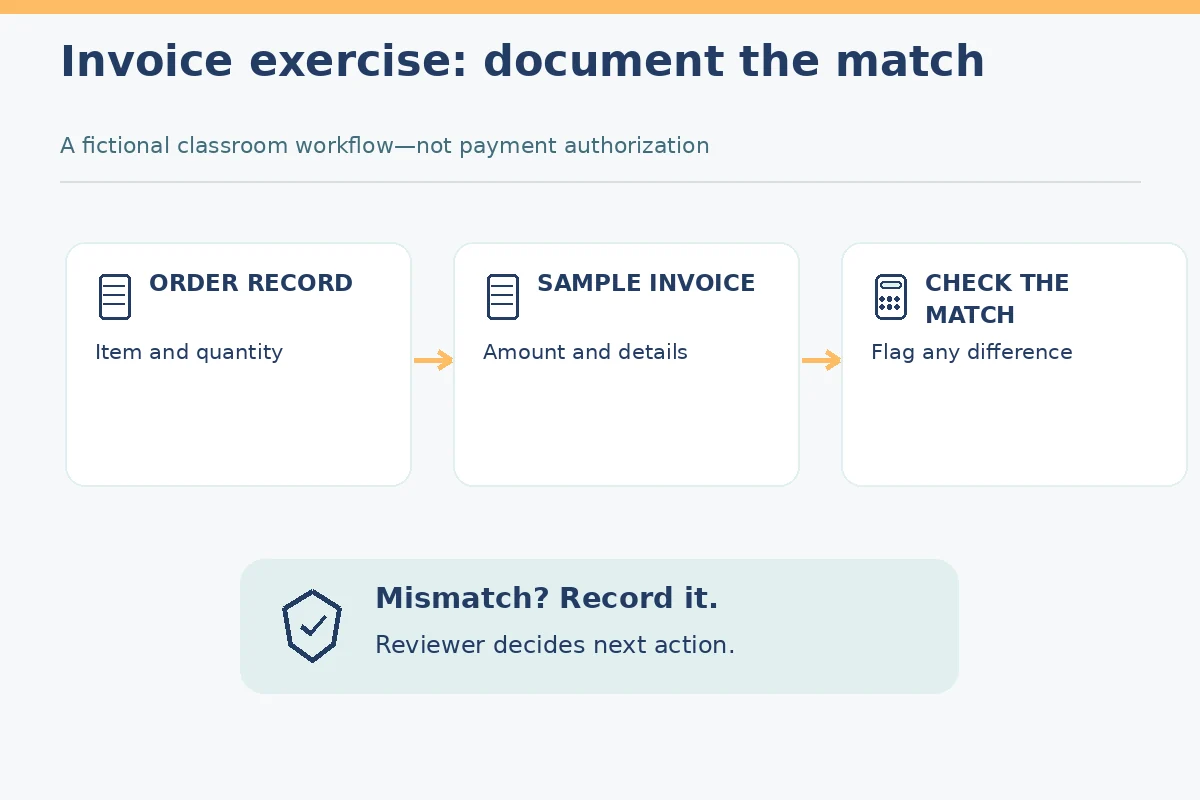
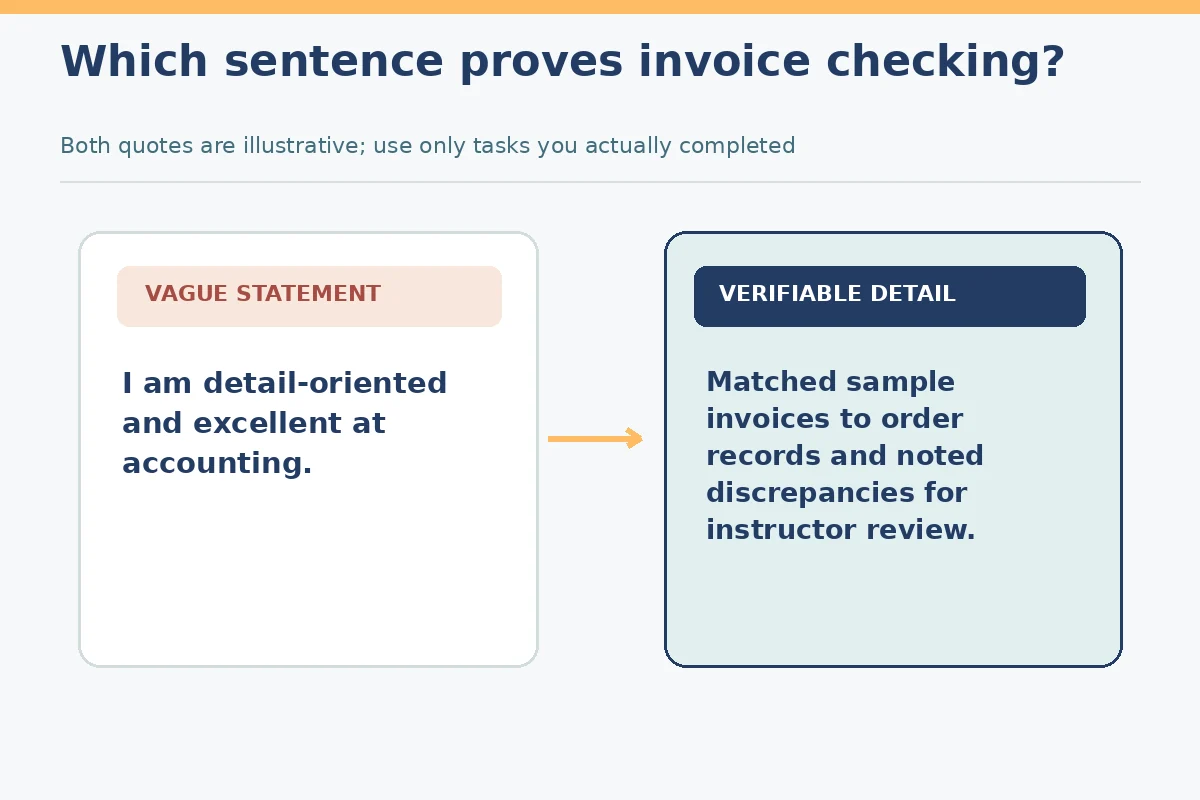
An academic exercise can demonstrate method. Describe how you compared a purchase order, an invoice, and a receiving record; checked dates and quantities; marked a disagreement; and asked a professor or team lead before recording a correction. If your actual assignment used only two documents, say so. Accuracy is more convincing when the reader can picture your steps than when the letter offers the unsupported phrase “excellent attention to detail.” Do not share real vendor account numbers or confidential billing files.
For example, a student who checked an invented invoice set can say, “In an accounting class, I matched sample invoices to order records, flagged inconsistent quantities, and documented the changes for review.” The example describes training, not paid accounts-payable employment. If you have no accounting coursework, a school-club purchasing log can support a narrower statement about keeping records and asking for approvals. Avoid calling yourself a bookkeeper solely because you managed personal expenses.
Write the opening around a specific clerical task
Name the exact position and one reason the employer’s described workflow fits your skills. A useful opening is: “I’m applying for the Accounts Payable Clerk opening. My introductory accounting coursework gave me practice matching sample transactions to supporting documents and recording exceptions for review.” Replace the qualification with your own genuine example. Avoid “I am eager to join any organization in any role,” which says nothing about the job or why this specific application is relevant.
If the posting mentions a certain ledger program, state your level accurately: learned a similar interface in class, practiced spreadsheet formulas, or have not used the tool yet. Do not imply a vendor certification or a professional audit. It is acceptable to be a beginner. Your task is to show a repeatable checking habit and the willingness to seek guidance before changing financial records. That is a more credible promise than “I will guarantee zero errors.”
Use a short sample letter without inventing employment
Illustrative letter — revise every detail: Dear Hiring Manager, I am applying for your entry-level Accounts Payable Clerk role. In a college accounting exercise, I compared sample invoices and order records, checked calculations, and listed items that required instructor review. I also kept an organized record of supporting files for our team project. Your posting emphasizes careful document handling and clear exception notes, which match the skills I practiced. I would welcome training in your procedures and software and would refer uncertain transactions to the authorized reviewer. Thank you for considering my application. Sincerely, [Your Name].
This is deliberately a student example, not a claim of completed professional payments. Use only the class tasks you actually performed and the specific requirements visible in the employer’s current posting. A club treasurer who managed approved reimbursements would use different evidence and should describe who had authority to sign off. If the employer wants a formal letter rather than a short email, follow its submission instructions and include any requested identifiers.
Describe limits around payments, access, and approvals
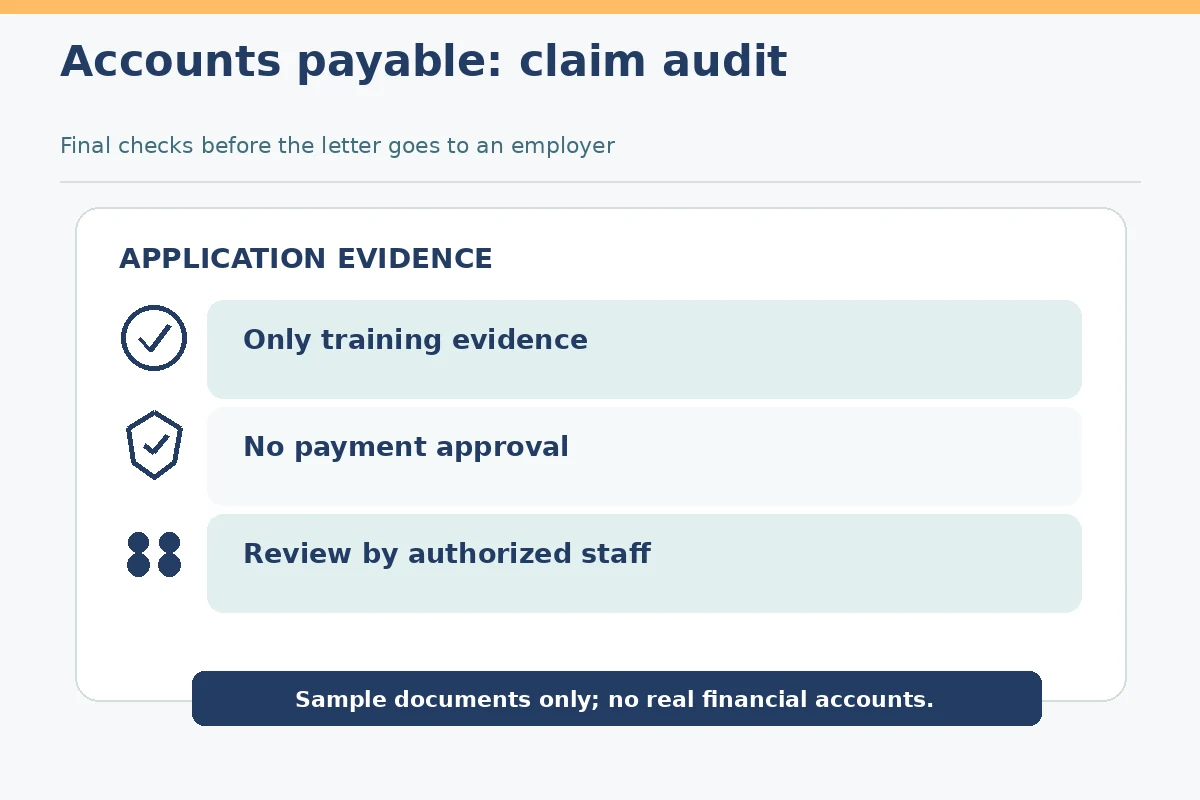
An entry-level clerk may prepare or check payment information while someone else authorizes disbursement. The precise division depends on the employer. Your letter should never claim you released funds, created a vendor, changed banking information, or approved expenses unless you truly did so with the appropriate permission. Presenting yourself as willing to ask questions before making consequential changes is a strength, especially when you lack work experience with financial controls.
Keep samples synthetic and remove identifying details. A spreadsheet screenshot containing real names, account numbers, or internal rates is not a suitable portfolio item. If a recruiter requests a work sample, ask what they expect and supply a newly created fictional document or a sanitized class example you have permission to share. Do not send scans of bank statements, tax records, or a former employer’s invoices to prove that you can handle a billing task.
Perform the final AP cover letter review
Check the job title, company name, and spelling of any software you mention. Compare the letter with the resume so the same class project is not presented as paid work in one document and coursework in the other. Read each sentence and ask: “Could I explain precisely what I did if interviewed?” If not, rewrite the claim. Keep the letter concise enough that the experience example remains the center rather than burying it under generic adjectives.
Attach or paste the letter in the format required by the application system. A portal text box may remove elaborate styling; simple paragraphs survive better. Open the final PDF if one is requested and verify that the contact details and file name match this application. Save a dated copy of the exact version submitted. A properly presented example does not guarantee an interview, but it makes the evidence easier to evaluate.
How We Research These Cover Letter Examples
We compared career-center cover-letter guidance with government occupation descriptions or directly documented institutional duties relevant to this role. The sample letter and scenarios are illustrative, not real employer testimony; no applicant, salary, job offer, outcome, or employer policy is invented as fact. Employers set their own qualifications and approval rules, and actual postings take priority. We reviewed reference pages on November 4, 2026. See our affiliate disclosure; no paid relationship with any cited institution is implied.
Sources and Further Reading
References reviewed November 4, 2026: Source 1 — UC Davis explains using one to three actual experiences or projects to demonstrate fit in a cover letter. Source 2 — O*NET lists accounts payable clerk titles and bookkeeping duties such as checking records, matching documents, and reporting discrepancies. Source 3 — Louisville career guidance recommends matching middle paragraphs to job-description qualifications and truthful resume evidence.
More Resume and Cover Letter Guides
Yes when the vacancy accepts beginners and you meet its stated requirements. Describe the exercise as coursework and be explicit about what you checked.
No. Say you have introductory exposure or are learning the tool; do not claim hands-on professional proficiency you lack.
Use truthful evidence from record-keeping or checking a school budget, and say you seek employer training in invoice procedures.
Only with proper authorization and suitable redaction; a fictional invoice and documented process are safer for a general sample.
Usually a concise single page is enough unless the employer specifies another format; focus on one specific example and a clear fit statement.