
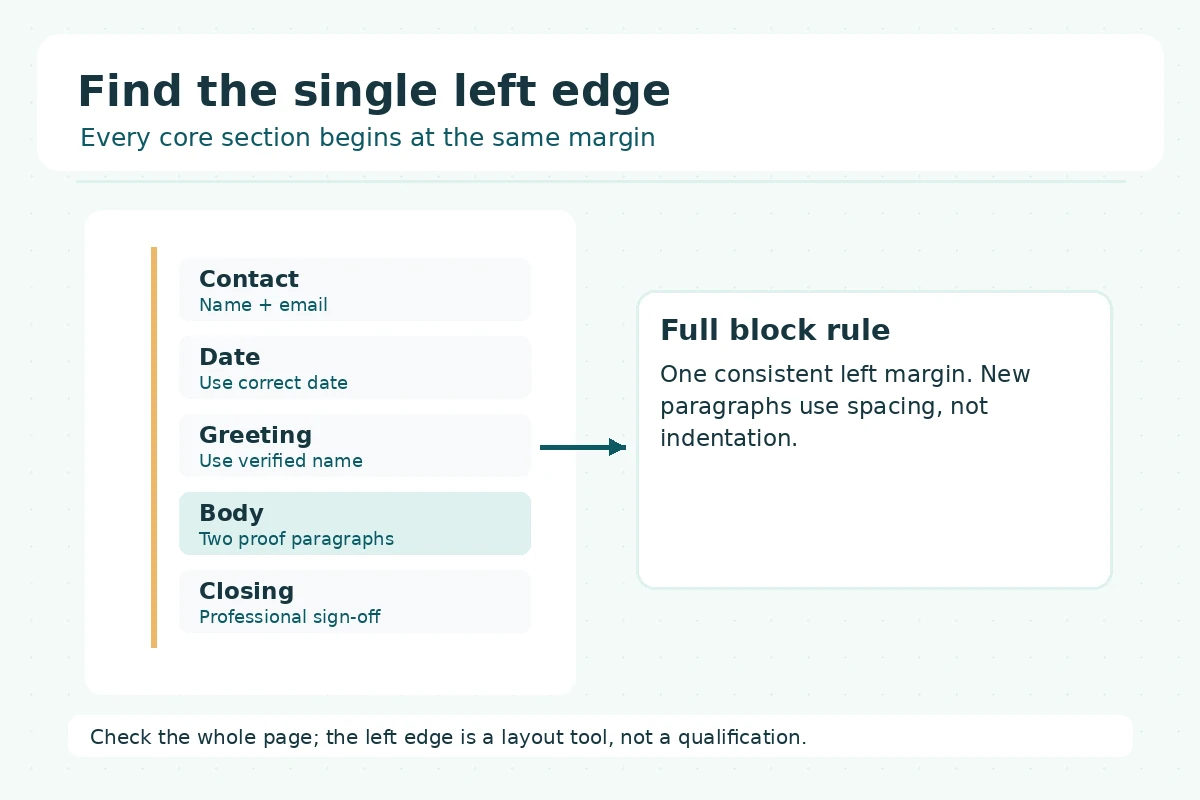
A block-style cover letter uses one consistent left margin for its contact block, date, recipient line, greeting, paragraphs, and closing. It is a familiar business-letter arrangement, not a special recruiting trick. For most private-sector openings, keep the letter concise and make the body about the specific job instead of explaining the format. The practical test is simple: can the reader identify the role, see credible evidence of fit, and locate your contact details without scanning around the page? Follow the employer’s requested file type or online text field first; layout conventions come second.
What block style means on a real application
In a full block business letter, paragraphs are left-aligned rather than indented; blank space separates them. Purdue OWL distinguishes this from modified block, where the date and closing may move toward the center. Neither approach makes an applicant more qualified. Choose block style when you want a straightforward, easy-to-check layout, particularly if the employer provides no sample. Use a clean font that remains readable when exported. A visually polished file cannot compensate for a generic explanation of why you are applying.
Place contact information without unnecessary personal details
Start with a recognizable name, professional email address, and a reliable contact method. A city and state may help when relevant, but a full street address is usually unnecessary for an online job application unless specifically requested. Put the date on its own line. Include a verified organization name and contact person only when you actually know them; otherwise use a neutral hiring-team greeting. Do not invent a hiring manager, office address, or department to fill an attractive-looking template. The header must agree with your resume and application profile.
Give the first paragraph a precise job target
The opening should identify the actual position and tell the reader why the applicant can contribute. That might mean stating the job title and a directly relevant kind of work: maintaining project records, resolving service requests, or producing documented analyses. Do not spend the opening on claims such as “I have always dreamed of joining a world-class company.” If the vacancy lists a requisition number or location, add it when it would remove ambiguity. Double-check the identifier against the posting rather than copying an old application.
Build body paragraphs around one or two examples
A good middle section connects something the employer needs with a specific task you personally performed. Name the situation, what you did, what you checked, and how the work was handed off. If the example comes from coursework or volunteer work, call it that. If results are not measurable, describe an observable deliverable rather than creating a percentage. Harvard and Penn both emphasize tailored, factual examples. One paragraph with a verifiable action can be stronger than a long list of flattering adjectives. Keep the sentence boundaries visible and avoid dense walls of text.

Read the layout as an actual page, not a template
Before exporting, use print preview at a normal viewing size. The header should not crowd the greeting; the greeting should have enough separation from the opening; and the closing should follow naturally after the final paragraph. For non-academic jobs, a one-page letter is a common university career-center recommendation, not a mandatory law of recruiting. Do not shrink type to an uncomfortable size merely to force a weak paragraph onto the page. Remove repeated material instead. Leave space so headings and signatures do not collide with the bottom edge.
See an illustrative cover letter sequence
Illustrative example, not a real applicant: “Dear Hiring Team: I am applying for the operations coordinator position. In a campus event project, I maintained the task tracker, confirmed changes with the faculty sponsor, and prepared handoff notes for volunteers. When a room assignment changed, I updated the shared schedule and notified the affected teams. I would bring the same attention to version control and clear communication to your coordination work. Thank you for considering my application.” Keep the contact block, date, greeting, body, and closing on the same left edge. The wording should change with the applicant’s real evidence.
Adapt the structure to email and application portals
A pasted text box may discard spacing, fonts, and indentation, so a perfectly designed business letter can become messy when copied into an application form. In that case, preserve the greeting, clear paragraphs, and a short closing, but do not insist on a full physical-address block. An email message may already display your sender address and date. The employer’s instructions decide whether to attach a PDF, use a document upload field, or paste the letter. Test the final appearance in the destination rather than assuming what the word processor showed will survive.
Inspect the final PDF or document for hidden mistakes
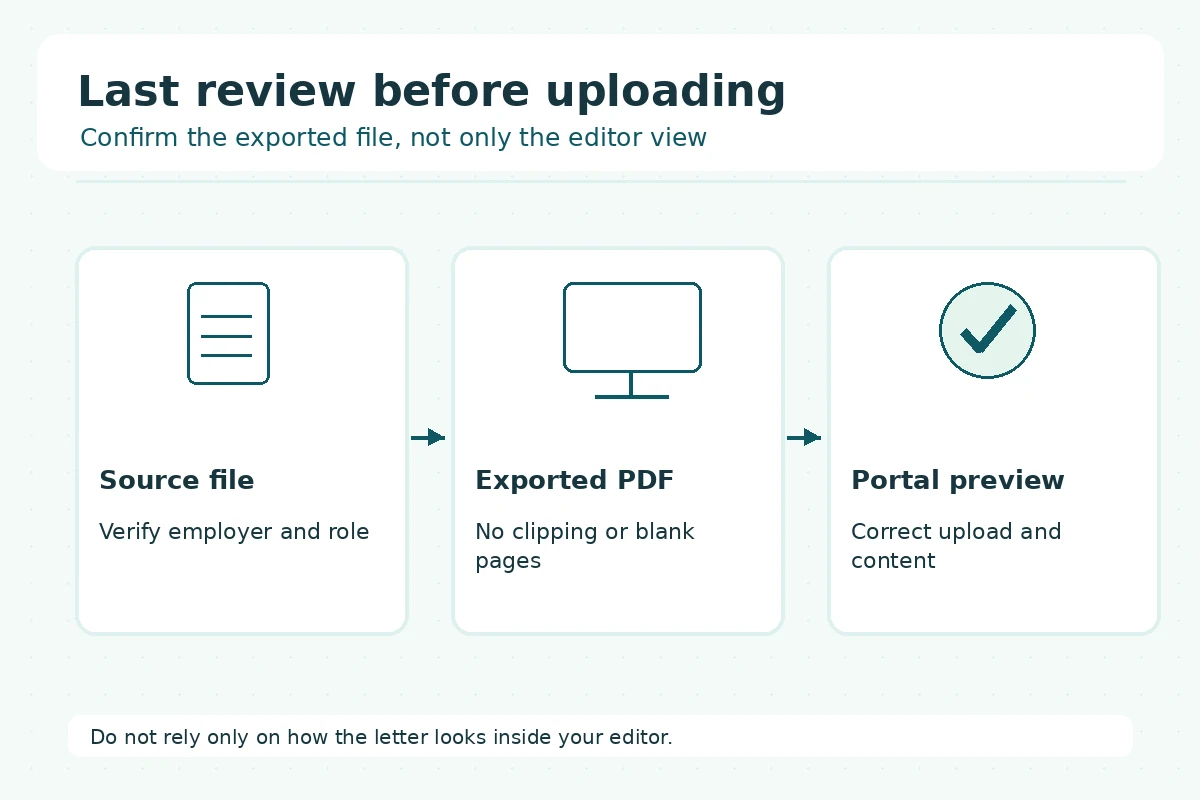
Check the exact file you will submit. Open it on a second viewer if possible, look for missing characters, broken links, clipped bottom lines, unexpected blank pages, and wrong employer names. Make sure dates and titles match your resume. A filename should identify the applicant and the role without exposing unrelated personal data. If the portal asks for a Word document rather than PDF, follow that instruction. Save a separate role-specific copy so later edits to a master template do not accidentally replace the version you meant to send.
Make the final choices with your own evidence
If you are borrowing a design from a business letter sample, treat its physical-mail details as optional for online recruiting. An old sample may include a street address, a long recipient block, and a handwritten-signature gap. None of these features proves that you can do the advertised job. Prioritize a correct role name and two grounded paragraphs. When an employer supplies a unique form or worksheet, do not force the block layout into it. Reviewers are much more likely to need the requested information clearly than a reproduction of paper correspondence conventions.
Create a personal submission checklist that starts with content and ends with pixels: correct role, true example, correct reviewer or greeting, consistent contact details, requested file format, and a final preview. If you submit through multiple portals, save a different role-specific copy. Mark the date you applied and the actual filename in your own private tracker. The objective is to prevent an avoidable wrong-version error, not to create a perfect template for every industry.
How We Research and Verify Cover Letter Guidance
We reviewed primary career-center and official application guidance for the format and decisions in this article. Our editorial test also compares the intended role, the content of the letter, and the requirements of the employer’s actual submission workflow. Suggested examples are explicitly illustrative and must be replaced with true experience. Layout is advice, not a promise of interview selection, software compatibility, or hiring outcomes.
Sources checked on November 4, 2026: Purdue OWL (Purdue OWL explains block and modified-block alignment, business-letter sections, and paragraph spacing.); Penn Career Services (Penn Career Services advises tailored cover letters with specific relevant evidence and a clear standard layout.); Harvard Career Services (Harvard career guidance emphasizes concise, factual job-specific cover letters and final formatting review.). These sources provide guidance, not employer-specific requirements. Check the current posting and compare our affiliate disclosure before taking any commercial action; this article does not claim an affiliate relationship.
More Resume and Cover Letter Guides
No. It is a conventional business-letter layout. Follow any employer-specific format instead, and prioritize legibility and relevant evidence.
Not in full block style. Align paragraphs at the left margin and separate them with clear spacing.
For an online application, not usually unless the employer asks for it. Accurate contact information matters more than filling every traditional address line.
Yes, but simplify it for the email medium. Use a greeting, readable paragraphs, and a concise signature rather than recreating a paper letterhead.
Read the exported or pasted version and verify employer name, position, contact details, evidence and submission format.