
Bullet points can work in a cover letter when you have two or three distinct pieces of evidence that are easier to compare in a short list than in one dense paragraph. They are optional, and some employers prefer conventional paragraphs. A letter should still sound like an explanation of your fit: introduce the role, connect the bullets to the employer’s work, and close professionally. Avoid copying the skills list from your resume. Each bullet should show a task, your contribution, and a useful outcome or handoff. Check how the list survives the submission format.
Choose bullets for evidence rather than decoration
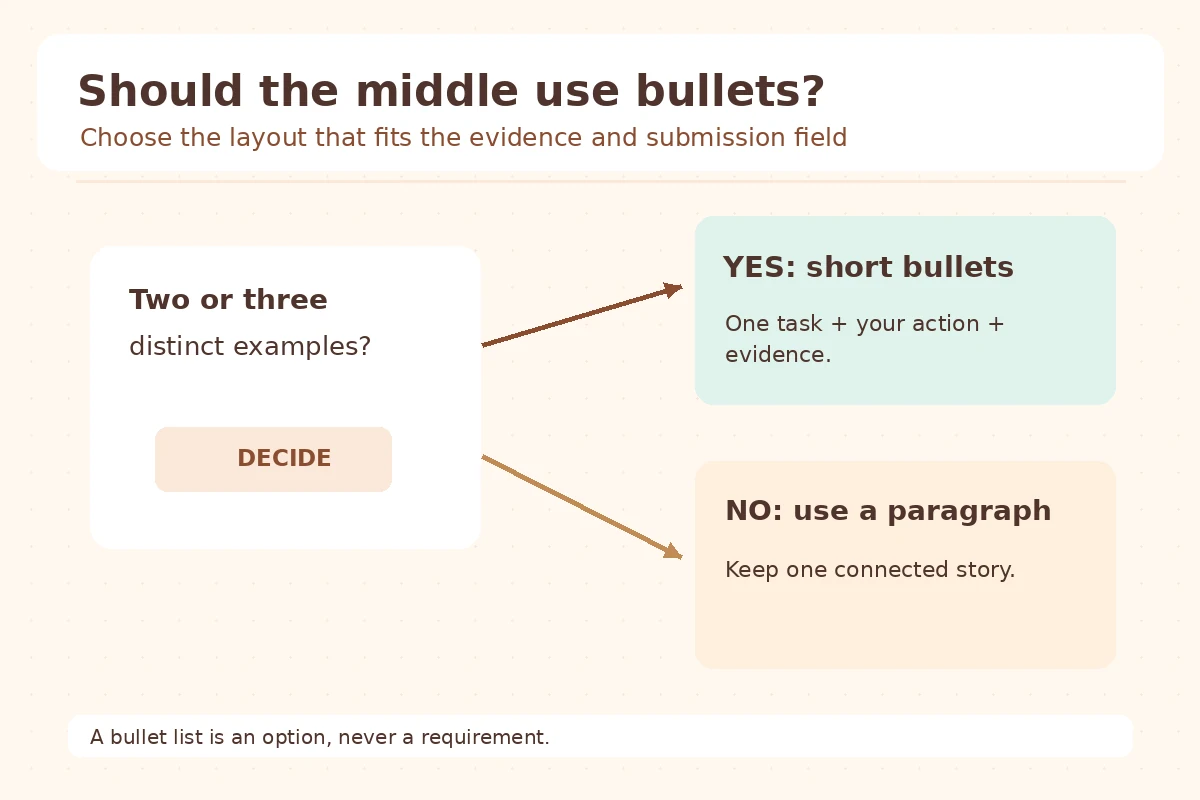
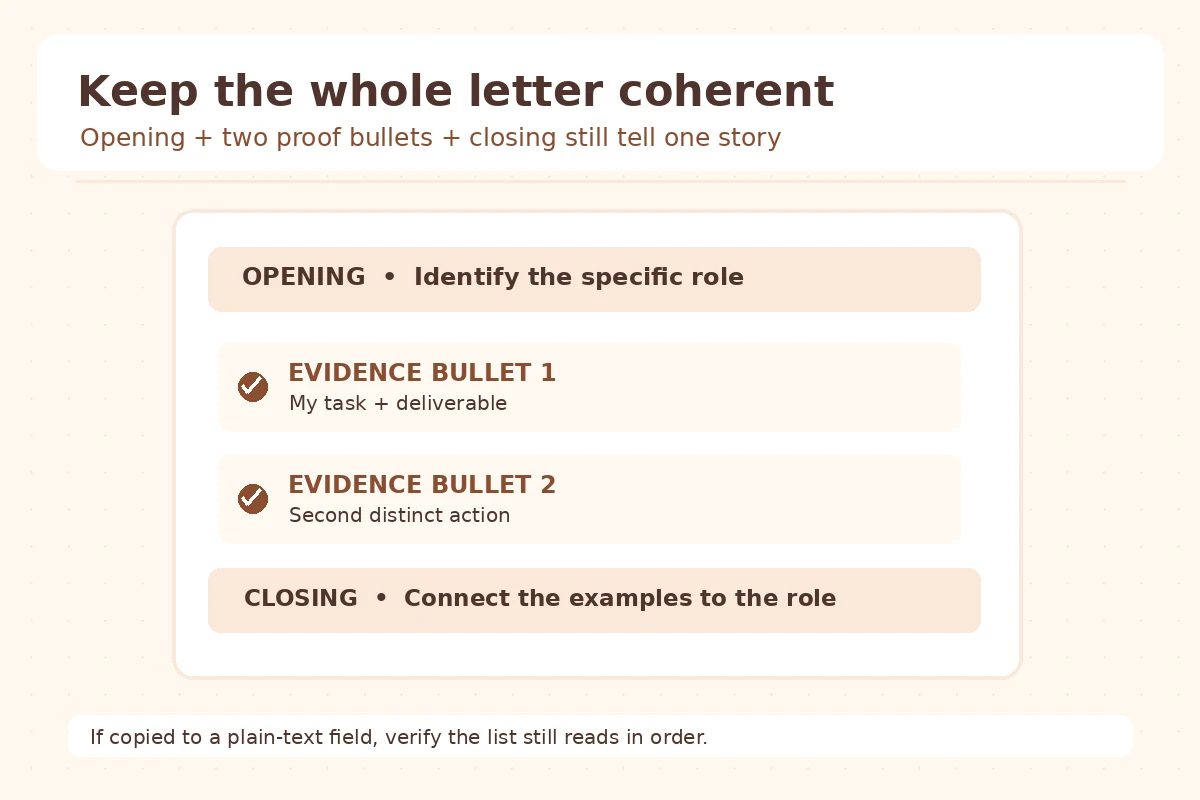
Use a bulleted middle when the job posting names several separate needs, such as tracking records, communicating with users, and checking quality. If you can give each need one concrete example, the list makes the fit easy to locate. If you have only one substantial story, a paragraph is usually more natural. Do not turn every sentence into a bullet; that looks like a second resume. A clear opening and closing create context so the reader knows why these three examples matter for this specific role.
Limit the list to distinct, job-related points
Two or three bullets are often enough for a normal one-page application letter. This is a suggested editorial choice, not an employer rule. Choose different types of work so the list does not repeat the same claim. For example, one bullet could show records accuracy, another a stakeholder handoff, and the third a documented improvement. If two points both say “communicated effectively,” combine them. Read the requirements first, but do not copy vague keywords into the letter without showing what you actually did.
Write each bullet as a short proof statement
Start with the relevant action and give the reader a concrete object: a reconciliation log, a service ticket, an annotated draft, or a meeting summary. Add the setting and who reviewed or used the work. Avoid invented figures and avoid asserting that you approved a decision when you only prepared information for the approver. A student might write, “Maintained a versioned project tracker for a campus team and confirmed schedule changes with the faculty coordinator.” That is stronger than “Excellent organizational skills,” while clearly identifying the setting and scope.
Add a bridge sentence before the bullets
A list needs a reason to exist. After a brief opening, write a transition such as: “The posting emphasizes accuracy, handoffs, and timely updates; my related experience includes the following.” Then provide two or three bullets showing those distinct behaviors. This allows the employer to see the connection rather than perform it alone. Do not present the list as a ranking of qualifications unless you actually know the hiring priorities. The bridge should be written for that specific posting, not pasted from the same template to every application.
Compare strong bullets with empty resume repetition
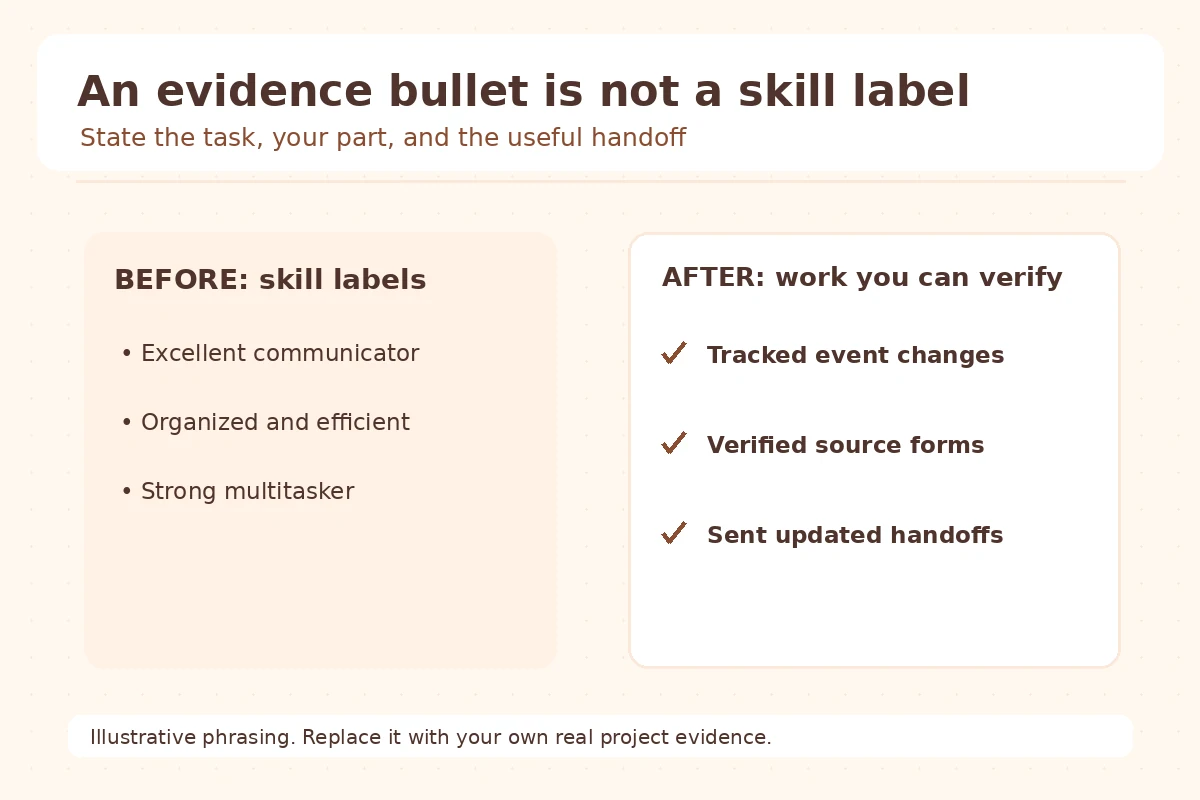
Weak: “Proficient in spreadsheets; good communication; multitasking.” Illustrative revision: “Compared registration entries against source forms, marked discrepancies for review, and maintained the corrected event list,” followed by a separate point about communicating schedule changes. The revised bullet names evidence a supervisor could reasonably verify. It does not promise a hiring outcome or imply responsibility for final data approval. If you have no workplace examples, clearly label coursework, student organization activity, or volunteering and describe the same three elements: work item, own action, and useful next step.
Keep the closing in natural paragraph form
After a bulleted section, return to a short paragraph that connects your evidence to the role and thanks the reader. Do not end with a detached list of five more skills or a demand for an interview. State your interest in discussing the opportunity and point readers to attached materials when appropriate. A credible close should sound proportionate to the experience you described. If the employer asks for a writing sample or requires a formal letter format, a conventional paragraph structure may better display sentence-level writing than a heavily segmented list.
Handle plain-text portals and bullet characters carefully
Some application fields remove indentation or replace bullet symbols with inconsistent characters. When this happens, use short lines beginning with simple hyphens, or convert the section to two compact paragraphs. Copy the letter into the actual form and inspect the preview if available. Do not assume special punctuation, columns, or tabs will render as intended. If the company requests a PDF attachment, review the exported PDF separately. The reader should never need to reconstruct your list after pasting destroyed the layout.
Decide whether the list makes the letter better
Read the whole letter aloud. Are you still making an argument for this job, or merely presenting disconnected capabilities? Can someone point to a fact behind every bullet? Does the list add information not obvious from your resume? Would one short paragraph read more smoothly? These questions are more valuable than copying an internet template with a fixed bullet count. Penn and Michigan career centers both stress that examples, employer fit, and writing quality matter; the list format is only a vehicle for those elements.
Make the final choices with your own evidence
Keep a small evidence bank before you draft. For each posting requirement, write one line describing a real event and identify whether it was paid work, school, or volunteering. Next note who confirmed the work and what deliverable existed. From that bank, select no more than the strongest distinct examples for a short list. You may discover that the same project supports several skills, but the letter should not split one achievement into three nearly identical bullets. If you cannot verify a result, remove the unsupported number rather than keeping it to fill space.
For the final edit, compare each bullet to the corresponding resume entry. The dates, employer, project type, and level of responsibility should not drift. A bullet about preparing a report must not become a claim that you approved company policy. Show a friend the letter without the job advertisement and ask whether the point of each bullet is clear. Then show the posting and ask whether the selected examples actually address the work. Both tests matter: readability alone is not relevance, and keyword overlap alone is not proof.
How We Research and Verify Cover Letter Guidance
We reviewed primary career-center and official application guidance for the format and decisions in this article. Our editorial test also compares the intended role, the content of the letter, and the requirements of the employer’s actual submission workflow. Suggested examples are explicitly illustrative and must be replaced with true experience. Layout is advice, not a promise of interview selection, software compatibility, or hiring outcomes.
Sources checked on November 4, 2026: Penn Career Services (Penn advises demonstrating job-relevant skills through concrete stories rather than empty declarations.); Michigan Career Center (Michigan recommends a concise application narrative connected to two or three relevant experiences.); Harvard Career Services (Harvard recommends factual, tailored cover-letter examples rather than generic language.). These sources provide guidance, not employer-specific requirements. Check the current posting and compare our affiliate disclosure before taking any commercial action; this article does not claim an affiliate relationship.
More Resume and Cover Letter Guides
Not automatically. A short list can clarify several distinct examples, but use the format that suits the employer and application field.
Two or three distinct evidence bullets are a practical starting point, not a universal requirement. Remove any that repeat the resume.
No. Connect to real duties and use your own verifiable examples instead of copying keywords without support.
Replace symbols with plain hyphens or convert the list to short paragraphs, then inspect the submitted preview.
Yes, if the project is described as academic and the applicant identifies their actual contribution and reviewer.