
An academic cover letter for a faculty appointment usually needs to explain three things: your research direction, the teaching you can genuinely support, and why those contributions fit the advertised department. It works alongside the CV and any requested research, teaching, or diversity statements; it should not simply duplicate them. University guidance notes that conventions vary by field and institution, so the posting and advice from faculty in your discipline matter more than a rigid universal template. Put the position and central fit near the opening, then build a short case with verifiable academic evidence.
Read the institution and role before drafting
An advertised position may prioritize undergraduate teaching, research production, clinical supervision, or interdisciplinary collaboration. Look at the stated duties and any requested dossier materials. Do not infer a department’s strategy from rankings or prestige labels alone. If the institution asks for a teaching-focused narrative, lead with documented classroom or curriculum practice; if the role centers on research, explain your scholarly program clearly. Berkeley notes that academic cover letters vary with the department and target institution. The way to tailor is to change the evidence and order, not to praise the university generically.
Use the opening to locate your scholarly identity
Identify the actual position and your research or teaching area in words a cross-disciplinary committee can understand. If a degree or dissertation is incomplete, state its real status rather than claiming completion. Give the reader a concise reason that your preparation relates to the advertised role. Avoid leading with an exhaustive list of conferences, mentors, or publications; the CV already records those. A strong opening establishes a coherent direction for the later research and teaching paragraphs, while leaving space for details that distinguish the candidate from the broader applicant pool.

Explain research beyond a dissertation title
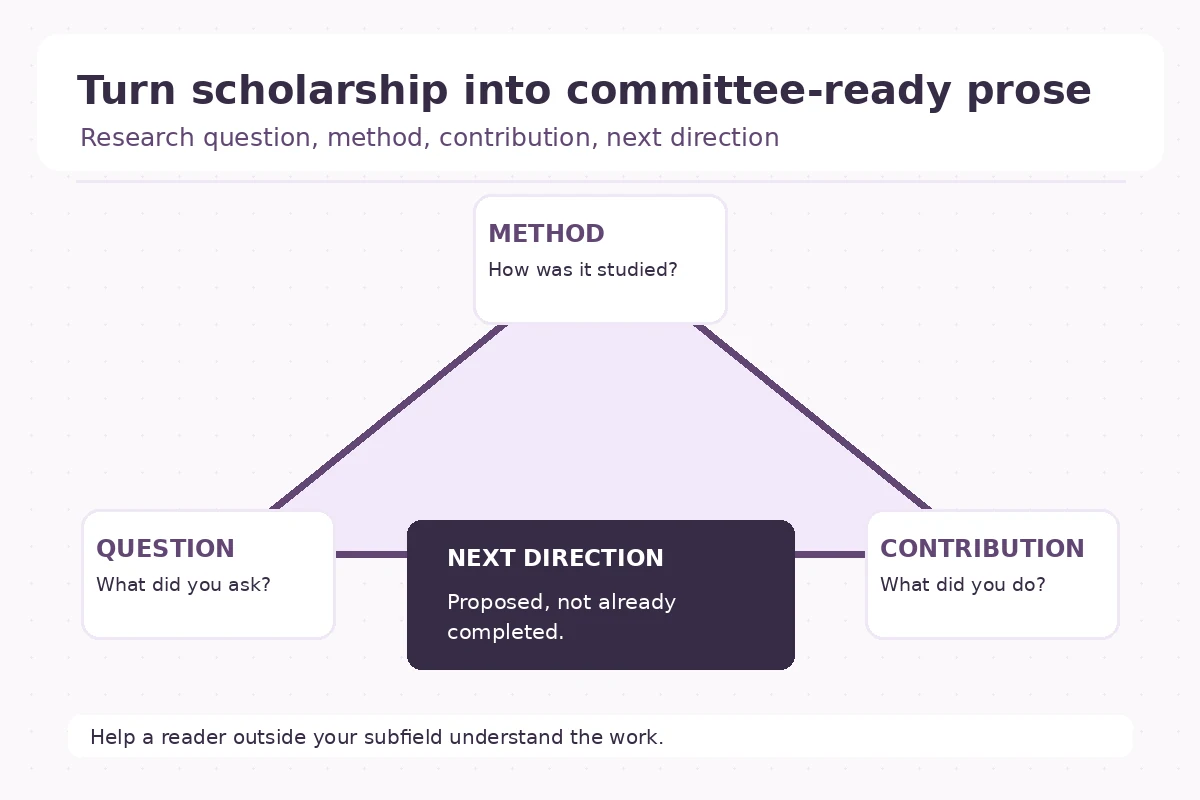
A committee may include members unfamiliar with your subfield. Describe the research question, the methods or evidence you use, what you contributed personally, and which inquiry comes next. If a project was collaborative, identify coauthor or lab responsibilities accurately. Do not promise publications, grants, or research findings that are not secured. Berkeley guidance stresses making the scholarly direction understandable and showing a future agenda. One concrete research case often does more work than several sentences calling your scholarship groundbreaking or transformative without evidence.
Describe teaching through actual choices and observations
A teaching paragraph should show what you taught or supported, who the learners were, and what instructional choices you made. For example, you might describe designing discussion prompts and revising them after supervised feedback, or organizing a lab section while following the instructor’s course plan. Name teaching-assistant or guest-lecturer roles honestly; they are not identical to being instructor of record. If the vacancy requests courses you have not previously taught, distinguish preparation from experience and say which academic background supports your proposed contribution.
Use service and departmental fit selectively
Departmental fit is more specific than saying you admire the institution. Review publicly available program descriptions and the job announcement to identify a plausible match between your work and the stated needs. Service might involve committee participation, advising, outreach, peer review, or program coordination, but only include it when relevant and verifiable. An application for a teaching-focused position may need more attention to student support; a research-intensive opening may need more space for a scholarly pipeline. Avoid writing as though you know the committee’s private deliberations.
Compare two illustrative emphasis choices
Illustrative research-centered opening: “My work examines how local archives document migration, using comparative catalog analysis; I would develop this line through a cross-institutional collection project.” Illustrative teaching-centered opening: “My supervised seminars use primary-source workshops to help undergraduates evaluate competing interpretations.” Neither example represents an actual scholar or guarantees appointment. An applicant should replace generic projects with real work, label prospective research as proposed, and check that any claimed teaching is consistent with the CV and teaching statement.

Plan length around discipline and instructions
Unlike many private-sector letters, academic letters can reasonably be longer when a committee needs research and teaching context. Berkeley suggests not exceeding roughly one and a half to two pages as general guidance, while also emphasizing variation and judgment. Do not treat that as a strict rule for every field or institution. Write enough to make the distinctive academic contribution comprehensible, but remove paragraphs that only repeat the CV. Ask a mentor familiar with your discipline to review the substance and expectations.
Check all dossier materials and the closing
The close can mention the required materials being submitted: CV, research statement, teaching statement, writing sample or other documents only when the announcement actually asks for them. Berkeley recommends using the letter and checklist to verify the packet, but never presume every application requires the same components. Confirm the submission portal, document labels, references and deadline. Do not upload confidential student records, unpublished collaborators’ data, or other materials without permission. The letter should help the committee navigate your application, not create a new set of unsupported claims.
Make the final choices with your own evidence
Before drafting, create a two-column grid using only publicly available job requirements and your documented work. Mark research expectations, teaching load or topics if stated, mentoring, service, and required application materials. You may have strong evidence for some categories and only a credible plan for others. Use different verbs to communicate those distinctions: “taught,” “assisted,” “designed,” or “would develop.” That prevents future intentions from being misrepresented as completed work. If the posting asks for separate research and teaching statements, the cover letter should preview rather than reproduce them.
Ask a faculty mentor or trusted colleague to check whether the work is described accurately for the discipline and understandable beyond your immediate subfield. Check collaborative projects and author order against the CV and any relevant publication record. A teaching statement may contain more detail about pedagogy than the letter needs; a research statement may carry methods and future directions in greater depth. Your letter should make the connection among those documents legible, while the specific instructions decide how many files to submit and how to label them.
How We Research and Verify Cover Letter Guidance
We reviewed primary career-center and official application guidance for the format and decisions in this article. Our editorial test also compares the intended role, the content of the letter, and the requirements of the employer’s actual submission workflow. Suggested examples are explicitly illustrative and must be replaced with true experience. Layout is advice, not a promise of interview selection, software compatibility, or hiring outcomes.
Sources checked on November 4, 2026: Berkeley Career Engagement (Berkeley explains academic letter differences, research and teaching narratives, institutional fit and dossier checks.); Michigan Career Center (Michigan describes the interaction between an academic cover letter, CV, and additional research or teaching statements.); Penn Career Services (Penn emphasizes a cover letter as a narrative complementing rather than repeating an applicant’s CV or resume.). These sources provide guidance, not employer-specific requirements. Check the current posting and compare our affiliate disclosure before taking any commercial action; this article does not claim an affiliate relationship.
More Resume and Cover Letter Guides
Yes. Discipline and vacancy expectations vary; Berkeley describes a roughly one-and-a-half- to two-page upper guide, not a universal mandate.
Prioritize what the advertised role emphasizes and what your verified record can demonstrate.
Usually not. Explain the question, approach, personal contribution and a credible next direction in accessible terms.
You can discuss courses you are prepared to teach if relevant, but distinguish preparation from teaching experience.
Only the items actually requested or submitted for that vacancy; verify each one in the portal.