
For a federal job, the job announcement—not a generic cover-letter template—controls what documents you must submit. USAJOBS says a cover letter may be included to highlight relevant skills or goals, while each announcement identifies required and optional documents. Before drafting anything, read the Required Documents and How to Apply sections for that particular vacancy. If a letter is useful or requested, write it as a concise explanation of job-relevant evidence. Do not treat it as a substitute for a complete resume, eligibility documentation, or answers required by the agency’s assessment.
Start in the Required Documents section
Open the exact announcement and look for the document list. USAJOBS distinguishes documents required for eligibility or qualifications from optional materials such as a cover letter in many announcements. The details may depend on who is applying, the hiring path, the agency, and the vacancy. If the letter is marked optional, decide whether it adds a meaningful explanation absent from your resume. If the announcement asks for particular supporting proof, complete that requirement first. A beautifully written letter cannot cure a missing required document.
Read How to Apply and the assessment instructions
An application may move from USAJOBS to an agency-specific system. Check where the letter is uploaded, the accepted file types, deadlines and any separate questionnaire. These steps can differ even within the same agency. Do not assume that uploading a document to a profile means it was included in this particular application. Use the final review screen or confirmation, if available, to check that each attachment is associated with the right vacancy. If instructions conflict or remain unclear, the announcement normally provides an agency contact for clarification.

Make the first paragraph specific to the vacancy
If you write a letter, identify the advertised position, agency and any announcement number that helps distinguish it. Confirm that identifier in the current announcement. Explain the job-relevant knowledge or work you will discuss, rather than writing a general statement about serving the public. Some roles emphasize case records, some technical review, and others public-facing service; show that you read the Duties and How You Will Be Evaluated sections. Never invent federal employment, clearance, preferences, eligibility, or certifications to fill a paragraph.
Use evidence that is consistent with your resume
A letter can bring context to work already documented on a resume: how you verified records, managed a handoff, reviewed an analysis, or worked within an approval process. It should not contradict dates, hours, job titles, or the scope of the listed employment. If the example comes from a civilian employer, college, or volunteer role, state the setting. If you contributed evidence and another official approved the decision, preserve that boundary. Federal applications can involve detailed qualification review, so vague statements of leadership or a clever letter design are not replacements for clear resume facts.

Do not add sensitive identifiers for credibility
Keep personal or government-sensitive information out of ordinary cover-letter prose. A cover letter does not need a Social Security number, identification document image, medical details, or confidential work product. Follow the secure procedures specified for any required proof. Do not attach supporting records merely because a broad internet checklist suggested them; the agency may specify different fields or eligibility paths. When a special hiring authority, prior federal employment, or professional license matters, use the announcement’s actual instructions and official help content.
An illustrative federal letter excerpt
Illustrative example, not an actual applicant: “Dear Hiring Team: I am applying for the Program Support Specialist position identified in the announcement. In a university administrative role, I maintained a request log, compared submissions with intake criteria, and sent incomplete items to the authorized reviewer. The work required accurate tracking, careful correspondence, and timely escalation of exceptions. I would welcome the opportunity to apply these documented practices to the duties described in this vacancy.” Replace the title, setting, and actions with true experience; add an announcement number only if verified.
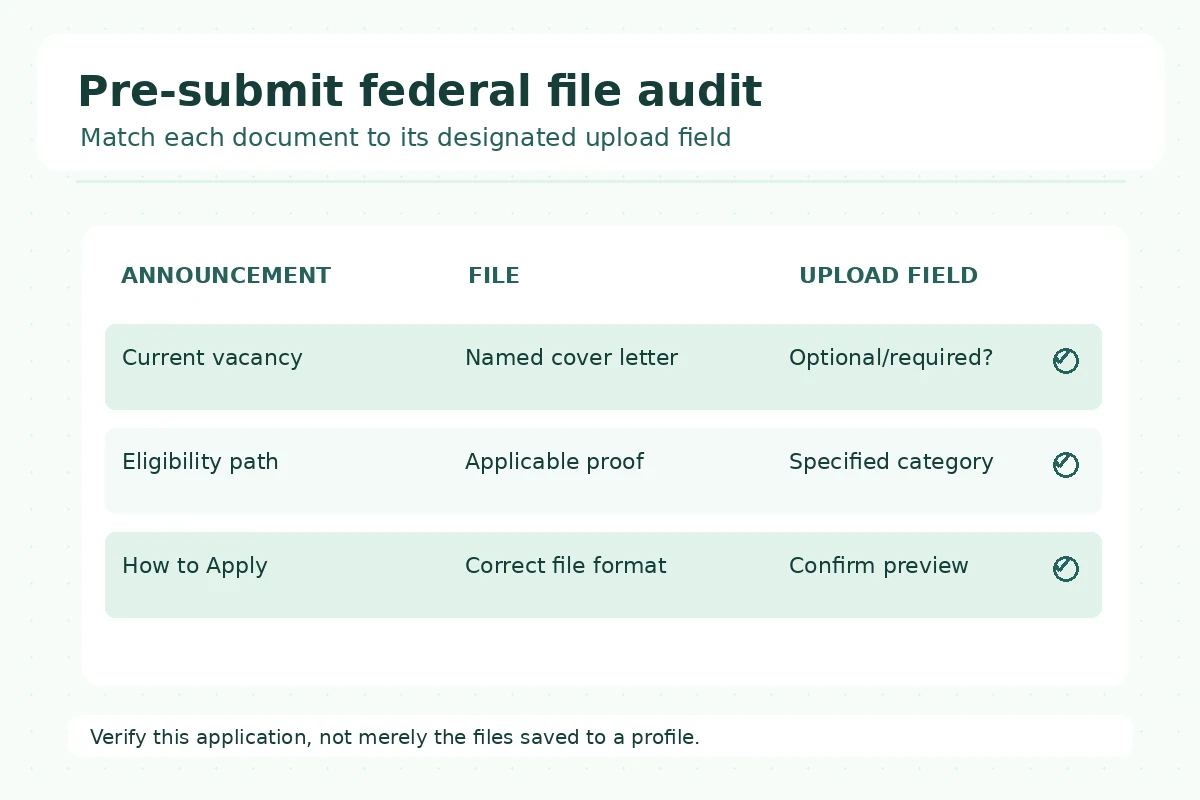
Distinguish optional narrative from required evidence
USAJOBS notes that the Required Documents section may include items such as eligibility forms, transcripts, or supporting records, depending on the opening. This is not a checklist to attach every possible document. A letter offers narrative context; required evidence proves something the agency must verify. Treat those as separate jobs. Keep a simple list with three columns: announcement requirement, your supporting file, and confirmed upload location. A missing mandatory item needs attention before stylistic edits to the letter.
Audit the version submitted to this announcement
Name the file clearly and use the permitted format. Open the completed version before upload to catch clipped text and broken formatting, then verify the application package after submission. A previously saved cover letter can contain the wrong agency, position title, city, or announcement number. Because federal announcements and instructions can change, recheck the active posting rather than applying a rule from a different role. The official USAJOBS Help Center is a better starting point than third-party templates for deciding which items are mandatory.
Make the final choices with your own evidence
Build an announcement-specific checklist rather than relying on a universal list of federal application documents. Copy the actual vacancy title into your private working notes, then record which files the current announcement describes as required, conditional, or optional. Be precise about which eligibility path you are using; different applicant groups may need different supporting records. If the announcement leads to a separate agency portal, confirm its upload steps rather than assuming the USAJOBS profile controls everything. Use the letter only for explanatory context supported by your resume.
When deciding whether an optional letter is worth writing, ask whether the resume leaves one relevant connection hard to see. For instance, an applicant moving from campus records coordination into administrative support may explain why source checks and review handoffs match the described duties. If there is no distinct evidence to add, focus on completing required documents correctly. Keep screenshots or a private checklist of your own submissions where permitted, but do not circulate identifiers or secure documents as proof of an application. The instructions attached to the current vacancy remain authoritative.
How We Research and Verify Cover Letter Guidance
We reviewed primary career-center and official application guidance for the format and decisions in this article. Our editorial test also compares the intended role, the content of the letter, and the requirements of the employer’s actual submission workflow. Suggested examples are explicitly illustrative and must be replaced with true experience. Layout is advice, not a promise of interview selection, software compatibility, or hiring outcomes.
Sources checked on November 4, 2026: USAJOBS Help Center (USAJOBS explains that a cover letter may be included and required documents depend on the particular opening.); USAJOBS Help Center (USAJOBS describes the announcement Required Documents section and the consequences of missing applicable proof.); USAJOBS Help Center (USAJOBS identifies the Duties, Requirements, Evaluation, Required Documents and How to Apply sections.). These sources provide guidance, not employer-specific requirements. Check the current posting and compare our affiliate disclosure before taking any commercial action; this article does not claim an affiliate relationship.
More Resume and Cover Letter Guides
Not universally. Check Required Documents for each specific vacancy; USAJOBS says a cover letter may be submitted when relevant.
No. Follow the announcement’s supporting-document rules and submit the applicable proof in the required format.
It can help identify the vacancy if accurate, but follow the application instructions and never copy an identifier from another posting.
Do not include sensitive or unauthorized work product. Use a sanitized description of your own contribution.
Review the USAJOBS help material and contact the hiring agency using the contact listed in the announcement.