
An executive cover letter should quickly explain the leadership problem you are equipped to address, the scope of decisions you actually owned, and the evidence behind your results. It is not a longer version of a general cover letter and not a substitute for an executive resume. The opening must match the role’s mandate; the middle should connect one or two leadership cases to that mandate; and the closing should be measured. Be especially careful when describing company-wide outcomes, board decisions, confidential forecasts, or programs executed by many teams.
Read the mandate before selecting achievements
Executive titles are not interchangeable. A role may emphasize stabilizing operations, leading a transformation, building a function, or managing controlled growth. Highlighting generic “strategic vision” misses that distinction. Study the posting and public organizational information; separate explicitly stated priorities from your own assumptions. In the opening, name the one or two problems for which your verified experience is relevant. Do not suggest privileged inside knowledge or claim the employer has a crisis merely because its industry faces pressure. An executive letter should sound informed without pretending to know the board’s private agenda.
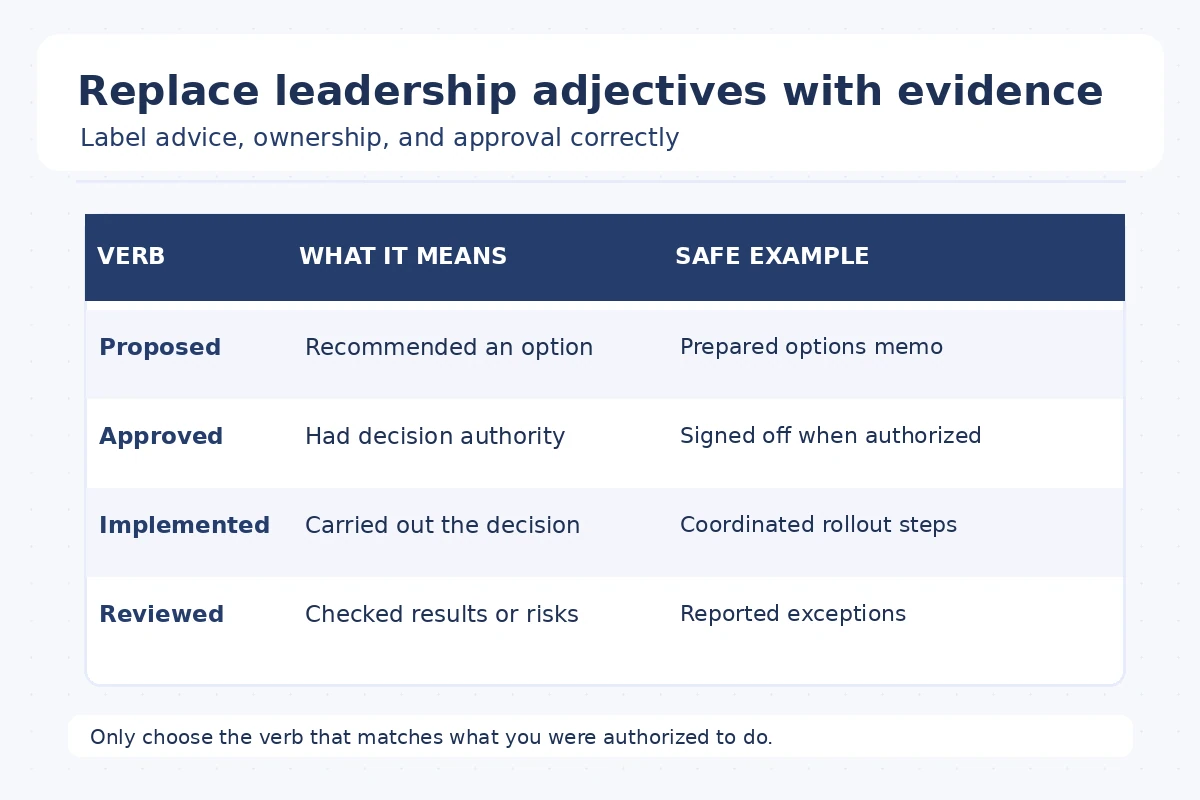
Define accountability with accurate decision verbs
Senior candidates often collaborate across teams, committees, and boards. Use language that identifies whether you approved, proposed, sponsored, implemented, or reported a decision. Those verbs are not interchangeable. If you built the evidence base and the board authorized the investment, say so; claiming you personally authorized it would distort your scope. If a program was shared among several executives, name your part and the governance process. The letter gains credibility when it acknowledges how large decisions move through real organizations rather than presenting every success as the work of one person.

Pick a leadership example with a verifiable baseline
Choose an initiative you can describe without exposing confidential information. Explain the initial operating need, the decision or option you owned, the teams involved, and what changed. Use metrics only if they are accurate, relevant, and safe to share; otherwise describe tangible deliverables and review outcomes. An illustrative case might involve standardizing a reporting cadence across departments, but it must not be written as the applicant’s real history. Claims such as “transformed performance nationwide” need substantiation and should not appear merely because they sound senior.
Connect the story to stakeholders and controls
In executive hiring, influence is often expressed through informed tradeoffs rather than just persuading people. Show how you handled competing demands from operations, finance, customers, and compliance. Was a decision escalated? Who reviewed material risks? What information did leaders need before approving implementation? Describe the role of those controls without turning the letter into an internal policy memo. This makes your management approach more legible while protecting sensitive details. The goal is to demonstrate judgment about where authority begins and ends.
Use an economical three-part letter structure
Open with the role and relevant mandate. Use the middle for one strong leadership example and a complementary capability; conclude by relating those examples to the organization’s stated priorities. A non-academic one-page letter remains a useful starting point under Harvard and Penn career advice. If an organization specifically asks for a longer statement of qualifications, follow its instructions. Avoid a giant executive biography, a list of all former companies, and decorative headlines that bury the position title. White space and restrained typography support readability; neither can rescue unsupported claims.
Compare an illustrative weak and strong passage
Weak: “I am a visionary executive who single-handedly doubled business performance.” Illustrative revision: “I coordinated an operating-review redesign across finance and service teams, defined the reporting questions with functional leads, and presented the resulting options to the executive committee for approval.” This example deliberately claims no numerical improvement and no committee approval authority. An actual candidate should replace it with their own verified record, including an outcome when it can be substantiated. The key difference is clarity about actions, collaborators, decisions, and who signed off.

Protect confidential information and third parties
Do not paste board minutes, customer lists, deal terms, sensitive personnel details, or nonpublic financial forecasts into an application. Even a correct figure may be inappropriate to disclose. Use a sanitized description of the process or a publicly reported result if you are authorized to discuss it. Avoid inventing generic metrics as a substitute. If you cannot describe the result safely, demonstrate the reasoning, cross-functional process, review checkpoint, and value of the deliverable. A prospective employer should see discretion as part of the executive judgment being described.
Edit for a specific reader, then verify the export
A search committee, recruiter, or board representative may read for different signals, but you usually cannot know an individual reviewer’s private priorities. Write a clear single narrative for the advertised mandate rather than guessing. Ask a trusted reviewer to check whether the letter distinguishes decision ownership from influence, spells organizations correctly, and keeps sensitive details out. Confirm titles and dates against the executive resume, then open the uploaded file to check layout. Never assume an attractive layout compensates for unexplained changes in responsibility.
Make the final choices with your own evidence
Build a private evidence ledger before writing: mandate, timeframe, team scope, approved action, your exact authority, collaborators, and outcome. Cross-check what is publicly reportable and what is covered by confidentiality obligations. You do not need to expose the ledger to a prospective employer; it is a safeguard against overstating executive accomplishments. If a result occurred after you left, avoid implying that you directly delivered every phase. If other leaders initiated the work, say what you added. The resulting letter will be more precise and often shorter.
Consider the level of the advertised role. A division leader may need to show execution and cross-functional coordination; a C-level opening may ask for enterprise governance, but the exact posting controls. Do not fill a page with impressive-sounding management vocabulary. Select one case that demonstrates operating judgment and another that reveals collaboration or a deliberate tradeoff. Then ask a reviewer to mark every sentence whose authority or scale could be challenged. Revise until you can substantiate each claim without revealing nonpublic data.
How We Research and Verify Cover Letter Guidance
We reviewed primary career-center and official application guidance for the format and decisions in this article. Our editorial test also compares the intended role, the content of the letter, and the requirements of the employer’s actual submission workflow. Suggested examples are explicitly illustrative and must be replaced with true experience. Layout is advice, not a promise of interview selection, software compatibility, or hiring outcomes.
Sources checked on November 4, 2026: Harvard Career Services (Harvard describes concise, factual and tailored letters based on the reader’s job requirements.); Penn Career Services (Penn recommends concrete career examples, a clear narrative and a connection to the target organization.); Michigan Career Center (Michigan outlines the opening, evidence, and closing components and stresses accuracy and concise writing.). These sources provide guidance, not employer-specific requirements. Check the current posting and compare our affiliate disclosure before taking any commercial action; this article does not claim an affiliate relationship.
More Resume and Cover Letter Guides
A concise one-page letter is a sensible default for many non-academic roles; the employer’s instructions override that convention.
Only when accurate, relevant, and appropriate to disclose. Describe scale or governance in nonconfidential terms when figures cannot be shared.
Yes if true, but distinguish your leadership role from the board’s formal approval authority.
No special typography is required. A professional greeting and restrained, readable formatting generally work.
A clear mandate, your actual decision or contribution, the relevant stakeholders, and an outcome or deliverable that can be checked.