
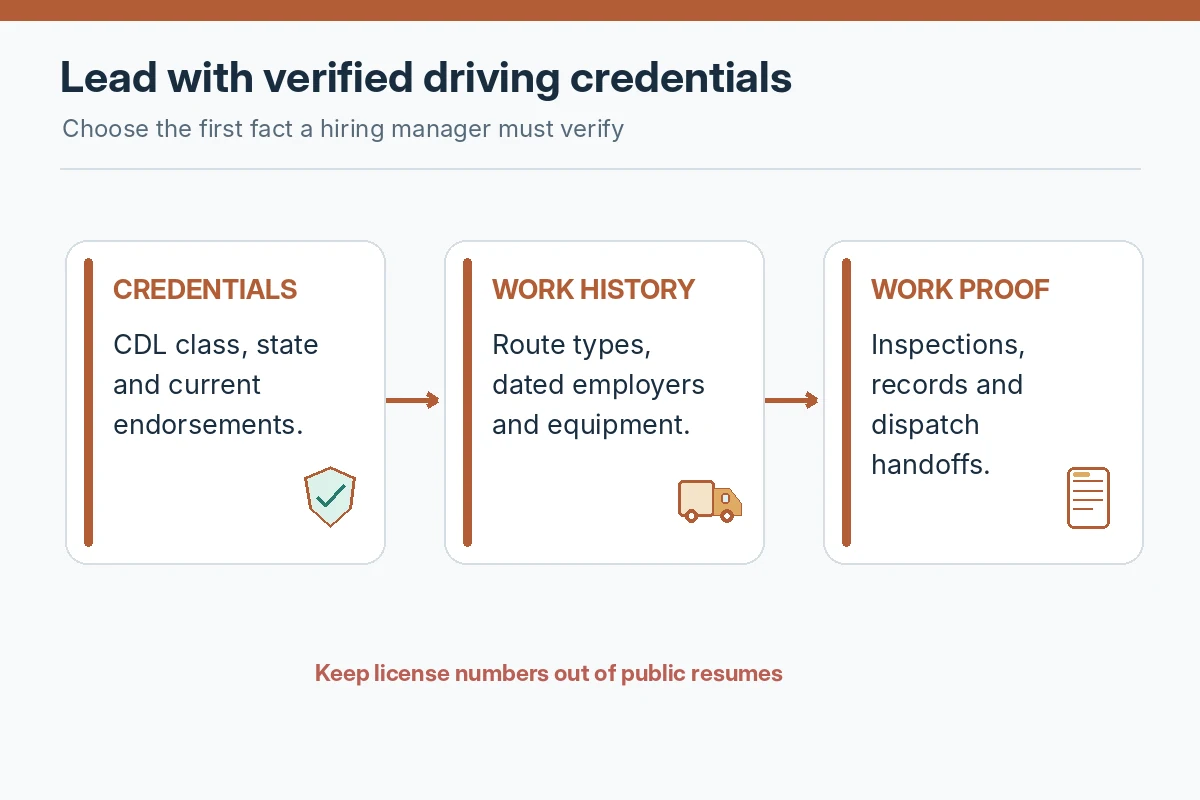
A reliable truck driver resume format begins with verified qualifications, relevant experience and readable evidence, not a decorative template. A commercial driver resume must make licensing easy to understand. After your contact details, show your valid CDL class, issuing state when useful, relevant current endorsements and any information the vacancy specifically requires. Do not decorate the top with a truck photo, giant slogans or an identification number. A recruiter evaluating a heavy vehicle vacancy needs to distinguish a currently qualified driver from someone who has completed training but is still in the licensing process.
Put CDL eligibility above general delivery experience
The Federal Motor Carrier Safety Administration explains that commercial driver’s licenses have distinct classes and optional endorsements. State licensing procedures and restrictions matter. Use the exact credential labels, and verify a requirement against the current posting and your issuing state’s record. A class or endorsement is a legal eligibility detail, not a skill adjective. If you have a learner permit rather than the license required by the role, say that plainly and avoid a resume headline that implies full authorization.
Choose work-history bullets that show route scope
Put employers and dates in a conventional work-history section. Within each driver role, explain what kind of work it actually involved: local delivery, regional runs, long-haul transport, dedicated routes, team driving or a different category relevant to the posting. If the truck or trailer type matters, describe it accurately. Do not silently convert warehouse yard movements, ride-alongs or practice trips into independent long-haul commercial driving.
The Bureau of Labor Statistics identifies route work, cargo handling, incident reporting, inspection and logkeeping among commercial driver responsibilities. Your bullet should show what you did, not assume you did every duty in the occupation. A fictional line might say: “Completed assigned regional deliveries, recorded required inspections, and reported equipment issues to dispatch for follow-up.” Adapt every word to your own documentation, including whether another person assigned the route or authorized corrective action.
Present inspections and logs as process evidence
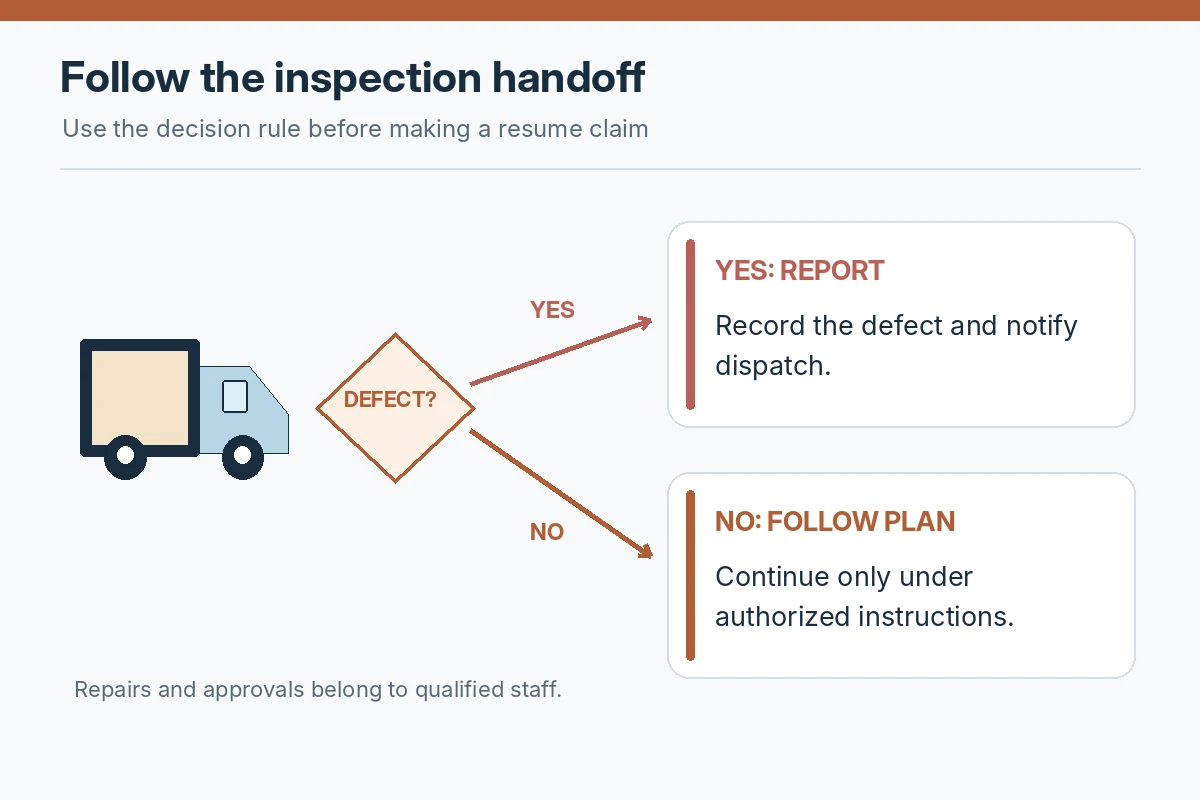
Safety-related evidence should describe real repeated habits: conducting required checks, recording defects, following escalation procedures and keeping accurate operating records. If you are unsure which regulation applies to a route or vehicle, do not add a regulatory compliance claim from a sample resume. Actual hours-of-service rules can be technical and vary by operation; a job application is not the place to invent a blanket statement that every trip complied with a specific exemption.
Separate observation from repair authority. A driver may identify a mechanical problem and report it while a qualified maintenance worker or fleet manager determines the next authorized step. Similarly, cargo securement responsibilities depend on the role, training and type of freight. Mention only the tasks you actually performed and can describe. Avoid stating “perfect safety record” or “zero violations” without a verifiable reference period and a valid reason to share that claim.
Organize equipment, freight, and customer handoffs
A compact Skills and Equipment section can clarify what an employer would otherwise have to infer. Name vehicle combinations or freight types only when you have directly worked with them. If your route experience includes refrigerated loads, flatbeds, local retail deliveries or distribution center handoffs, choose the examples that correspond to the posting. Each may entail different training and workplace practices; do not assume a general CDL automatically certifies every equipment or cargo specialization.
A professional handoff example may show communication and records rather than a fabricated percentage: “Confirmed delivery paperwork with the receiving team and documented exceptions for the dispatcher.” It tells the reviewer how you communicate without inventing a total mileage, on-time performance number or customer endorsement. If counts and mileage are accurate and useful, you may include them; otherwise precise procedures can make an equally strong application. Keep route-security or customer location details out of public portfolio documents.

Separate training, endorsements and job experience
Driving schools, employer orientation, continuing training, and endorsements should not appear as if they were interchangeable paid driving roles. Put formal training under Training, the current license under Licenses, and independently performed work under Experience. Some openings require special experience or additional qualifications; you should verify those requirements directly. If you recently qualified, your prior work in logistics, shipping or customer-facing delivery may add useful transferable proof, but label it honestly.
For a learner, an illustrative entry might read “Commercial driver training program — completed supervised vehicle inspections and documented practice maneuvers.” Do not list that as a regional driver position. For an experienced driver, one concise line of training can be sufficient while work history occupies the largest area. If endorsements have been removed, expired or restricted, update the resume rather than leaving a stale credential that would mislead an employer or complicate an eligibility check.
Keep the design compatible with application forms
A simple, one-column resume works well for a practical role with licenses, dates and employer names. Use a strong heading hierarchy and plain section titles. CareerOneStop recommends consistent formatting. Avoid skill bars for “safe driving,” decorative gauges or a sidebar that buries credentials. If a company asks you to reenter driving history in its online form, use consistent employers, dates and titles instead of relying on a formatted attachment to communicate those details.
Open the exported PDF to check that license abbreviations, routes and employers are readable and not split awkwardly across pages. Check the final file on a phone and in print preview if possible. Never publish a photograph of a license, medical card, driving record or private customer document as a resume attachment. Follow the employer’s secure process for documents it legitimately needs during screening or onboarding.
Match your route history to the actual opening
A local distribution vacancy may prioritize daily dock handoffs, predictable scheduling and pretrip checks. A long-haul posting may prioritize qualifying over-the-road experience, route types and communication across dispatch changes. Neither requires embellishment. Read the advertisement for equipment, experience, scheduling and licensing requirements; then lead with evidence you have. Do not substitute a generic “able to drive all trucks” claim for exact credentials.
Keep a private master list of dates, role titles, equipment, training and approvals so that different application versions stay consistent. When asked about a gap, a transition from school to independent driving, or a change in fleet type, explain it accurately. The strongest finished resume makes it easy to verify fit before an interview, not to infer authority that the license or employer never granted.
How We Research commercial driver resume guidance
CareerOneStop provides general formatting guidance. FMCSA explains CDL classes and endorsements, while BLS describes commercial driver tasks such as inspections, logs and dispatch communication. We use these sources to organize resume facts, not to certify an applicant or interpret a specific state licensing issue. Check FMCSA CDL guidance, BLS driver duties and CareerOneStop formatting.
Examples are fictional and are not a substitute for licensure verification or employer requirements. Read the JobAsk disclosure page for information about recommended services.
More Resume and Cover Letter Guides
Usually it is safer to show the license class, issuing state and relevant endorsements without publishing an identification number. Provide sensitive identifiers only through an authorized hiring or verification process if required.
Use a prominent Credentials or Licenses line with exact current status. Disclose restrictions when they affect the role and when required in the application; never imply an endorsement you have not received.
Describe verifiable activities such as pretrip inspections, reporting defects, accurate logs and following routing instructions. Avoid a blanket “accident-free” claim unless its exact period and documentation are supportable.
Yes, label it as completed training or a training program with accurate dates and outcomes. Keep practice driving and accompanied training separate from independently held paid commercial driver employment.
Yes when relevant and accurate. Show route type, equipment, freight or customer handoffs, and the responsibilities you actually performed, without disclosing sensitive customer or route-security information.