
A software engineer informational interview should uncover what happens between a feature request and a working release—not merely what programming languages someone uses. Ask how developers clarify requirements, test changes, review code, document trade-offs and share responsibility with other teams. Those answers help a student or career changer choose a realistic portfolio project and judge whether a posted “software engineer” role matches their interests. Keep the conversation educational; do not ask the engineer for private source code, production access or an interview shortcut.
Identify the Team and Engineering Context First
Software engineers can work in product teams, internal platforms, infrastructure, regulated systems and many other environments. A contact’s experience with one team is not a universal picture of the occupation. Before the meeting, read their public profile and choose one specific question: how a feature is reviewed, how junior developers get feedback, or where product requirements come from. O*NET describes broad software development activities, but it cannot tell you the workflow of a particular company.
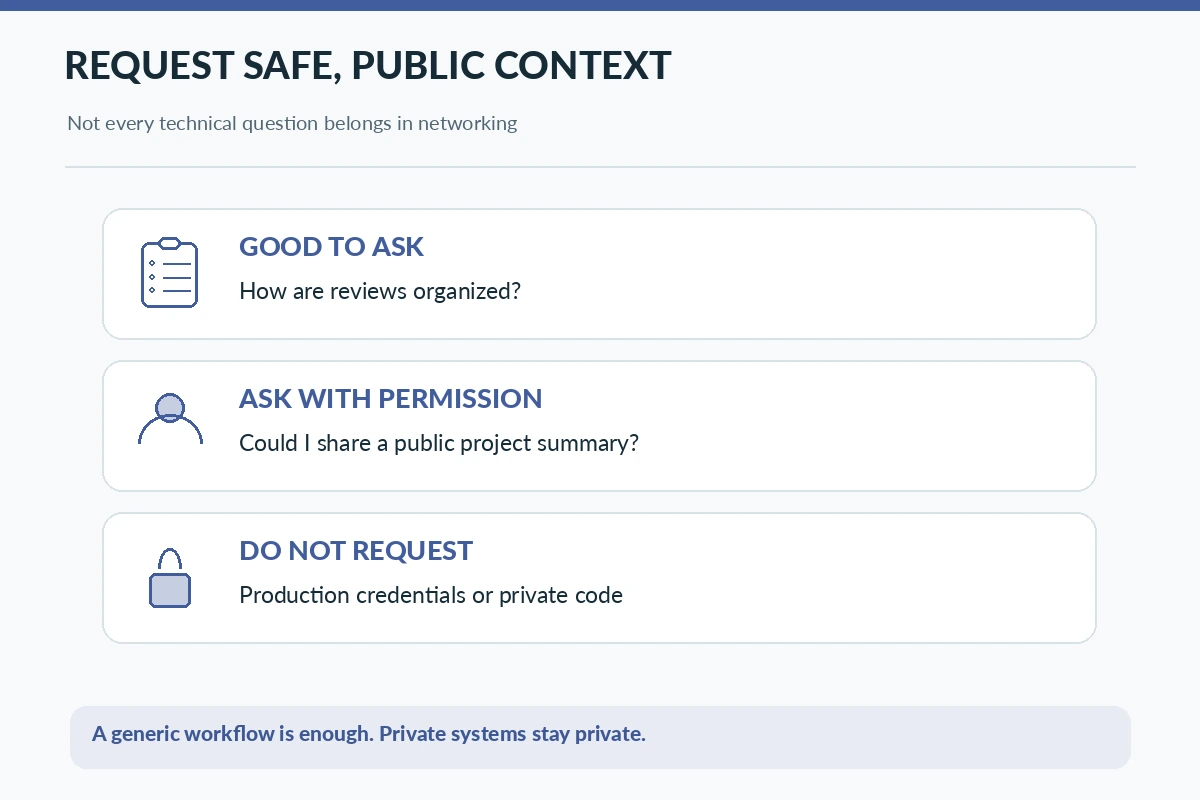
Ask the person to describe their team in general terms. Who translates a user need into a task? Who can approve a technical change? How do engineers coordinate with design, security, quality or operations? Avoid proprietary architecture details or internal customer information. If the contact works on sensitive systems, use broad process questions and let them decide which examples are appropriate to share. You only need the shape of the work to compare roles.
Trace a Feature From Request to Review
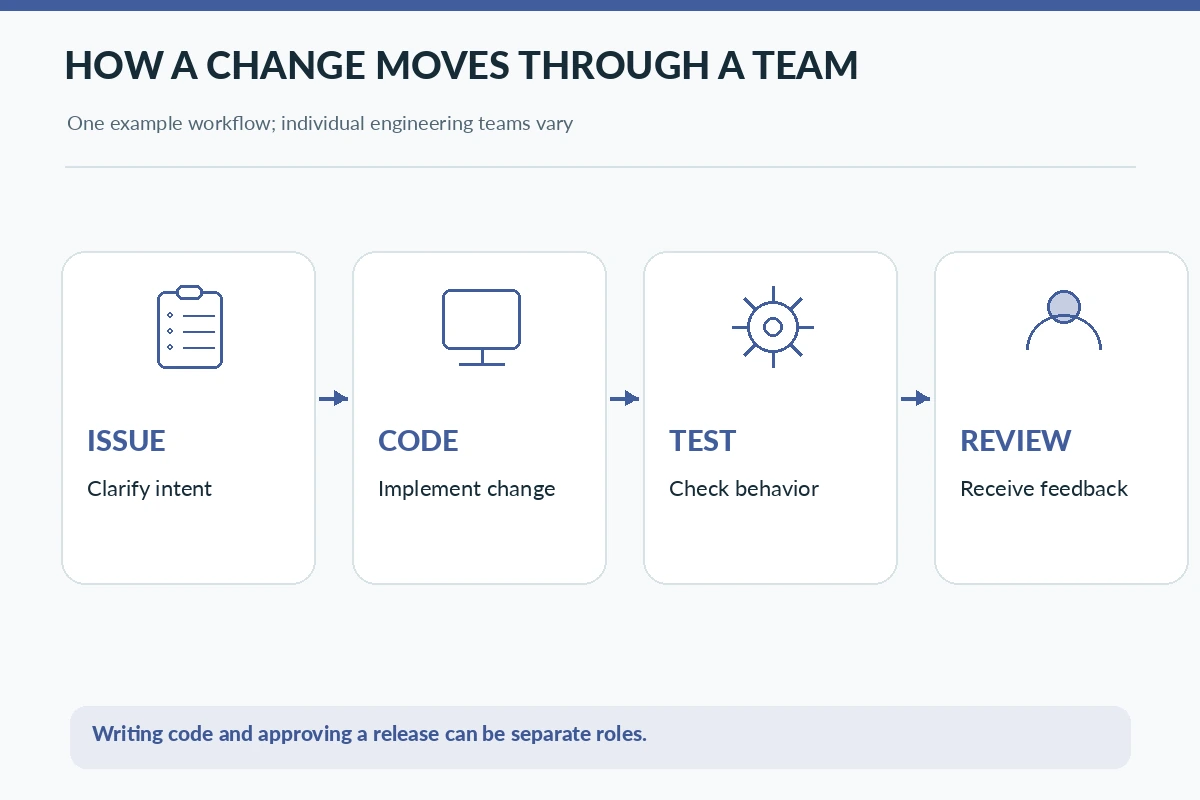
One useful question is: “Could you walk me through the stages a routine, nonconfidential change goes through?” A typical answer might mention issue clarification, design discussion, coding, automated tests, code review and release checks, but individual teams will arrange these differently. Note where feedback is given and who holds final approval. The point is to learn how collaboration and quality controls operate, not to obtain a secret template from one employer.
Follow up by separating authorship from approval: “Which parts would a new engineer own independently, and which would require review?” This clarifies why a portfolio showing a personal app may not prove production ownership at the same level. If the engineer mentions an incident or outage, ask about general escalation and learning processes, not customer impact details, infrastructure weaknesses or security-sensitive recovery steps.
Ask What Junior Engineers Actually Practice
Ask which beginner contributions are common: reproducing a bug, adding a test, updating a small component, maintaining documentation or asking clarifying questions. Then ask what a good review comment looks like and how people respond when an approach is rejected. These are better learning prompts than “What language should I master?” because tools vary and the review process exposes the reasoning habits teams value.
Listen for the difference between developing an isolated demo and working in a shared repository. A small public project can show readable code, tests, setup instructions, issue history and thoughtful changes. That does not prove you had access to production systems or led a commercial release. When discussing experience, label independent coursework and volunteer contributions accurately. Never upload client code, private issue screenshots or employee account data to a public portfolio.
Prepare Questions About Quality and Trade-Offs
Instead of inviting a broad opinion about the “best stack,” ask how the team makes decisions with competing constraints: speed, maintainability, accessibility, performance and safety. “What makes a change ready for review?” or “How do you tell whether a test covers the intended behavior?” encourages an explanation of practice. A developer may discuss standards without revealing proprietary implementation. Record the decision criteria rather than turning the conversation into a list of brand names.
Ask about documentation and communication, too. How are assumptions captured? What information makes a bug report actionable? Who communicates risks before a release? These questions highlight the parts of engineering that a coding exercise alone may miss. If you cannot yet understand a technical term, ask for a plain-language distinction and look up the official documentation afterward. The contact’s time is better spent on contextual judgment than delivering an impromptu programming lesson.

Keep Technical Boundaries Professional
A networking meeting is not a security review or a request for free consultancy. Do not ask for live system access, credentials, internal repositories, customer datasets, unannounced products or incident specifics. Nor should you send the contact an unsolicited large codebase and expect detailed feedback. If you want portfolio advice, ask whether a short summary of a public practice project would be appropriate. Give an easy option to decline.
For example, you might say: “I built a small scheduling app with synthetic records. Would describing how I tested input validation be a useful way to discuss my work?” If the contact agrees, summarize purpose, contribution, validation and the limitation of your example. Do not claim that the practice project underwent an employer’s security or release approval. That distinction protects both your credibility and the other person’s professional obligations.
Convert the Answers Into a Portfolio Revision
Use a simple artifact map: questions about review lead to a clear pull-request description; questions about testing lead to reproducible test cases; questions about collaboration lead to a decision log; questions about accessibility lead to documented checks. You can implement these in a personal repository with non-sensitive materials. The outcome is a portfolio closer to ordinary team practices, not a claim that an interviewer endorses your skills or would hire you.
Send a thank-you referencing one work process rather than asking the engineer to become an ongoing mentor. You might say, “Your distinction between writing a feature and getting a change approved helped me see why my project needs clearer tests and review notes.” Then identify one project revision and one current job posting to examine. If you later publish it, do not imply the contact reviewed or approved the result without permission.
| Ask about | Practice artifact | Claim to avoid |
|---|---|---|
| Code review | Public PR description | Employer-approved release |
| Testing | Reproducible test log | Production test ownership |
| Bug triage | Synthetic issue report | Internal incident access |
| Documentation | Setup and change notes | Team lead authority |
How We Research and Check These Examples
We reviewed independent career-services guidance on the purpose and etiquette of informational interviews, and compared any profession-specific claims with relevant official occupational or federal guidance. All outreach notes, questions and practice examples are illustrative; no contact, meeting, candidate result or employer response is represented as real. Sources reviewed on 2026-11-05. One worker’s experience cannot replace current job announcements, credentialing rules or an employer’s official hiring policy. Read our affiliate disclosure for the site policy.
Research sources: www.career.berkeley.edu guidance — UC Berkeley distinguishes informational conversations from hiring interviews, recommends respecting agreed time and following up.; careerservices.fas.harvard.edu guidance — Harvard advises short, specific requests and open-ended career questions instead of asking for a job.; www.onetonline.org guidance — O*NET software developer tasks include designing and creating software, investigating requirements and working with others.; careerservices.fas.harvard.edu guidance — Harvard networking guidance recommends a focused informational conversation rather than a disguised hiring request.. Check the full primary source and the current vacancy before making a career or education decision.
Related Job Search Guides
You may ask whether they are open to looking at a brief public sample, but do not assume they owe you a full code review or free consulting.
First ask about the team’s actual tasks and required skills. Tool choices and compensation vary by role, location and employer.
Describe it accurately as a class or personal project, including what you built and tested. Do not present it as an employer production release.
Ask who reviews routine changes, what tests or documentation help, and how junior developers receive and act on feedback.
No. Work with your own or openly licensed practice code and respect confidential materials and permission boundaries.