
A federal employee informational interview should help you understand what a public-service role does, how the team’s work differs from its job title, and which published hiring rules you still need to check. It is not a way to obtain special access, nonpublic government information or a promise of selection. Ask the employee for a short, voluntary conversation about general duties and career experience, then read the relevant USAJOBS announcement for actual eligibility, qualifications and application instructions.
Start From a Public Job Announcement
Before contacting an employee, choose a public USAJOBS announcement or occupational series you want to understand. Read the Duties, Requirements, How You Will Be Evaluated and How to Apply sections. Identify one ambiguity that a practitioner could discuss in general terms: which stakeholders an analyst works with, how training is typically organized or what a normal reporting cycle looks like. Do not ask the employee to interpret secret selection criteria or bypass the announcement.
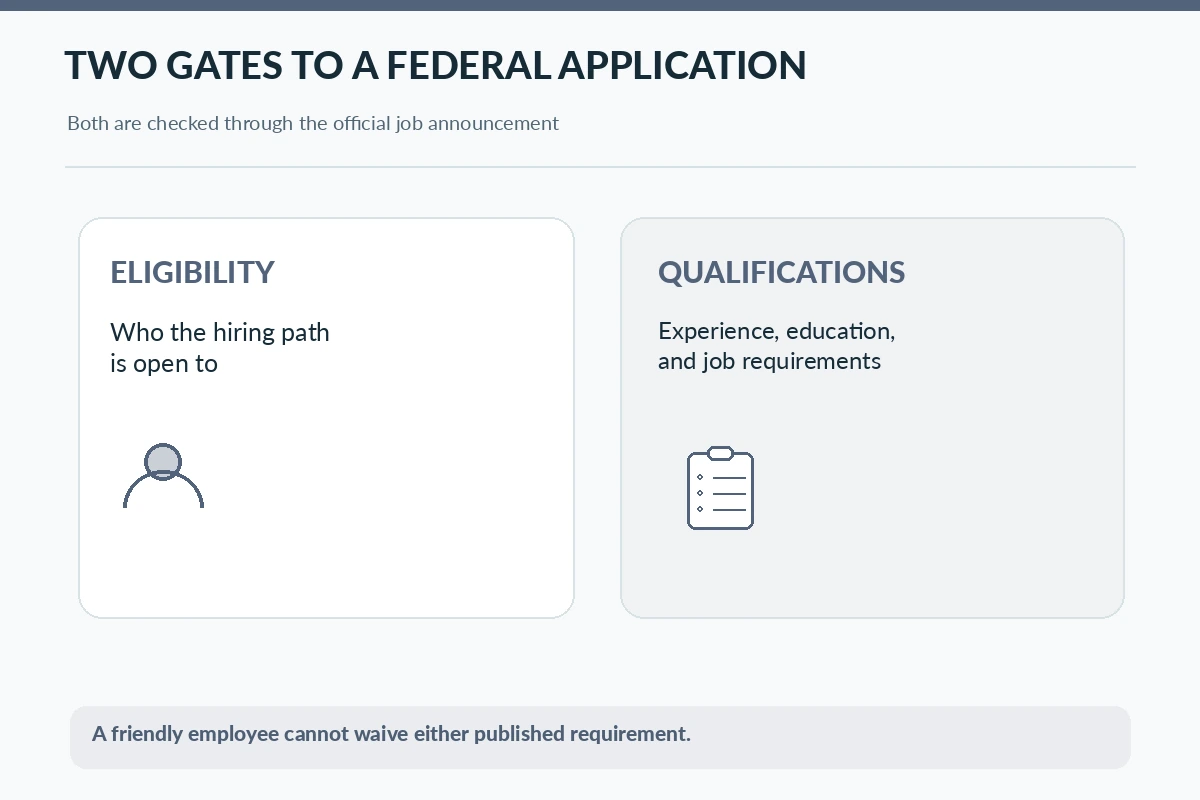
USAJOBS makes a critical distinction between eligibility and qualifications. Eligibility concerns whether you are in the hiring group for which the announcement is open; qualifications concern experience, education and skills. A career contact may help you understand daily work but cannot make you eligible, waive a formal requirement or decide the hiring agency’s assessment. Write these two categories on your preparation sheet so you do not confuse friendly career advice with an official hiring determination.
Request a Conversation Without Claiming Influence
Use a professional channel that the person or agency permits for outreach. A hypothetical request: “I’m researching program analyst duties and found your public professional profile. Would you be open to a brief career-information conversation about general work processes? I am not seeking access to a vacancy, confidential information or a recommendation.” State clearly why you chose that person, keep the time request modest and accept a decline. A government employee may have agency rules or workload constraints that limit availability.
Avoid language suggesting endorsement, special status or influence over hiring. Do not offer gifts, favors or payment for preferential treatment. The Office of Government Ethics explains that executive-branch ethics standards address misuse of official position and nonpublic information; application of rules can depend on the employee and agency. The appropriate aim is understanding publicly discussable work, not obtaining privileged assistance. You may also use an official agency information event as a safer alternative.

Ask What the Public Duties Mean in Practice
A title such as program analyst can cover different assignments. Instead of asking for restricted records, ask the contact to translate public duty statements into general tasks: “When a vacancy says analyze program data, what kinds of decisions does an entry-level employee prepare for review?” or “What does collaboration with policy, field and administrative staff look like in general?” You are learning work boundaries, not requesting sensitive program findings.
Ask who typically reviews recommendations, how work products are documented and what kinds of training help newcomers read relevant policies. Do not ask who is being investigated, what an agency has not announced or how to influence a selection panel. If the person cannot discuss a topic, move on. Keep notes at the level of public function and general transferable skills rather than collecting names, case details or confidential decisions.
Check Eligibility, Qualifications, and Documents Yourself
After hearing how the job works, return to the official vacancy. Record the hiring path in “This job is open to,” review Qualifications and Specialized Experience, and verify the Required Documents list. The contact’s personal route into government may have used a different hiring authority or a different announcement. Do not assume an employee’s degree or years of experience establish the standard for your vacancy. When eligibility is unclear, use the official HR contact provided in the announcement.
Distinguish general professional preparation from formal selection. A writing sample or work history may help explain your abilities, but a federal application must follow the advertised procedures. Ask an employee which public resources they found helpful, not whether they can manually move your application ahead. OPM and USAJOBS describe agency review and selection processes that are not replaced by an informational chat.
Understand the Ethics Boundary Before Asking
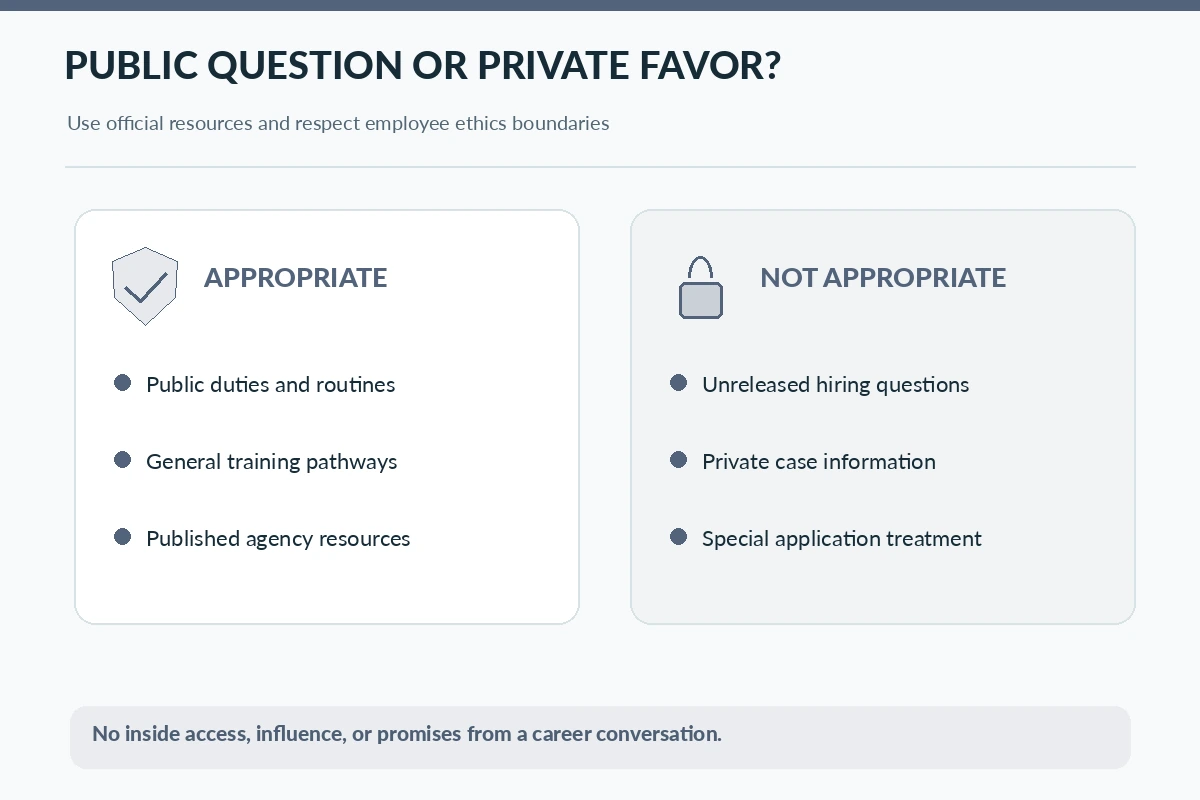
Government workers may have rules about nonpublic information, conflicts of interest, official resources and use of position. Treat this as a reason to ask only broad questions. “What publicly available reports show the kinds of work your office does?” is reasonable. “Can you send an unreleased report or internal interview questions?” is not. You should neither request access to nonpublic data nor interpret a willingness to chat as permission to receive it.
Do not photograph restricted workspaces, request a government login or publish a colleague’s personal contact details. If an agency offers an approved career event, follow its rules for participation and materials. The source-backed principle is clear even without legal analysis of a particular person’s circumstances: your research should not compromise confidentiality or seek an unfair private advantage. For binding ethics guidance, agency employees should consult their own ethics officials.
Translate What You Learned Into a Fair Application Plan
Make a four-column worksheet: public duty, contact’s general explanation, your documented example, and official announcement requirement. For example, a public reference to documenting findings may align with your own fact-checked research memo. Describe that experience truthfully, including who reviewed or approved it, rather than claiming you authored government policy. A friendly conversation is a source of context—not a credential, recommendation or employment guarantee.
Conclude with a tailored thank-you and no request for inside treatment. You might write: “Your explanation of how analysts prepare recommendations for review clarified the difference between research and approval. I will read the public qualification and documentation instructions closely.” Record the official source you will verify next and let the person choose whether to maintain contact. Respect agency communications policies and avoid publishing their remarks as an official government position.
| Question | Use informational chat for | Verify officially with |
|---|---|---|
| Daily duties | General work examples | Duties section |
| Eligibility | Broad pathway context | This job is open to |
| Qualifications | Work-task perspective | Requirements section |
| Application status | Not an appropriate request | Agency HR/contact |
| Ethical limits | General boundary awareness | Agency ethics office |
How We Research and Check These Examples
We reviewed independent career-services guidance on the purpose and etiquette of informational interviews, and compared any profession-specific claims with relevant official occupational or federal guidance. All outreach notes, questions and practice examples are illustrative; no contact, meeting, candidate result or employer response is represented as real. Sources reviewed on 2026-11-05. One worker’s experience cannot replace current job announcements, credentialing rules or an employer’s official hiring policy. Read our affiliate disclosure for the site policy.
Research sources: www.career.berkeley.edu guidance — UC Berkeley distinguishes informational conversations from hiring interviews, recommends respecting agreed time and following up.; careerservices.fas.harvard.edu guidance — Harvard advises short, specific requests and open-ended career questions instead of asking for a job.; help.usajobs.gov guidance — USAJOBS explains the duties, requirements, evaluation and application sections of federal vacancy announcements.; help.usajobs.gov guidance — USAJOBS distinguishes hiring-path eligibility from job qualifications.; www.oge.gov guidance — OGE describes executive-branch ethical limits involving misuse of office and nonpublic information.. Check the full primary source and the current vacancy before making a career or education decision.
Related Job Search Guides
They can describe their work history, but official eligibility and qualification criteria come from the job announcement and hiring agency.
No. Seek publicly available descriptions of duties and competencies, not nonpublic selection material or privileged access.
No. It is a voluntary career conversation and does not substitute for an agency’s published selection process.
Do not request preferential treatment. Apply through the official steps and direct eligibility or process questions to the announced agency contact.
Accept the boundary and find a published agency resource, USAJOBS help topic or authorized information session.