
Consulting informational interview questions should uncover how a consultant frames a business problem, works with client teams, analyzes evidence, and communicates recommendations. The conversation is for career research—not a case interview, a request for client files, or a pitch for a referral. Use the sample question paths below to learn whether research-heavy analyst tasks, client-facing workshops, or implementation work fits you. Record general workflows rather than identifying details about clients or contracts.
Choose the consulting work you actually want to understand
“Consulting” does not identify a single daily schedule. A management analyst may study processes, interview staff, compare data, draft recommendations, or help determine whether a change is working. The Bureau of Labor Statistics and O*NET describe those functions, but a particular consultant may be assigned only a subset. Distinguish strategy work, operations improvement, implementation, internal consulting, and specialized technical advice before you select questions.
Read the professional’s public biography and the firm’s public practice description. If it mentions process improvement, ask how a team decides what evidence is enough to recommend a change. If it highlights implementation, ask who owns the decisions after a recommendation is delivered. Avoid questions that require proprietary pricing, client identities, security details, or metrics. Your aim is to learn a method and a role boundary that could transfer across organizations.
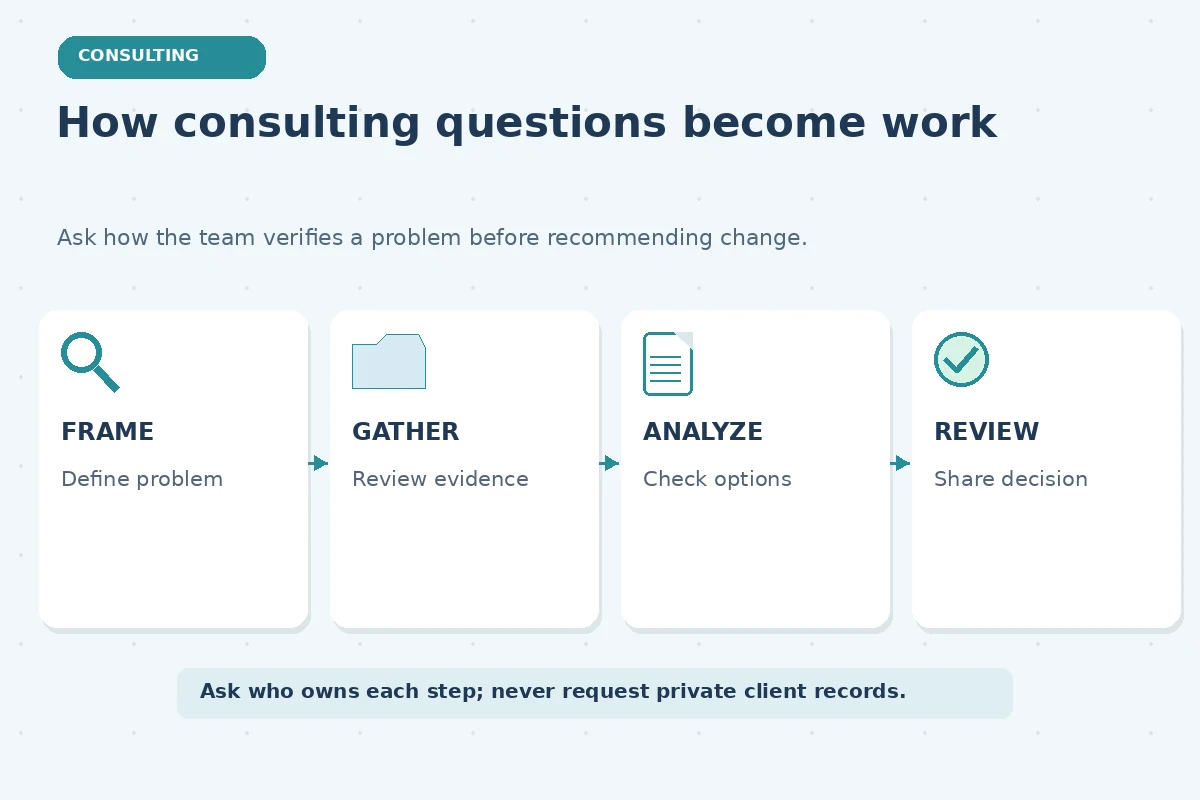
Ask about the life cycle of a client problem
Begin with an open invitation: “Without naming a client, how does your team usually turn a broad business concern into a defined question?” Then ask what data or interviews are suitable for that stage and how findings are checked. Follow with “Who reviews a recommendation before it reaches leadership?” These are better than asking for a secret slide deck or the firm’s most profitable engagement. An ethical example can be completely generic and still useful.
A compact sequence is problem definition, evidence gathering, analysis, recommendation, and follow-through. Ask which stages are done by junior staff, which require senior review, and where client approval matters. A person may describe a different sequence; let that variation inform your career research rather than treating the sequence as a universal consulting standard.
Compare analyst tasks, manager decisions, and client ownership
Useful questions include: “What work product might a new analyst draft during the first month?” “When does an engagement manager review assumptions?” “Who owns changes to the client’s actual procedures?” and “How does the team communicate uncertainty?” Each question explores a different responsibility. Do not assume an analyst can promise a result to a client or authorize a business change independently.
For example, the consultant may explain that junior staff clean permitted datasets and document assumptions while a manager challenges the logic and the client ultimately decides whether to adopt the recommendation. That is an illustrative pattern, not a report of any employer’s practice. Write it in your notebook as a hypothesis to verify with a second contact in another organization or practice area.

Use a short, respectful mock conversation
The following dialogue is fictional; it is a script for practice, not a real interview transcript. Applicant: “Your public profile mentions operations consulting. In a typical project, which part of the problem takes the most clarification?” Consultant: “It depends on the client, but defining the question can be harder than analyzing it.” Applicant: “How does a new analyst contribute before that scope is settled?” Consultant: “By organizing questions, checking sources, and asking what assumptions need validation.” Applicant: “What would you recommend I practice?” Consultant: “Show that you can frame and verify a problem.”
Notice that the candidate did not ask for an active client name, confidential data, job offer, or an endorsement. One follow-up probes a skill; another asks about starting-level contribution. In a real meeting, listen to the particular answer instead of forcing these exact lines.
Turn advice into a testable preparation plan
After the call, divide notes into three columns: observed work, entry-level proof, and a low-cost next action. “Validate assumptions” might connect to an academic process map with clearly stated sources. “Present trade-offs” might connect to a short, public-data memo that compares two alternatives. “Interview stakeholders” might connect to permission-based research practice. These are possible learning projects, not substitutes for qualifications or permissions.
Before paying for an expensive course, ask a second professional in a different setting which skills they really use and which junior roles exist. Job descriptions, actual education requirements, and the employer’s application instructions must still be checked independently. One person’s career trajectory is not a guaranteed entry route, and informal advice should not be treated as an offer.

Close by asking for a field perspective, not a favor
Keep the meeting to the agreed time. A useful closing question is “What is one misconception you would correct for someone exploring this line of work?” You can also ask for a public resource or a broad type of professional to speak with next. Do not press for a referral, internal client information, or special hiring access. Thank the person for a concrete insight, then review your notes while the examples remain clear.
When recording lessons learned, distinguish the professional’s personal view from verified occupational information. A conversation with a boutique-firm consultant may not reflect a large company or an in-house analyst group. MIT career guidance recommends using multiple conversations rather than leaning on the impressions of one or two people. That cross-check is especially helpful where job titles conceal different responsibilities.
How We Research Career Conversations
We compared published U.S. university career-center guidance on informational interviews, outreach, preparation, note-taking, and follow-up. Where this article discusses occupational duties, we checked the cited occupational description separately. The question scripts and dialogues are hypothetical teaching examples, not actual interviews, employer policies, or guarantees that a professional will respond. Guidance from one organization may not reflect every profession, employer, or school assignment.
Sources reviewed November 13, 2026: www.bls.gov — The U.S. Bureau of Labor Statistics describes management analysts investigating organizational problems, gathering information, and developing recommendations, including consulting engagements.; www.onetonline.org — O*NET lists management analyst work activities such as examining procedures and recommending improvements; the occupation includes management consultants.; capd.mit.edu — MIT advises informational interviewers to research a person, ask thoughtful questions, respect time, and evaluate information from multiple conversations..
This is general U.S. career guidance, not professional hiring or legal advice. Ask permission for sensitive notes or recording and follow applicable institutional policies. Review the JobAsk affiliate disclosure. The navigation links here are informational, not evidence of employer endorsement, a job placement, or an affiliate agreement.
Related Job Search Guides
No. It is a career-learning conversation led by your questions. A hiring case interview is an employer assessment and requires different preparation.
Ask about general approaches and publicly shareable experiences. Do not request confidential identities, contracts, data, or deliverables.
Focus on training, typical tasks, review practices, how they ask for help, and the difference between drafting analysis and approving recommendations.
Prepare more than you need, but prioritize three to five open-ended questions for a short meeting and follow the other person’s answers.
It can improve understanding and relationships, but it is not a job offer or hiring shortcut. Apply through the employer’s stated process.