
Put every work location on a calendar before replying yes. To accept this particular type of job offer responsibly, check the written terms against actual work conditions, ask targeted questions, and confirm the result through the employer’s official channel. This guide gives you a practical review tool for accepting a hybrid job offer without assuming that an informal conversation creates a permanent guarantee. Examples are hypothetical and should be adapted to your real offer.
Check the offer against practical working conditions
Start with the employer’s written offer, the job posting, and any notes from interviews. Identify the legal employer, job title, start date, main location, and contact for questions. Record the offer deadline so you can request clarification in time. Read important policies instead of relying on general assumptions or a recruiter’s shorthand. A short set of factual questions is usually more useful than a broad request to explain every benefit.
For this role, put these four items in a review sheet: office days, remote location, tools, changes. Mark each one CONFIRMED, NEEDS ANSWER, or DOES NOT APPLY. If the offer document and hiring discussion contradict each other, send one email listing the discrepancy. Do not answer with a final, unconditional yes while assuming that the employer will interpret an unstated condition in your favor.
Translate the word hybrid into actual workdays
“Hybrid” does not tell you how many office days are required, whether the pattern changes by team, or whether a training period is fully on site. Before accepting, place each weekday in a simple location grid. Ask which office the position reports to, which days are fixed, and whether the schedule is the same during onboarding. If a recruiter says “roughly two days” while a hiring manager says “three set days,” treat the difference as a question to resolve, not a detail to interpret optimistically.
A useful written answer names the usual office, the regular attendance pattern, and who approves any exceptions. It does not need to predict every future meeting. The OPM guidance we cite concerns federal arrangements and shows what an explicit telework schedule can contain; it does not make those particular federal rules universal across US private employers. If a location requirement affects your ability to take the job, obtain a precise statement before sending an unconditional acceptance.

Make the commute and approved remote site visible
Calculate the real trip for the stated site, not only for the headquarters named in the advertisement. Consider predictable transport, parking, access badges, and how often an extra trip might be needed. An office move or assigned coworking location could change that calculation. If you live in another state, do not assume the company can employ you from that state simply because the work involves a laptop. Ask HR which locations the employer approves and whether relocation would require a revised arrangement.
Distinguish your own commute from occasional travel to another office. Do not assume that ordinary commuting costs will be reimbursed. Ask about scheduled visits to other locations and any travel policy if the role has multiple sites. A clear request might be: “Is the east campus office my regular site, and do visits to the other campus require advance approval?” This is more useful than a vague question about flexibility.
Check equipment, access, and support responsibility
List what the work actually needs: a managed computer, secure network access, headset, authentication method, and any specialized software. Confirm who buys or provides those items, who repairs them, and whether remote work may begin before access is provisioned. Do not assume you should buy a device yourself or accept a reimbursement check from an unknown sender. The FTC warns that fake recruiters may use supposed equipment purchases to obtain money or sensitive information.
Ask whether sensitive files must remain inside an approved system and who handles access requests. If the job includes calls or regulated information, the employer should explain approved workflows and privacy practices. Avoid promising that your home setup satisfies a policy you have not read. A reasonable answer is: “I have a quiet work area; I will follow the employer’s security and device requirements once they are provided.”
Ask how extra office days and hours are decided
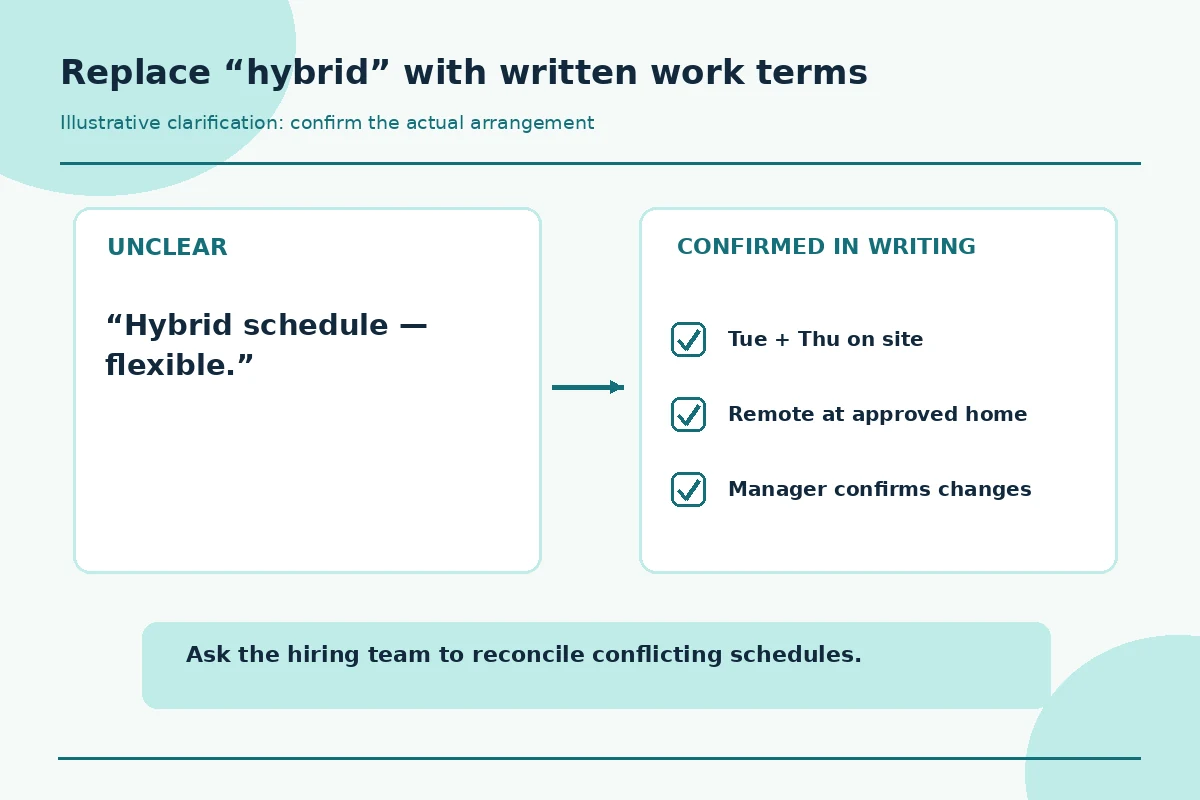
Even a written Tuesday–Thursday arrangement may be modified for customer visits, team events, urgent work, or training. Ask for the normal notice practice, who approves swaps, and what happens when the office closes. Also ask whether the hours stay the same at home and on site. Flexibility can mean shifting locations, shifting hours, or having occasional schedule changes; those are separate terms.
Keep the question operational rather than adversarial. For example: “If an additional onsite meeting is needed, will my manager normally confirm the date in advance?” If the role requires immediate attendance with no reliable notice, decide whether that is workable for your commute. Do not frame a manager’s informal reassurance as a guaranteed permanent schedule. Confirm important details in the offer, an attachment, or an HR email you can save.
| Area | What to verify | Useful question |
|---|---|---|
| Office days | Named site and usual days | Which days are normally on site, and where is that site? |
| Remote location | Approved address or state | Is remote work permitted from my proposed location? |
| Tools | Who supplies and supports devices | Who supplies and maintains the laptop, monitor, and approved software? |
| Changes | Who can alter attendance | How much notice is usually given before an extra office day? |
The table is a working aid, not a standardized employment form. Replace its descriptions with the particular employer’s documents, and do not assume an unknown term is favorable. If a question affects compensation, a legal obligation, required credentials, or a protected employment right, ask HR for the applicable policy and obtain qualified advice when necessary. Keep the conversation factual and avoid inventing claims about what the law guarantees.
Send a short acceptance that references the agreed arrangement
Once the conditions are clear, answer by the employer’s stated deadline. Identify the exact job title, say that you accept, confirm the start date, and refer to the written hybrid schedule without rewriting the entire offer. If the organization uses a signature portal, use that official process. An email should not be treated as a substitute for any required offer document. Where HR has confirmed a detail separately, keep that response with your offer records.
A hypothetical final sentence is: “I’m pleased to accept the Operations Coordinator offer with the June 15 start date and the hybrid schedule described in your May 28 offer and the June 1 HR clarification.” Replace every date with your real details. If the employer has not answered a material question, send a clarification request instead of saying “I accept, provided that…” and assuming the condition is understood. Ask how they want conditions documented.
Illustrative clarification email: Subject: Acceptance of Hybrid Operations Coordinator Offer — Work Arrangement. Hello Hiring Team, thank you for offering me the Operations Coordinator position. I am excited about the work. Before I confirm acceptance, could you verify that the regular schedule is Tuesday and Thursday at the downtown office and the other workdays at my approved home workspace? Please also confirm which equipment the company provides and how office-day changes are communicated. Once the written terms match, I can reply with my acceptance by the stated deadline. Thank you. This sample is not a message sent by a real applicant and contains no verified employer promise. If you already have clear written terms, simplify it into a brief acceptance instead of unnecessarily reopening agreed points.
Use a seven-day check before your first week
After acceptance, record the site address, badge instructions, team meeting time, equipment delivery route, and the first day you are expected in person. Confirm whether remote access and required training will be ready. Review any policies about working from another location or using personal devices. Be alert to sudden messages demanding that you purchase equipment or enter bank information into an unfamiliar portal; verify requests via the employer’s known official contact.
Create a one-page reference with the ordinary office days and one named manager or HR contact for exceptions. This is not about resisting change. It helps prevent confusion when one supervisor expects an office visit and another assumes you are remote. If the employer later changes the arrangement, compare the new instruction with the documented agreement and ask for the updated schedule in writing.

How We Research Job Offer Decisions
JobAsk compared this intent with the WordPress title list provided for the project, read the existing production plan, and reviewed primary public guidance relevant to the specific scenario. Official publications explain some general practices and federal standards; they do not replace the employer’s own terms or professional advice for an individual dispute. The suggested questions, email wording, and diagrams are editorial examples, not verified hiring outcomes. The site’s affiliate disclosure explains editorial and commercial relationships.
Source: www.opm.gov — OPM describes schedule, communication, and notice-of-change provisions that can be documented in a telework arrangement; its federal rules are an example, not a private-employer mandate.
Source: www.opm.gov — OPM lists telework agreement details including equipment, worksite, contact details, and tasks for federal employees.
Source: consumer.ftc.gov — The FTC explains how to verify recruiters and recognize requests for sensitive financial information in fake job offers.
Related Workplace Guides
No. Hybrid may mean fixed attendance days or a manager-approved pattern. Ask for the usual schedule and approval process in writing.
Only if the employer approves that work location. Confirm location restrictions before making plans; do not assume that “remote” means anywhere.
Do not buy equipment based on an unverified recruiter message. Ask HR what is provided and independently confirm the official onboarding process.
Request a written reconciliation from the hiring team before accepting. Keep both communications for reference.
No. OPM resources describe federal arrangements. Your own employer’s documented policy and applicable rules control your situation.