
Ask about a normal month, not an unexplained travel percentage. To accept this particular type of job offer responsibly, check the written terms against actual work conditions, ask targeted questions, and confirm the result through the employer’s official channel. This guide gives you a practical review tool for accepting a job offer with travel without assuming that an informal conversation creates a permanent guarantee. Examples are hypothetical and should be adapted to your real offer.
Check the offer against practical working conditions
Start with the employer’s written offer, the job posting, and any notes from interviews. Identify the legal employer, job title, start date, main location, and contact for questions. Record the offer deadline so you can request clarification in time. Read important policies instead of relying on general assumptions or a recruiter’s shorthand. A short set of factual questions is usually more useful than a broad request to explain every benefit.
For this role, put these four items in a review sheet: frequency, destinations, bookings, expenses. Mark each one CONFIRMED, NEEDS ANSWER, or DOES NOT APPLY. If the offer document and hiring discussion contradict each other, send one email listing the discrepancy. Do not answer with a final, unconditional yes while assuming that the employer will interpret an unstated condition in your favor.
Turn a travel percentage into a realistic month
An offer that says “25% travel” or “up to 50%” rarely tells the whole scheduling story. It could mean one overnight week each month, short client visits every week, seasonal travel bursts, or irregular work across several sites. Ask the hiring manager to describe a recent representative month and a peak month. Request locations, typical trip lengths, notice, and whether weekend travel sometimes occurs. A written example helps you compare the job with family commitments and transport realities.
Treat a percentage as an estimate rather than a ceiling unless the employer explicitly defines it. If the team covers an expanding territory, ask whether destinations may change. Avoid inserting invented mileage or hotel costs into your comparison. You can create a personal calendar showing tentative trip blocks and mark each uncertain item with a question. If the answer remains “travel varies significantly,” decide whether that level of uncertainty is acceptable before replying.

Separate business travel from ordinary commuting
The company may have a headquarters, assigned office, customer sites, and overnight destinations. Ask which location is the regular worksite and which trips count as business travel under its policy. Do not presume that every drive to work earns mileage reimbursement or that all time away from home is paid the same way. The DOL discusses federal hours-worked principles, but detailed travel-time treatment depends on the circumstances, employee status, and potentially state rules.
Clarify whether you must drive your own vehicle, use a pool car, or take an approved rental. Ask what happens if a trip changes after booking and how emergency returns are handled. If travel requires operating equipment, transporting passengers, or entering secure customer sites, ask what authorizations and training apply. None of those obligations should be assumed from a job title alone. Make a list of arrangements you can comply with and restrictions that require a decision.
Follow the approval, booking, and reimbursement chain
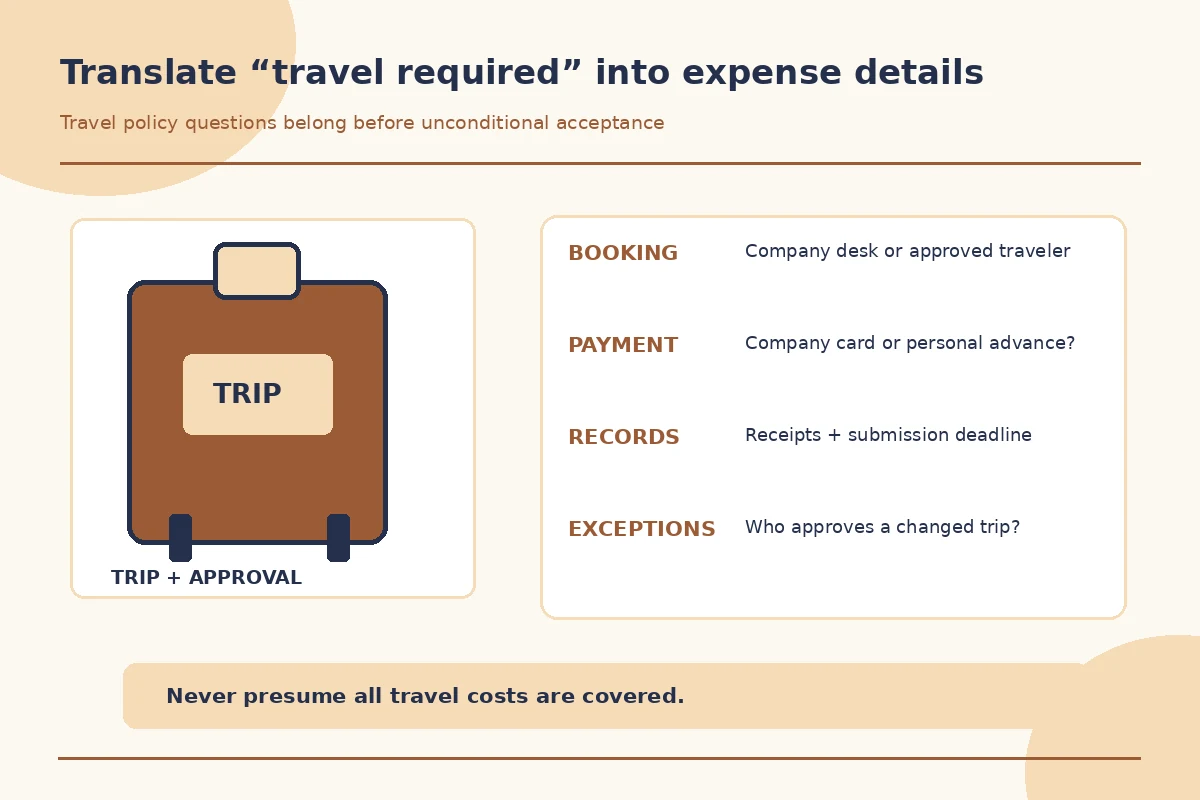
Before accepting, request the travel policy or a concise summary of the relevant sections. You need to know who approves trips, whether an internal travel desk books flights and lodging, which payment method to use, and which receipts are required. If employees initially pay expenses personally, ask how quickly approved costs are typically reimbursed and what happens if a claim is rejected. An offer with frequent travel can create a cash-flow problem even when costs are theoretically reimbursable.
The IRS distinguishes accountable and nonaccountable reimbursement arrangements and describes documentation responsibilities. That tax framework does not mean a specific employer must repay every category of expense. Ask directly whether meals, local transportation, baggage, parking, mileage, and tips are covered under your employer’s policy. Do not present any sample per diem rate as universally applicable. Never route money through an unknown recruiter or deposit a supposed equipment or travel check from an unverified source.
Check notice, cancellation, and personal-time boundaries
A travel role can be manageable when the employer provides predictable notice and backup coverage. Ask how far in advance a typical trip is assigned, whether destinations change on short notice, and who arranges coverage if an approved trip is canceled. Confirm whether evening events or client meetings are standard and what rest or schedule adjustments are expected afterward. You are asking how the team works, not demanding a guarantee that travel will never change.
A practical question is: “If a customer visit is rescheduled the night before, who handles the new booking and approval?” The answer reveals whether the employee has support. Ask whom to contact during travel delays and what to do if you cannot safely make a trip. Avoid promising immediate travel availability without knowing documents, accessibility needs, or personal commitments. If travel expectations are crucial to accepting, request written confirmation before the deadline.
| Area | What to verify | Useful question |
|---|---|---|
| Frequency | Typical trips per month | How many overnight trips did this team make in a typical recent month? |
| Destinations | Where and how long | Who books travel, and is a company card available? |
| Bookings | Approver and company payment | Which meals, mileage, lodging, and transport require approval? |
| Expenses | Receipts and repayment schedule | What records and deadlines apply to expense repayment? |
The table is a working aid, not a standardized employment form. Replace its descriptions with the particular employer’s documents, and do not assume an unknown term is favorable. If a question affects compensation, a legal obligation, required credentials, or a protected employment right, ask HR for the applicable policy and obtain qualified advice when necessary. Keep the conversation factual and avoid inventing claims about what the law guarantees.
Write an acceptance after clarifying material terms
If the travel pattern and expense process work for you, accept using the employer’s official instructions. Confirm role, start date, and any key travel clarification already documented. Do not put a lengthy expense negotiation into a cheerful acceptance note. If a reimbursement policy remains unclear, ask for it before accepting rather than assuming all costs are included. Keep the offer letter, policy attachment, and the person who supplied each important answer.
Hypothetical acceptance wording: “Thank you for the Regional Support Specialist offer. I’m pleased to accept the role beginning June 15, with travel expectations and the company booking process outlined in the attached policy.” The exact details must match your documents. An employer may attach policy language that can change; read that carefully. If the travel frequency is inconsistent between interview and offer, ask the employer to reconcile it in writing instead of choosing the version you prefer.
Illustrative clarification email: Subject: Questions Before Acceptance — Regional Support Offer. Hello Hiring Team, thank you for the Regional Support Specialist offer. I am interested in accepting and want to confirm the travel expectations described as “up to 40%.” Could you share what a typical month looks like, which locations are usually visited, and who books and pays for transportation and lodging? I would also appreciate the written expense and travel-time policies. I can respond by the offer deadline once those details are clear. Thank you. This sample is not a message sent by a real applicant and contains no verified employer promise. If you already have clear written terms, simplify it into a brief acceptance instead of unnecessarily reopening agreed points.
Prepare a first-trip records checklist
Before your start date, learn which portal records trip approvals, which receipts must be uploaded, and how missing or canceled receipts are treated. Save emergency contacts, travel support, accessibility arrangements where relevant, and any security restrictions about carrying company devices. Your first-trip checklist should focus on operational facts: approved itinerary, safe arrival, expense submission, and escalation. It should not include personal bank details in an ordinary email thread.
Keep a simple log of actual trips and expenses and compare them with what the offer described. If the pattern diverges materially, raise a concrete example with your manager rather than waiting for frustration to build. A question such as “We have had four overnight trips this month; is that the expected ongoing pattern?” is easier to answer than “This is too much travel.” Accurate records make the discussion productive.

How We Research Job Offer Decisions
JobAsk compared this intent with the WordPress title list provided for the project, read the existing production plan, and reviewed primary public guidance relevant to the specific scenario. Official publications explain some general practices and federal standards; they do not replace the employer’s own terms or professional advice for an individual dispute. The suggested questions, email wording, and diagrams are editorial examples, not verified hiring outcomes. The site’s affiliate disclosure explains editorial and commercial relationships.
Source: www.irs.gov — IRS Publication 463 explains how employer travel advances, allowances, and expense reimbursements can be handled and documented under accountable plans.
Source: www.dol.gov — The DOL explains that working time depends on circumstances and includes specific principles for travel and other time; individual situations require separate review.
Source: consumer.ftc.gov — The FTC explains how to verify recruiters and recognize requests for sensitive financial information in fake job offers.
Related Workplace Guides
Not necessarily. Ask how the employer calculates the percentage and whether busy periods differ from the usual month.
That depends on the employer’s travel policy. Confirm the booking contact, approved payment method, and reimbursement process.
No universal rule covers every item in every situation. Request the actual policy and review applicable laws if a dispute arises.
It depends on facts such as timing, duties, employment classification, and applicable rules. See DOL guidance and ask HR for the policy.
You can choose to, but do not assume favorable terms. If frequent travel is essential, ask for the policy before committing.