
Learn when a cover letter needs a posting or requisition reference, where to place it, and how to avoid confusing a job ID with your application confirmation. This guide explains what to change for this specific format, shows hypothetical examples rather than real applicant outcomes, and separates ordinary editorial advice from any employer-specific requirements. Use the latest official announcement before submitting.
Identify which number the employer actually uses
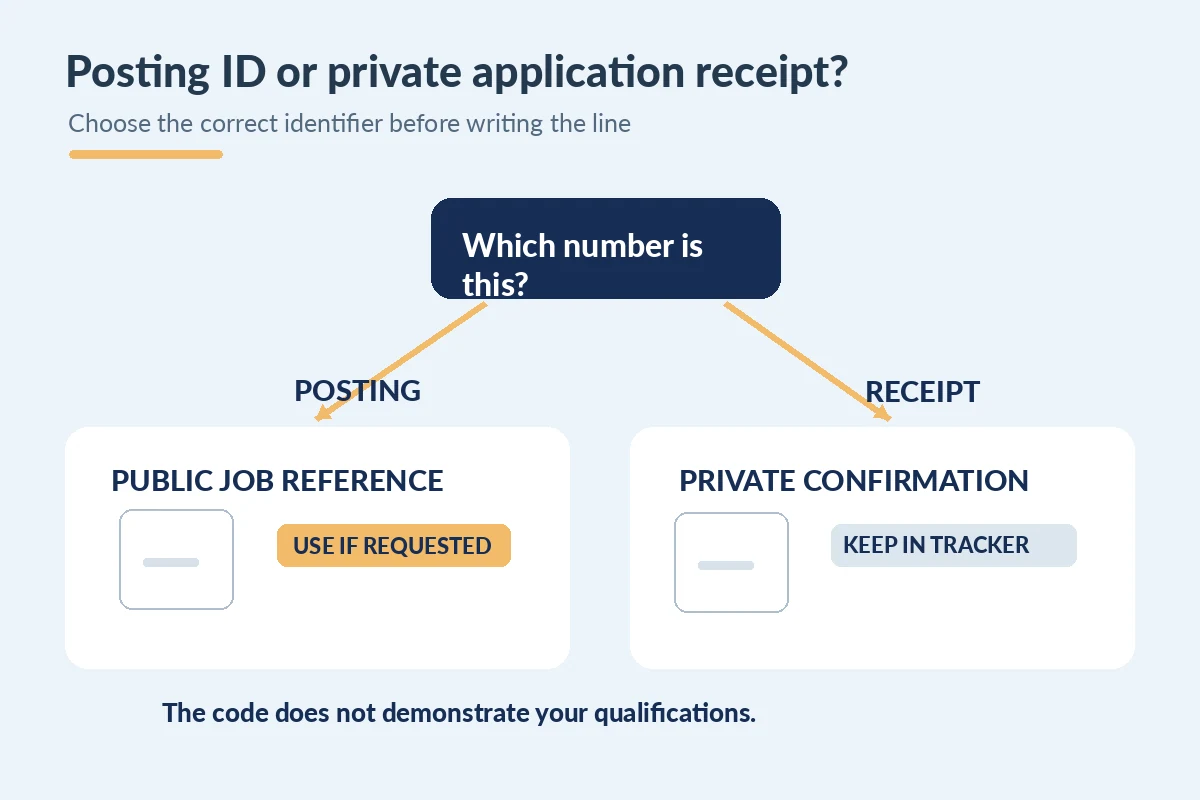
A posting can have a public job number, requisition code, vacancy ID, or reference line. These are not always interchangeable. Read the employer’s official announcement and copy the label exactly when it asks applicants to identify a specific opening. An application confirmation number, by contrast, is often generated after submission and may relate to your private account. Do not put that identifier in a cover letter addressed to an unfamiliar recruiter unless the employer explicitly asks for it. A reference line should help route the document, not reveal more application information than necessary.
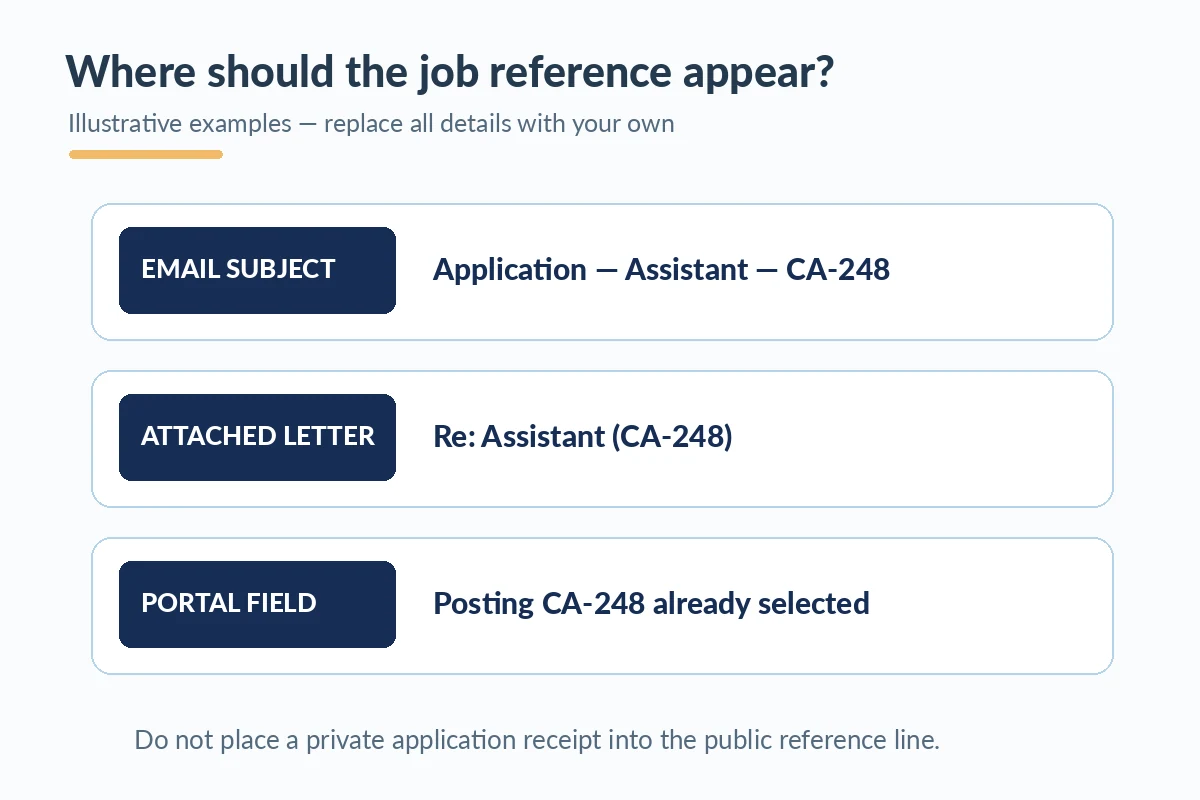
For a fictional organization listing “Communications Assistant — Requisition CA-248,” the relevant letter reference might be “Re: Communications Assistant (CA-248).” It is not necessary to use the letters “Re:” when the role is already clear. Check whether you are applying to two similar postings under the same company: each may have a different requisition number. If you cannot verify the code, use the exact role title alone instead of guessing a plausible number. The ability to omit an uncertain reference is better than making a confident formatting error.
Choose the right location for email, document, or form
For an email application, the employer may prescribe a subject line such as “Position title — vacancy number.” Use that precise format first. If no subject is specified, a concise subject with the position title, your name, and an optional verified posting ID can be useful. You usually do not need a second “Re:” line at the top of a short email body. This guide is about a reference inside a cover letter, not how to compose or track all the attachments in an application email.
For an attached business-style cover letter, the opening paragraph can identify the exact position and a reference can appear as a small line above the greeting or in the first sentence. In an online application, a separate job-number field may already be populated; avoid pasting the reference repeatedly into a limited message box. A portal may attach the message to the correct opening automatically. The employer’s instructions, not a decorative template, determine whether the additional line improves clarity. Never overwrite an application field with a number that belongs to a different posting.
Write a clean reference without inventing recipient details
Consider an illustrative document header: “Taylor Morgan | taylor@example.com”; “November 8, 2026”; “Hiring Team”; “Re: Scheduling Coordinator — Posting SC-410”; and then “Dear Hiring Team:”. These names and codes are hypothetical examples, not current jobs. The reference identifies the target opening while the greeting avoids pretending to know a manager’s name. If the announcement specifically provides a contact person, use that verified information. If it gives no person or mailing address, you can omit the blank fields rather than fabricate them for symmetry.
In the opening paragraph, say why this role fits a skill you actually used. For instance, an applicant who maintained a real volunteer sign-up calendar could explain that work while applying for a scheduling role. Keep the role ID as routing information, not proof of qualification. Avoid mixing the posting code into the body of every paragraph. A cover letter still needs a relevant example and a courteous closing; its format cannot substitute for substantive evidence. Compare your subject, header, and first sentence side by side before sending.
Correct the common ID and role mix-ups before submission
Copying an old letter can leave a correct employer name beside the wrong reference number. Before attaching a file, open the version you are actually going to submit, locate the role title and every occurrence of a posting ID, and compare them with the current announcement. A simple cross-check table has four rows: role, reference code, employer, and submission channel. The rows should all describe one application. If you are applying to separate roles at the same employer, save separately named versions and inspect each rather than altering the filename alone.
Do not confuse a referral or recommendation with a job reference line. Mentioning a person who referred you requires a real and authorized relationship; a vacancy number does not. Similarly, a confirmation receipt generated in a dashboard is not an employer’s public requisition number. If the instruction says “Quote reference in subject,” put it in the subject rather than only in your document’s header. If the job closes or is reposted under a new ID, check whether the employer wants a new application before recycling a previous identifier.
| Element or channel | Specific check |
|---|---|
| Email subject | Use employer-prescribed wording and verified posting code. |
| Attached letter | Identify role once; use a reference line if useful. |
| Portal free-text field | Skip redundant number when posting is already selected. |
| Application receipt | Keep private unless asked through the authorized channel. |
Run a final channel-specific reference check
An employer may want a single PDF, a document pasted into a form, or a brief email accompanying separate files. The same information may need different placement in each format. For a PDF, preview the header and confirm the code has not wrapped awkwardly into another line. For email, check the entire subject line before sending. For an application form, make sure the designated field carries the correct information and the free-text area remains readable. Follow official directions when they conflict with a generic sample.
Use this practical sequence: verify the source posting, identify the role, locate the requested reference, choose one appropriate location, review the actual file, and submit through the official channel. Do not create a fake job ID, claim the recruiter personally requested your letter, or disclose private application-account details in public communications. An accurate reference may reduce confusion, but it does not promise that the employer will read or advance the application. The important result is an honest, clearly labeled letter that belongs to the intended vacancy.

How We Research Cover Letter Formats
We reviewed official career guidance and document-accessibility resources for the specific presentation and channel questions in this article: CareerOneStop. CareerOneStop. USAJOBS. The examples use fictional applicants, posting codes, and organizations; they are not employer policies, application receipts, testimonials, or promises that software will accept a document. Where an employer specifies a different field, signature, length, or file format, the actual announcement controls. See our affiliate disclosure; these informational links carry no invented affiliate relationship.
More Resume and Cover Letter Guides
No. Include it when requested or when it clearly distinguishes the opening; otherwise the exact role title may be enough.
Not always. A public vacancy reference and a private application confirmation serve different purposes.
Follow the posting’s subject-line instruction. Without one, a descriptive subject can identify the role and verified code.
Use a separate, correct number for each application and avoid sending an ambiguous combined letter.
Read the current announcement and its reapplication instructions before reusing an old reference.