
When an employer asks for your availability after an interview, first clarify what the dates are for: another interview, a work sample, a proposed shift, or a possible start date. Then respond with times you can genuinely attend, the time zone, and any important limits. An availability request means the employer is gathering scheduling information; by itself, it is not an offer or confirmation that you passed the interview. If your calendar is still uncertain, say when you can confirm rather than accepting times you may have to cancel. Keep personal explanations brief and send availability through the same approved recruiting channel.
Identify what kind of availability they need
A message saying ‘Are you free next week?’ is incomplete unless you know the purpose. It might refer to a second interview, a panel meeting, an assessment, a follow-up phone call, or the tentative first days of employment. Those events have different commitments. Reply with a concise clarifying question if the message does not identify them: ‘Happy to share times. Is this for another interview or to discuss possible start dates?’ Do not assume that scheduling a conversation means the hiring decision is made.
Harvard FAS career guidance emphasizes knowing the next step in the interview process. Here, that means identifying the event and the organizer before presenting a detailed calendar. If the employer requests a test or work sample, ask for duration, format, accessibility arrangements if needed, and the submission deadline. If it asks about shift availability, describe your real recurring constraints separately from one-time interview slots. Keep these distinctions clear so the employer does not mistake a free afternoon for a permanent work schedule.

Offer a small set of real scheduling windows
For an interview, give two or three options across more than one day when possible: ‘Tuesday, November 17, 10:00 a.m.–noon ET; Wednesday, November 18, 2:00–4:00 p.m. ET; or Friday, November 20, 9:00–11:00 a.m. ET.’ Those are fictional examples; check the actual calendar and dates before using similar wording. Specify the time zone even when you believe the employer is local. If the interview duration is unknown, offer windows rather than one exact minute that may be too short.
Check travel, school, caregiving, work obligations, and time-zone conversions before sending the note. It is better to offer fewer realistic options than to claim unlimited availability you do not have. When working a current job, avoid disclosing your employer’s private scheduling records or putting yourself at risk by promising time you cannot take. You can say ‘I am unavailable during the morning shift, but I can meet after 3:00 p.m.’ without describing why.
Use a concise reply for the next interview
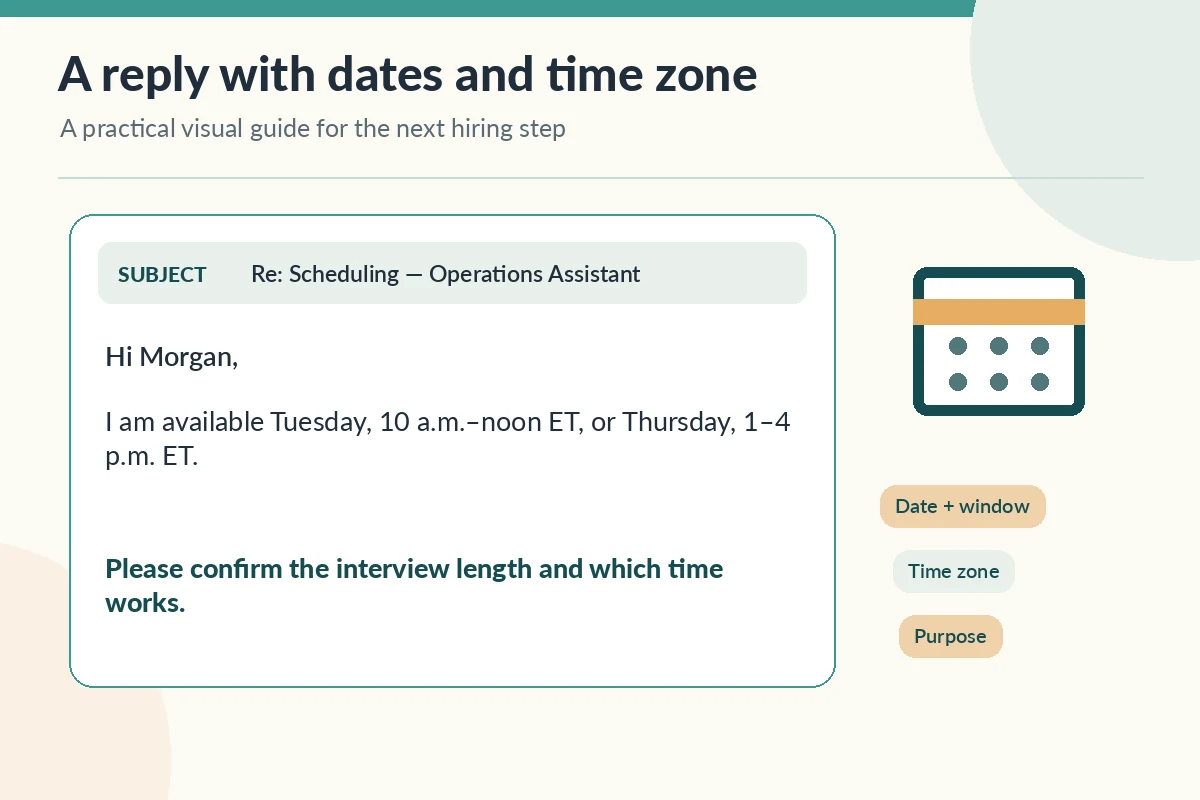
A practical illustration is: ‘Subject: Re: Scheduling — Operations Assistant. Hi Morgan, thank you for the invitation. I am available for a 45-minute video interview Tuesday between 10 a.m. and noon ET or Thursday between 1 and 4 p.m. ET. Please let me know which time works and whether there is anything I should prepare. Best, Jordan.’ This example is fictional and assumes the recruiter has already identified the interview format and approximate length.
If the organizer proposes a time outside the windows you gave, check before replying rather than immediately accepting. Ask for a calendar invite or written confirmation showing the date, local time, time zone, format, and access instructions. If the employer calls while you are away from your calendar, it is fine to say, ‘I can confirm by this afternoon.’ Confirming accurately reduces rescheduling and keeps the hiring process easier for everyone.
Do not confuse schedule questions with job terms
A question such as ‘Could you start next Monday?’ may be a preliminary availability check, but it is not sufficient to establish an offer. Confirm whether the employer is discussing a proposed start date, an interview, orientation, or a paid assignment. Until you have reviewed written offer terms, avoid resigning from an existing role or making irreversible commitments. Your response can be conditional: ‘I could discuss a start date after receiving and reviewing the formal offer and onboarding requirements.’
Shift availability also differs from interview availability. If the job requires evenings or weekends, report what you can regularly work, not what happened to be free on interview day. A tentative date is not a commitment until both sides agree to it. If the employer mentions pay, hours, location, or remote arrangements that differ from what you interviewed for, ask for clarification before confirming the timetable. This is a scheduling distinction, not legal advice about employment contracts.
Handle conflicts, late changes, and unclear invitations
When a proposed slot clashes with a fixed commitment, respond promptly with alternatives rather than ignoring the invite. ‘I cannot meet Wednesday at 11 a.m. ET, but Thursday after 2 p.m. ET or Friday morning works’ is sufficient. If the organization requests immediate confirmation for a time you cannot yet verify, state when you will know. Repeatedly moving confirmed appointments can undermine the usefulness of your reply, so check carefully before pressing send.
Use the employer’s designated scheduling system when one exists, and do not create duplicate appointments by both clicking a scheduler and emailing different times. If the scheduler shows an error or the invite lacks a time zone, ask the recruiting contact to verify the appointment in writing. If a new contact unexpectedly asks for identity documents or payment while arranging the next step, independently check the request; the FTC warns that fake recruiters may imitate genuine hiring communication.
Confirm the meeting and track the next step
After the employer selects a slot, compare the calendar invite with the message. Look at the correct calendar date, time zone, interview format, approximate duration, names or roles of participants if provided, and link or location. Ask for clarification about any mismatch, but do not send a series of unnecessary confirmations. Keep the final scheduling details in your private job-search tracker. For in-person meetings, verify the address and check travel time without inventing a location or assuming parking is provided.
Once the next interview is confirmed, prepare for that stage rather than continually asking whether you have received the job. After the meeting, follow the new interviewers’ stated timeline. If the employer never confirms a slot, one concise reminder through the original channel is more useful than multiple messages across personal accounts. If the employer says it cannot proceed, mark the schedule unresolved and continue other applications rather than treating a tentative calendar hold as a promise.

How We Research Interview Follow-Up Decisions
We checked career-center guidance and, where relevant, employer-process or consumer-protection information, then separated source-backed advice from editorial examples written for this situation. Sources reviewed: Harvard FAS; University of Washington Bothell; USC Career Center; Federal Trade Commission. All people, dates, sample roles, and correspondence shown here are illustrative rather than real hiring records. JobAsk may contain commercial links; see our affiliate disclosure. Nothing here guarantees employer contact, an interview outcome, or a job offer.
More Interview Preparation Guides
No. The employer may be arranging another interview, a test, or exploring a possible start date. Ask what the dates are for, and wait for formal written terms before treating the conversation as an offer.
Two or three realistic windows across more than one day often make scheduling easier. Use actual dates and a time zone, and leave enough room for the stated meeting length. Follow any specific booking instructions first.
Say when you can confirm, or offer only the windows you already know are available. Do not accept a conflicting appointment or disclose unnecessary personal information to justify the limit.
Yes. Describe recurring days and times you could work, rather than one-time interview openings. Ask whether the employer is discussing shift needs, orientation, or a proposed start date before making any commitment.
Ask the scheduling contact to confirm the exact date, time, and time zone in writing. Verify the corrected invitation before attending; do not rely on a guessed conversion or overlapping appointments.