
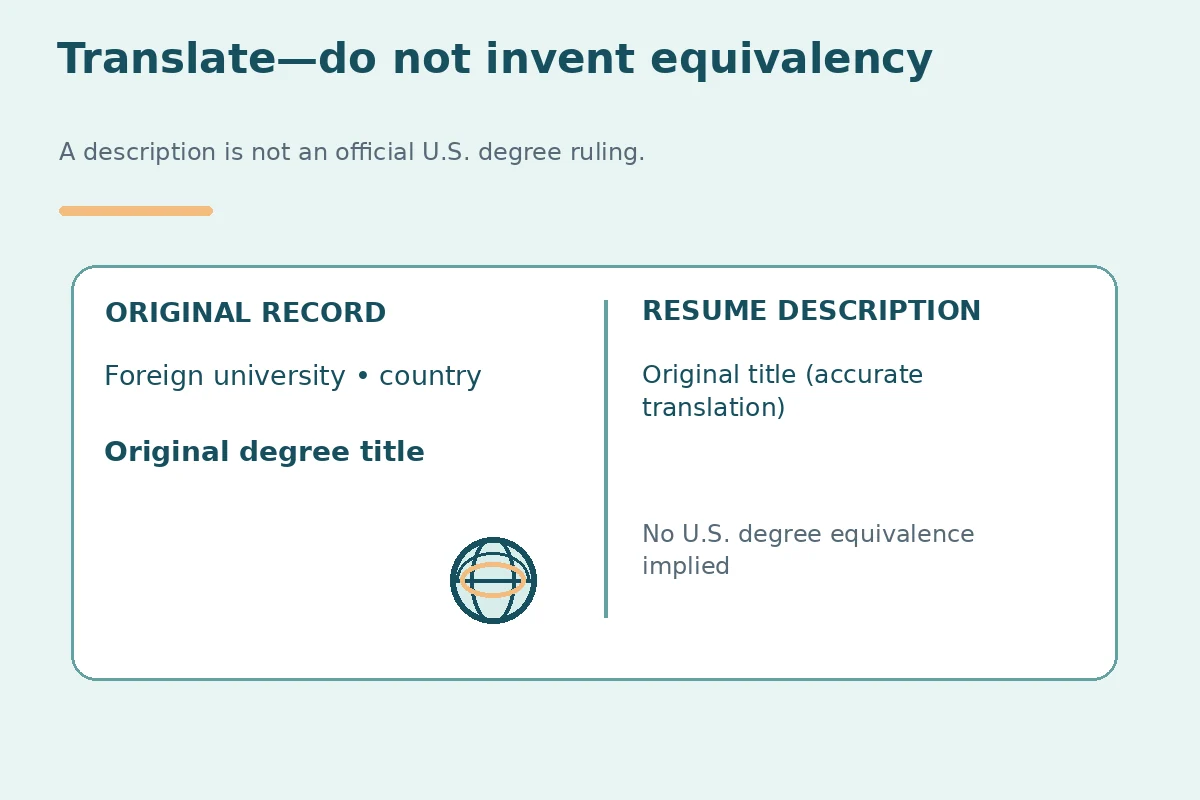
If your degree was awarded outside the United States, list the real institution, country, original credential, and an accurate English description on your U.S. resume. Do not simply convert a foreign qualification into a U.S. bachelor’s or master’s degree based on your own guess. The U.S. Department of Education explains that employers decide whether to accept education for employment and may ask for an external credential evaluation. State a U.S. equivalency only if a qualified evaluation or the receiving organization supports that statement; licensing requirements are a separate question.
Start with the official school and credential
Copy the legal awarding institution and award name from your degree certificate or transcript. Include the city and country so a U.S. reviewer can distinguish schools with similar names. If the original award uses a non-English title, you may add a careful English translation in parentheses, but preserve the original wording when a translation would be approximate. Do not invent an American-style major, credit count, or honor classification if your transcript uses a different system. The purpose is to help the employer understand what you completed, not to reconstruct an unfamiliar qualification as a domestic degree.
A hypothetical format is: “Licenciatura en Biología (biology degree) — Example University, Country | Awarded June 2023.” This is sample wording, not an equivalency ruling; actual translation depends on the jurisdiction and document. If your university has an official English title, prioritize that wording. If the document has a grading scale that differs from a U.S. 4.0 system, avoid calculating a GPA yourself. If a job application requests a GPA conversion, ask how the employer wants it reported and provide an approved evaluation if required.
Distinguish a translation from an equivalency judgment
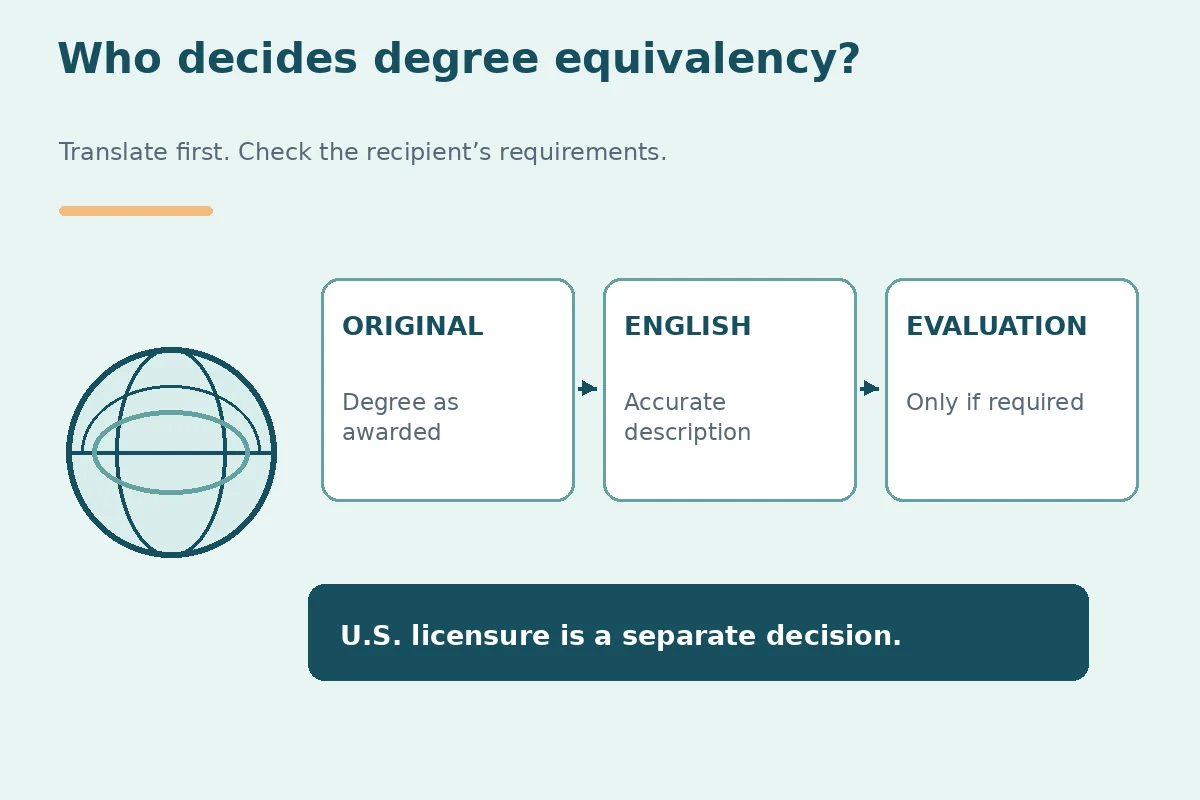
Translating the words on a diploma and deciding whether the credential equals a specific U.S. degree are separate tasks. A translation communicates what a document says; a credential evaluation compares education systems under a service’s methodology. The Department of Education does not itself evaluate foreign degrees and does not endorse a particular evaluation company. Some employers evaluate education internally. Others specify which evaluators they accept. The wrong approach is to buy an evaluation before checking application instructions and then assume that every employer or licensing body must honor its result.
Create a simple record with the original title, any authorized translation, the issuer, the date awarded, and the requirement in each application. An optional evaluation statement belongs on the resume only when accurate and useful: for example, “Credential evaluation available upon request” if you actually have one and the employer allows this phrasing. Do not claim “equivalent to a U.S. M.S.” without written support from the required evaluator or recognizing authority. If an evaluation has limits, include them when relevant rather than presenting the highest possible equivalence as a universal fact.
Find out who makes the decision for this job
For an ordinary private-sector role, start with the employer’s education requirement and HR instructions. For a regulated profession, a state board may control recognition and the license required to practice. For a federal employer, the vacancy announcement may specify evaluator membership, report type, transcript translation, or submission deadline. The NIH, for instance, publishes foreign-education requirements for its positions; those instructions are not a blanket rule for all U.S. jobs. Do not conflate being educated in a profession with being licensed to practice it in a particular state.
Before paying a private service, ask: Is an evaluation mandatory? Must it be course-by-course or document-by-document? Which organizations are acceptable? Is a translation required? When must the report be submitted? Do not send sensitive academic records to a site that is merely advertising “guaranteed approval.” Verify the recipient and any named evaluator through its official pages. Credential evaluations can take time and may cost money, so early instruction checks can prevent buying a report that does not satisfy the actual employer.
Show related experience without claiming a new degree
A foreign award can be supplemented by clearly separated U.S. or international work experience, a documented certificate, and job-relevant projects. For example, a candidate with a biology degree earned overseas might list laboratory documentation or research coursework in Education and describe a later permitted data-quality project in Projects. Neither entry should claim eligibility for a U.S. license. Describe exactly what you measured, reviewed, or submitted and whether the work was conducted under supervision. Avoid implying that an employer’s recognition of a degree gives automatic work authorization or a professional license.
If an applicant finished study at several universities, name the institution that actually granted the credential. Transferred credits can appear in a transcript review when needed, but should not turn into multiple degrees on the resume. For a resume targeting general business roles, a concise education entry may be enough. For a role with specific technical prerequisites, explain relevant courses and retain supporting transcripts. The appropriate level of detail is dictated by job relevance and verification demands—not by a perceived need to make an unfamiliar qualification sound larger.
| Check | What to verify |
|---|---|
| Original credential | Record the issuer and award title |
| Translation | Explain wording without upgrading level |
| Equivalency | State only when accepted or verified |
| Licensure | Check the relevant state board separately |
Prepare a document trail for verification
Before applying, collect readable copies of the official award and transcript, verify the spelling of names and dates, and review translation requirements. If the evaluator needs documents sent directly from the institution, follow its procedure; do not modify scans or recreate a transcript. Keep a record of employer instructions and which document was provided for each application. If your institution was renamed or merged, retain proof linking the old and current names. Avoid distributing passport numbers, birth dates, student IDs, or sealed records in a public online portfolio.
On the final PDF, show the institution, country, award, and date with consistent spacing and visible labels. Read the document as a reviewer who does not know the educational system: can they tell that the credential was actually conferred, where, and by whom? Where an evaluation is required, the application must still include the documents requested by that employer. A resume is an honest summary, not a substitute for verification. When uncertain about equivalence, keep the original award label and contact the decision-making authority before making the claim.

How We Research Resume Education Guidance
We compared U.S. career-center guidance on resume education and professional or government requirements relevant to this specific topic. Sources reviewed: Cos; Ed; NIH; American. Examples and institutions identified as illustrative are fictional; no candidate, school, employer decision, or hiring outcome is asserted. Always verify actual records and role-specific conditions before submitting an application. Review our affiliate disclosure. This article does not claim a paid referral or partnership.
More Resume and Cover Letter Guides
No. Employers set their own hiring requirements; some evaluate credentials themselves and others request reports.
No. It describes the recognition process but does not provide individual degree evaluations.
Do not assert U.S. equivalence without support from the recognizing body or accepted evaluation.
No. Licensed professions may require a separate state-board process.
Not by guesswork. Ask the employer for its required conversion or evaluation method.