
Academic job boards work best when you search by appointment type before searching by discipline. Faculty jobs, postdoctoral appointments, research staff positions, and campus administration can share a university name but use different hiring portals, selection criteria, and document requests. Use a broad academic board to find possibilities, then confirm the official posting and deadline with the institution. Avoid treating a listing’s headline as enough evidence of tenure track, funding, sponsorship, teaching load, or eligibility.
Sort your search by appointment, not by institution prestige
First label the role you actually want: tenure-track faculty, teaching-focused faculty, visiting lecturer, postdoctoral research, research professional, or administrative staff. These labels are not interchangeable. A faculty search may expect a research statement and teaching materials, while a staff role may center on service delivery and defined operational duties. Postdoctoral positions can differ in duration, supervision, funding source, and application route. A single term such as “professor jobs” will not reliably surface an appropriate mix.
Use a three-field search record: discipline or function, appointment type, and location or work arrangement. For example, “history lecturer full-time,” “computational biology postdoc,” and “student affairs coordinator” represent distinct recruitment pathways. Do not assume a board’s filters match the institution’s categories. The Inside Higher Ed Careers board separately lists faculty and administrative jobs, making the distinction clear, but each employer’s notice controls the actual position.
Start with discovery sites and finish on an institutional page
University career centers such as MIT and Cornell point researchers toward higher-education boards including HigherEdJobs, HERC, Chronicle Jobs, and discipline-specific sources. The list is a starting point, not a ranking or guarantee that all sites carry the same vacancies. Pick one broad platform, one field-specific source when applicable, and the official vacancy pages of your target institutions. This reduces duplicate alerts and allows you to see unique appointment language at the source.
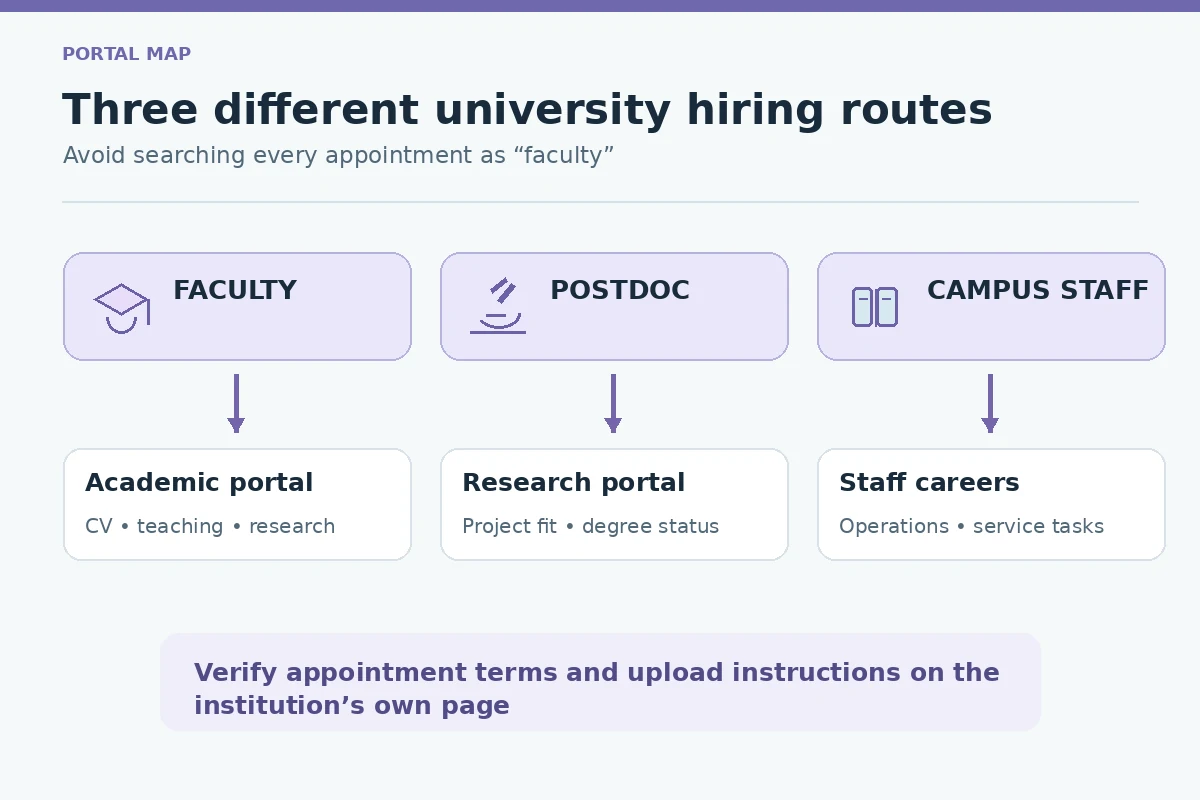
Do not confuse a university’s academic appointments portal with its staff careers site. Yale, for example, presents an academic positions page for faculty, postdocs, and scholars and directs readers looking for librarian, athletics, and other staff work to a different careers route. That is a useful model for interpreting university site navigation, not a promise that every institution divides hiring in the same way. Follow each employer’s current instructions rather than guessing based on another university’s system.
Inspect appointment status before collecting documents
An advertisement may state tenure track, fixed term, visiting, adjunct, continuing, grant-funded, or academic-year. The practical questions are who employs you, expected duties, start date, renewal conditions, and whether the schedule includes teaching, research, service, or all three. If an advert does not state a condition, mark it as unconfirmed and ask through the listed contact. Do not interpret a one-year term as renewable, an assistant professor title as tenure track, or a postdoc as independent employment without reading the notice.
For postdoctoral candidates, examine the project description, principal investigator or supervisor, required methods, and degree-completion timing. For faculty candidates, consider teaching responsibilities, research expectations, and whether the call seeks a particular area of expertise. For campus staff, compare the day-to-day administrative or technical tasks and the minimum qualifications. This pre-application classification prevents a long application package from being built for a fundamentally unsuitable role.
Check deadlines, time zones, and letter workflows
Academic applications may ask for multiple documents and confidential references. The institution can set different deadlines for initial consideration and final acceptance of applications. Record the precise date, time zone if provided, and whether the online portal permits updates after submission. Prepare a document map rather than assuming every posting requests the same standard package: CV, cover letter, research statement, teaching statement, writing sample, portfolio, references, or completed degree proof.
When confidential letters are requested, use the employer’s approved reference workflow and allow the referees adequate notice; do not upload a letter purporting to be confidential when you authored it yourself. If a portfolio includes student work, unpublished findings, or third-party data, seek permission or remove sensitive material. A role requiring a completed degree by a specified date should receive a truthful credential status rather than an optimistic or invented award date.

Test your fit using three concrete forms of evidence
Instead of deciding by institutional reputation, compare required methods, demonstrated work, and work you can reasonably explain. A hypothetical researcher might connect a validated data-cleaning pipeline to a job calling for reproducible analysis, while acknowledging that they have not led an independent laboratory. A hypothetical lecturer might describe syllabi they contributed to and sections they actually taught, not claim responsibility for courses managed by a supervising faculty member.
Create three evidence rows: direct proof, adjacent or transferable proof, and missing experience. Direct proof can be a publication, well-described project, student-support program, or documented service activity. Adjacent proof might be a teaching assistantship relevant to a campus learning specialist role. Missing experience is not fatal in every search but must not be concealed. The goal is to use a board to find credible matches and spend application effort on positions with a defensible story.
Detect confusing notices and questionable recruiters
Check that the position appears on an institution-controlled page or is connected from it to an approved recruitment portal. Compare the department name, job requisition identifier, contact address, and deadline across versions. Some valid institutions use third-party platforms; the important point is to reach those platforms through a trusted institution route. An academic-looking email domain, conference contact, or copied faculty profile is not sufficient proof of an authorized recruiter.
The FTC warns about employment scams that impersonate real organizations and seek funds or personal information. Do not pay to obtain a purported faculty interview, submit banking data to a stranger, or purchase equipment before verifying the position and offer. If the posting has disappeared, ask the department or human resources team using a contact route from the university site rather than relying on a link in a forwarding email.

Use a disciplined weekly review and application log
Set separate alerts for faculty, postdoctoral, and staff searches if you are considering more than one category. For each opportunity log appointment type, discipline, department, funding or term when stated, documents, referees, official URL, deadline, and current status. Save the advertisement locally for accurate tailoring. Avoid counting reposts as new opportunities or applying through a third-party board and institutional portal unless the instruction explicitly calls for both.
Allocate application preparation time based on the real requirements. A faculty package may need more preparation and reference coordination than an administrative support application; a postdoc may require a focused research fit explanation. Submit through the indicated system and keep the confirmation. After applying, follow the stated contact policy rather than expecting a response on a schedule invented by a job board.
How We Research Academic Job Listings
We checked university career-center guidance and live institutional listing structure, distinguishing searchable platforms from the employer’s own application requirements. MIT academic job-site guidance, Cornell academic-search resources, and Yale academic position listings support the distinctions described here. Job terms and vacancies change; verify each one directly before acting. We have no paid placement arrangement for these links. Read our affiliate disclosure.
Related Job Search Guides
No. Depending on the site, they can include faculty, postdoctoral, research, administrative, and leadership roles. Check the appointment type and actual employer listing before applying.
Not necessarily. Appointment classification, duration, eligibility, responsibilities, and benefits can differ. Rely on the specific university or research employer description.
Some institutions run separate systems for faculty and other academic appointments versus staff roles. Yale provides an example; look for the employer’s staff-careers page.
No. Research, teaching, reference, writing, and portfolio requirements vary by institution, discipline, and appointment. Make a document checklist from the current official posting.
Check the institution’s current recruitment page and ask the official contact about any discrepancy. Save the dated notice and do not assume a third-party listing is authoritative.