
For library jobs, start with a professional library listing site, then check the employer’s own hiring page. Use different search routes for public, school, and academic libraries: a single keyword such as “librarian” can miss circulation, page, technical services, and library assistant work. ALA JobLIST covers professional and support positions, but some local openings appear primarily on municipal or school district sites. Treat a job board as a discovery tool, not proof that an opening is current or that you meet its qualifications.
Choose the library setting before choosing a website
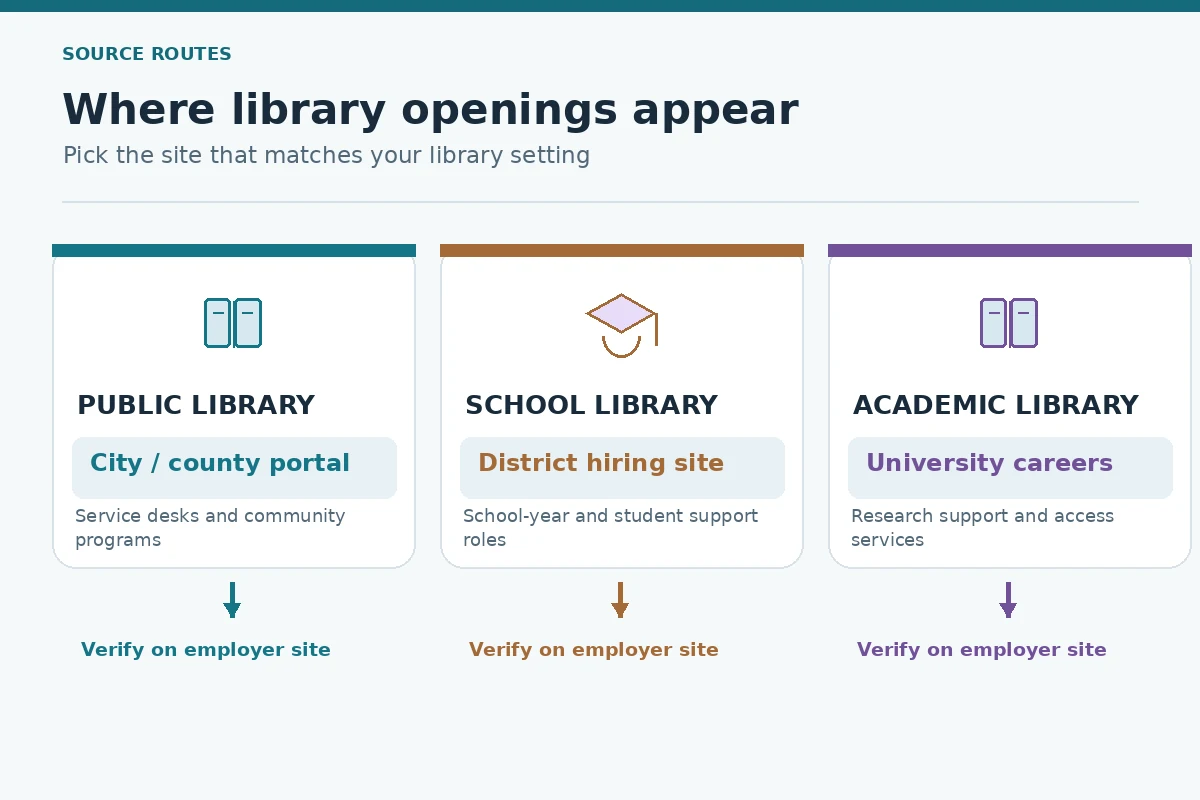
Public libraries, school libraries, and academic libraries hire for different kinds of work. Public systems may advertise circulation, programming, shelving, outreach, and technology support. A school district may use education-oriented titles and hiring portals. A university may separate librarian appointments from student employees and hourly service-desk staff. Decide which environment matches your training and desired schedule before opening a broad job search page; otherwise irrelevant results will drown out useful openings.
A practical first search pairs a setting with a task rather than a prestige title: “public library circulation assistant,” “school library aide,” or “university library access services.” If you do not hold a credential requested for a librarian role, include assistant or technician alternatives rather than implying that a support position is the same job. ALA guidance notes that library workers include support staff as well as librarians, and requirements depend on the specific position and employer.
Build a three-source search instead of a longer bookmark list
Use the American Library Association’s library job resources and JobLIST for cross-region discovery. Add the official city, county, library-system, school-district, or university careers website for employers you can actually reach. Finally, include a state library association or state-level listing when it serves your target area. The job-search process becomes stronger through complementary sources, not through ten overlapping aggregators publishing the same notice.
For example, a hypothetical candidate interested in public service could save a broad ALA search, a city civil-service portal, and a county library hiring page. A candidate interested in a school library should instead prioritize district hiring pages: the American Association of School Librarians explicitly directs applicants to district and state education posting channels. Record the real employer and direct application destination for each opening so you do not accidentally submit twice through two mirrors.
Separate credentialed librarian roles from support jobs
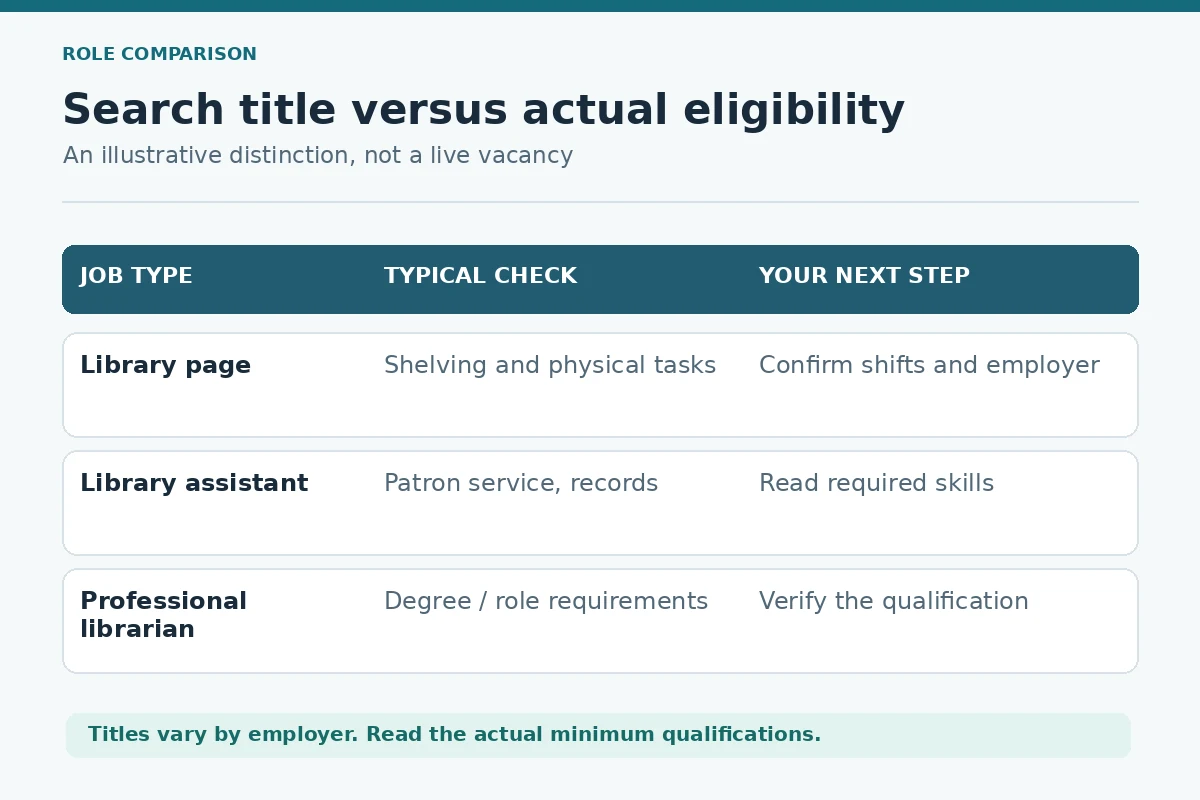
Do not use the label “librarian” as a shortcut for determining eligibility. Many professional positions request an accredited graduate library degree, but not every library job requires the same qualification. The Public Library Association describes graduate library education as common for public librarian positions, while the ALA’s job-search guidance also describes page, library assistant, and support roles. Use the job’s actual minimum qualification section, not a generic site filter, to decide whether it is a realistic application.
Look for explicit duties and credential language. “Cataloging” might require a particular system or professional judgment at one organization and supervised data cleanup at another. “Youth services” might describe program planning by a librarian or shelving and event setup by an assistant. Record requirements in two columns: required now and helpful after hire. Do not present an in-progress degree, software exposure, or volunteer time as a completed degree or professional appointment.
Check who employs you and where you will work
Library postings sometimes name a public agency, an educational institution, a consortium, or a staffing contractor. Verify the legal employer, worksite, travel expectations, and who supervises the position. A college library position may be campus-based even if the job board’s geographic filter includes a wider region. Public libraries may require evening or weekend coverage. School roles may follow a school-year schedule rather than a calendar-year schedule. Read the full listing rather than inferring these details from the title.
A useful comparison row includes organization, department, location, status, schedule, credential, duties, deadline, and official application URL. If information is missing, mark it “not stated” instead of assuming regular hours, remote eligibility, or benefits. A candidate considering two circulation jobs can then compare recurring shift coverage and customer interaction instead of treating the similar titles as identical.
Translate an advert into evidence you really possess
For a circulation or access-services role, gather honest examples involving accurate records, customer questions, shelving logic, appointment handling, or accessible communication. A student project involving a database does not make you a certified cataloger, but it may demonstrate careful data entry. For a school aide opening, show the particular classroom, reading-program, or youth-facing support you performed without making unsupported claims about independent teaching or student records access.
A hypothetical resume bullet could read: “Maintained a volunteer program sign-in sheet and flagged inconsistent entries for staff review.” This signals accuracy without claiming that the applicant managed a library circulation database. If you have no direct experience, reference assignments, community events, inventory tasks, and verified coursework. Keep patrons’ identities, school records, and other confidential materials out of public work samples.
Screen every listing for freshness and legitimacy
From the board, navigate independently to the employer’s website and look for the position or a hiring contact. Compare title, work location, reference number, application instructions, and closing date. If a posting is archived, closed, or not shown on the employer’s page, do not assume the board can still accept a valid application. Sometimes institutions use external application platforms; verify that the employer points to the platform before entering your information.
Be cautious when an unsolicited contact asks you to pay for a background check, send identification through chat, or buy equipment to qualify for a role. The FTC advises verifying openings with the actual organization and not paying for a job. A legitimate hiring process can include later identity or credential checks, but you should confirm who is collecting information and through which official process rather than following an unfamiliar email link.

Keep a small, useful weekly application routine
Review three sources on a schedule: professional library listings early in the week, direct local employer pages after that, and a final check of district or campus listings before any application deadline. Maintain one record per real position, not per site where it appeared. Record the date you verified the opening and when you actually applied; save the job description because employers sometimes remove it after closing.
Before submitting, confirm all required materials. Some positions request a standard resume; others request an application form, written answers, transcripts, or proof of credentials. Follow the particular employer’s instructions. If the role is no longer listed, use the official contact route to ask whether applications remain open, but do not email sensitive documents to an address you have not verified.
How We Research These Library Job Sources
We checked the American Library Association’s library employment resources, school-librarian posting guidance, and public-library career FAQ, along with FTC guidance on misleading postings. The sources explain where distinct types of library work tend to be advertised; they do not guarantee that any specific job is currently available. ALA library job search, AASL school-library postings, and PLA public-library FAQ supply the background. This article is informational, not a placement service. See our affiliate disclosure.
Related Job Search Guides
No. ALA is a useful discovery resource, but school districts, municipal systems, and universities can advertise on their own career portals. Use direct employer listings alongside the professional board.
Some library support, page, circulation, and assistant positions may have different minimum qualifications from professional librarian jobs. Read the exact employer criteria and never present an unfinished degree as completed.
Start with the district or state education hiring channel, then compare relevant ALA or state association listings. School library requirements and titles vary by employer.
Find the vacancy on an official employer page or use a trusted published hiring contact. Compare job reference, closing date, duties, and application route; do not submit private data to an unverified source.
Use accurate examples from volunteer sign-ins, classroom projects, shelving, event setup, customer interaction, or records work. State your actual responsibilities, supervision, and limits.