
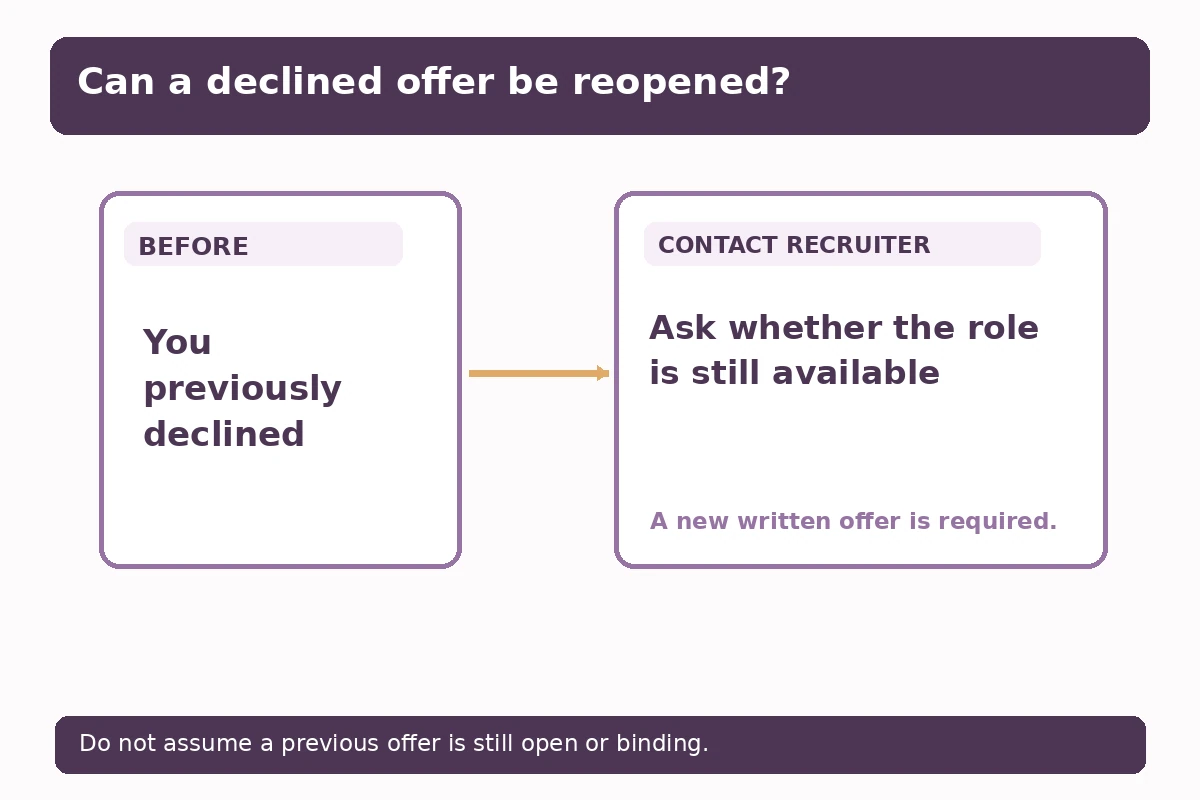
If you declined a job offer and now want to accept it, you cannot simply reply ‘I accept’ to the old letter and assume the job is yours. The employer may have closed the requisition, selected another candidate or withdrawn the offer. Send one concise message acknowledging your earlier decision, asking whether the role is still available, and expressing renewed interest. Wait for an explicit answer and, if the employer agrees, request a new or reaffirmed written offer with current terms before accepting. There is no guaranteed right to reverse a rejection, and a courteous inquiry may receive no response.
Identify exactly what you previously declined
Open the earlier email thread and confirm whether you declined a written job offer, withdrew from an interview, or merely said the timing was difficult. Those are different histories. If you sent an unambiguous rejection, assume it was received unless the employer says otherwise; do not reinterpret it as a negotiating tactic. Write down the date, employer, role and reason you gave in general terms. The UW–Madison career guidance stresses clear and timely declines because employers need to move forward. After a rejection, they may already have done so. Your goal is to ask whether there is still a possibility, not to invalidate the earlier message by implication.
Consider whether your reasons have truly changed
Before contacting the hiring team, review the problem that caused you to decline: schedule, location, responsibilities, written terms or another commitment. If that obstacle is still there, asking for the offer back may create another avoidable reversal. Separate negotiable preferences from terms that would make the job unworkable. If you previously accepted a different job, consider that commitment carefully and avoid implying that you can cancel obligations without consequences. Career centers such as the University of Michigan advise treating job acceptance as a sincere professional commitment. You should reach out only if you now genuinely intend to take the role under acceptable terms, not simply to hold another option.
Contact the original recruiter through a verified channel
Reply within the original email thread when appropriate, or use the recruiting address from the company’s official careers site. If the recruiter has changed jobs, ask HR for the correct contact without sending personal records. Do not approach unrelated staff through social media with a demand to ‘restore’ an offer. If you find the job still advertised, that is not proof that the old offer remains available; postings can stay open for many reasons. Make a single clear inquiry and let the organization decide whether reconsideration fits its hiring process. If someone replies with a suspicious link or requests a fee to reissue your offer, independently verify the sender before acting.
Use a short request rather than a premature acceptance
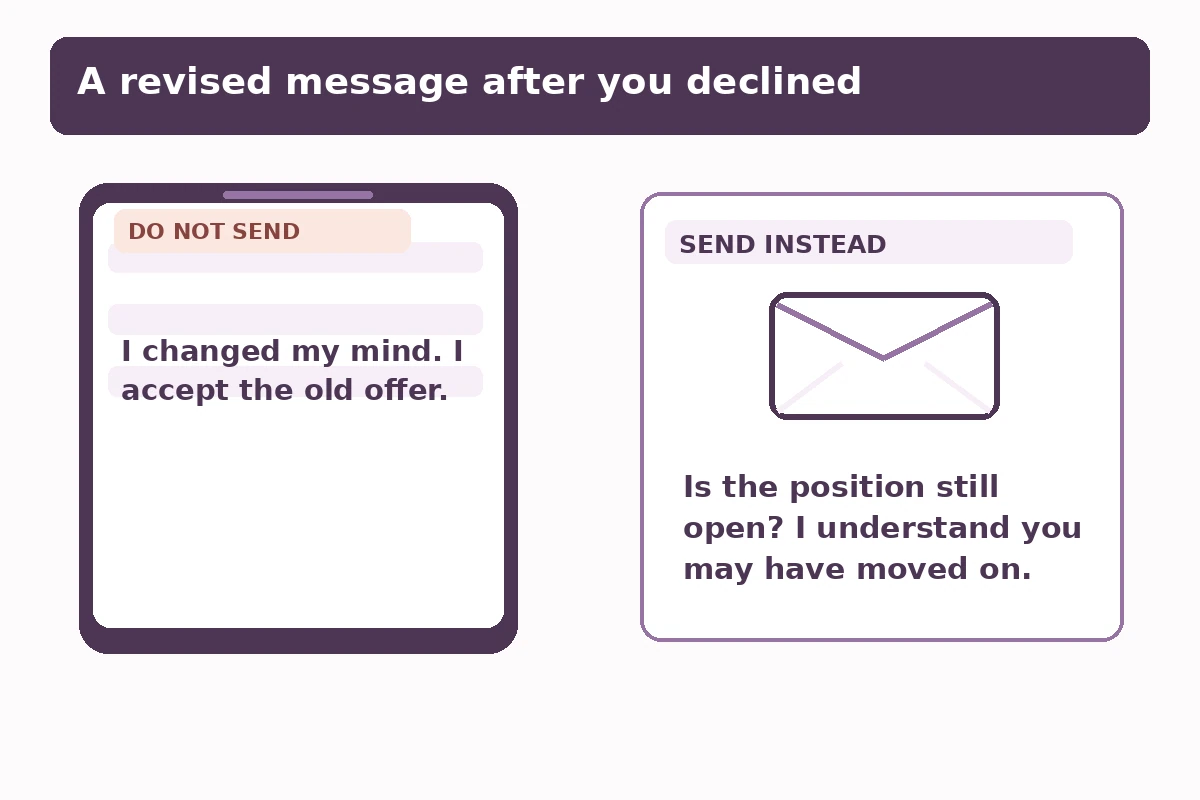
A hypothetical note could read: ‘Thank you again for offering me the Operations Associate position. I understand that I declined the offer on [date], and I appreciate that you may have moved forward with other candidates. My circumstances have changed and I would be genuinely interested if the role remains available. Would you be able to let me know whether reconsideration is possible?’ This is a request for information, not an acceptance. Avoid blaming the recruiter for having progressed with other candidates. You do not need to disclose intimate details or criticize the offer you initially chose. Replace every bracketed detail with truthful information before sending.
Explain the change without sounding unreliable
If the recruiter asks what changed, use a brief factual explanation that relates to your readiness for the role. For example, a scheduling conflict may have been resolved or you may now understand a work arrangement that was unclear earlier. Do not invent a family emergency to create sympathy or say you are desperate because another job fell through. Explain only what you are comfortable sharing. A good answer focuses on your present commitment: the location, hours and responsibilities now match your needs, and you have reconsidered carefully. The employer may still choose not to reopen the discussion, and your explanation does not create an obligation to negotiate.
| Stage or party | Evidence or responsibility | Your next action |
|---|---|---|
| Old declined offer | Not a current acceptance route | Ask whether role is still open |
| Recruiter reconsidering | No commitment yet | Wait for HR decision |
| Updated written offer | Current terms can be reviewed | Accept only after verifying |
Treat silence or a no as a decision
A hiring team may not respond to a request to reopen an offer. If there was no stated timeline, a single short follow-up after a reasonable business interval can be appropriate. Do not send daily reminders, repeatedly call a personal number or involve another manager to pressure the recruiter. If the answer is no, thank them for considering your inquiry and move on. Avoid sending old signed offer paperwork, because a prior letter is not necessarily a current invitation to accept. You can continue searching for other roles while the answer is unresolved. The most professional outcome may be a clean no rather than a prolonged ambiguous exchange.
If the employer is willing, verify terms from scratch
Even if the employer says the position is open, ask them to confirm that the original title, pay, location, supervisor, hours and expected start date still apply. The department’s needs or compensation approval may have changed. Request a new offer or written reaffirmation with a fresh response deadline. Case Western Reserve’s offer guidance emphasizes keeping updated offer terms in writing. Do not accept merely by referring to a superseded PDF without verifying that HR has authorized it. If the new offer contains conditions, read those individually. Treat the new agreement as a fresh decision, not an automatic reactivation of the old one.
Accept a reopened offer with a concrete message
If HR confirms a valid new written offer and you decide to accept, state the exact role and agreed terms. Example: ‘Thank you for confirming that the Client Support Specialist offer is available again. I accept the updated written offer dated [date], with the start date and location listed there. Please let me know the next onboarding steps.’ Do not use this message until the revised terms have actually been issued. If the organization requires a portal response or signed letter, complete that action too. Keep both the employer’s written confirmation and your acceptance in a private folder, rather than relying on a phone conversation remembered differently by each person.

Protect the relationship if the answer stays uncertain
It can be disappointing to learn that the vacancy has been filled. A short closing email can preserve professionalism: ‘Thank you for checking. I understand and appreciate your time.’ Do not ask the employer to remove a candidate who accepted after your original decline. You can ask whether future vacancies should be pursued through the normal application channel, but do not assume a promise of priority. If you later reapply to the same organization, be prepared to describe your interest honestly and briefly. One courteous inquiry is more likely to leave a positive impression than an escalating campaign to reverse a decision the employer was entitled to act on.
Use the three-state check before any new yes
Write a simple status note: ‘Declined — no new offer,’ ‘Employer reconsidering — pending,’ or ‘New written offer received — review terms.’ Only the third state gives you a current document to consider accepting. The fact that a recruiter replied warmly or said they would ‘check internally’ is not the same as an authorized job offer. Confirm who may approve the position and what deadline now applies. Be especially careful if another purported recruiter contacts you with a surprise acceptance link; verify identity independently. This three-state discipline lets you communicate with confidence without accidentally treating interest as a formal agreement.
How We Research Job Offer Acceptance
JobAsk reviewed these sources on November 16, 2026: UW–Madison recommends prompt, respectful and unambiguous offer-decline communication. University of Michigan advises evaluating offers before committing and treating acceptance as a genuine intention. Case Western Reserve recommends writing and documenting accepted job offer terms. FTC recommends verifying purported employer contacts rather than trusting an unsolicited job message. We checked the distinct user question against the supplied WordPress post inventory and searched for competing information. Public search cannot verify that a private WordPress slug is unused. Examples are hypothetical, not legal advice; organizational policies, local requirements and individual contract terms control. We do not invent employer terms, approvals, guaranteed outcomes or payments. See our affiliate disclosure.
Related Workplace Guides
Do not assume that. A declined offer may no longer be available; legal outcomes depend on facts and jurisdiction, so seek qualified advice for a dispute.
Give a brief honest explanation if useful. You generally do not need to disclose unrelated private circumstances.
No. It may be active for other reasons. Ask the authorized hiring contact whether a new offer is possible.
Do not rely on an expired or declined letter. Request current written terms and the employer’s confirmation first.
A single polite follow-up may be reasonable. Without a new offer, continue your job search and avoid repeated pressure.