
Accept a commission-based sales job only after you can explain what pay is guaranteed, what event earns a commission, when the money is paid, and how the quota is set. A headline on-target earnings figure is not the same as a promise that you will earn it. Request the current compensation plan, check it against the offer letter, and put material answers in writing before accepting. This guide focuses on interpreting the offer, not negotiating a salary or predicting your future sales results.
Identify which part of the pay is guaranteed
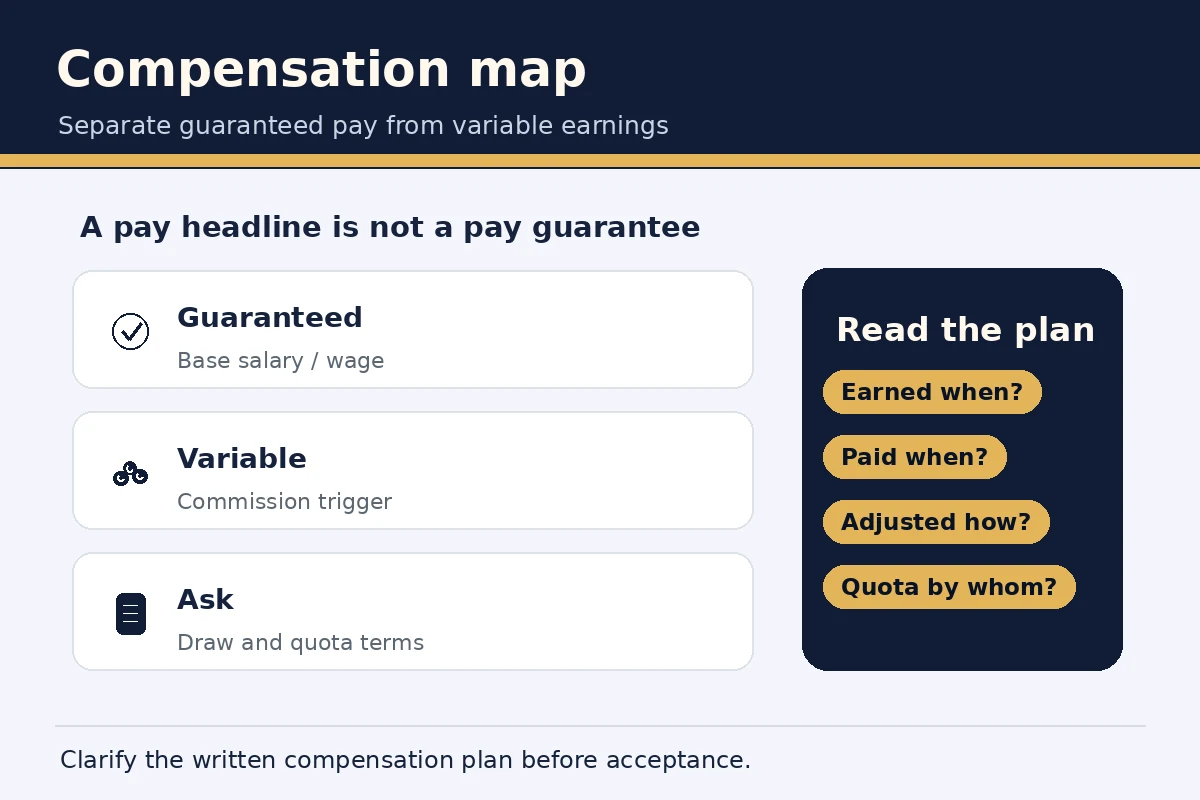
Begin by writing the guaranteed base salary or hourly pay on a separate line from commissions, bonuses, and estimated on-target earnings. A recruiter might quote annual earnings based on reaching a quota; that projection depends on results that have not occurred. Note the pay period, eligibility date, and whether a training-period guarantee ends. If the offer mentions a draw, ask whether it is recoverable, how a shortfall is treated, and when the arrangement changes. Do not assume a draw means permanent base pay.
The Department of Labor describes commissions as compensation commonly tied to the completion of sales tasks and notes that the federal FLSA does not itself require employers to offer commissions. Compensation and overtime rules depend on actual duties and applicable law, not the sales title alone. You are not required to interpret every exception yourself: request the employer’s written explanation of classification and how payroll will handle the plan.
Read the entire commission event chain
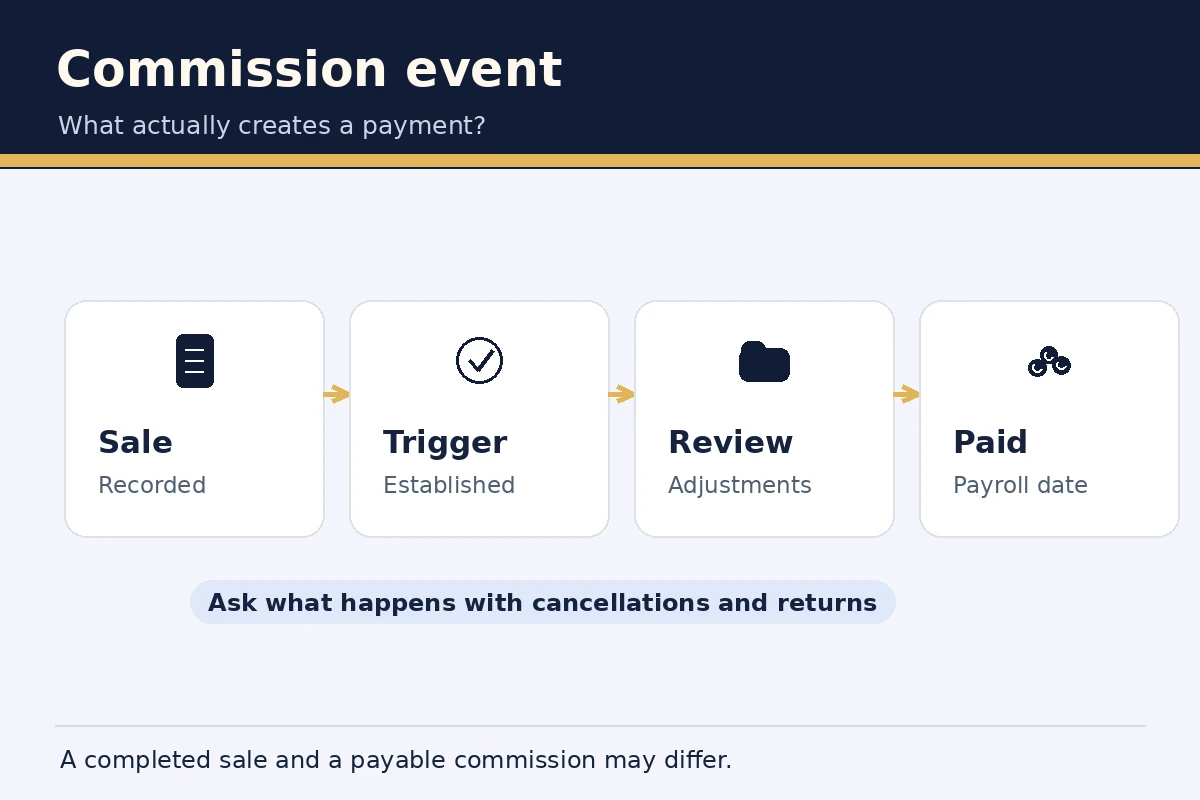
A deal is not always a paid commission. Find the contractual trigger: is compensation earned at signed order, customer payment, delivery, renewal, or some later milestone? Then check the statement date and payroll date. Ask whether returns, nonpayment, account reassignment, or cancellations change previously calculated commissions. The answer should come from a current document, not a promise that finance will explain it after you join.
Make a simple event chain from your actual plan: sale recorded → eligible amount confirmed → adjustments applied → commission statement issued → payment sent. If one link is missing, ask for that link in writing. This also helps you distinguish a legitimate administrative delay from an unresolved disagreement about what counts as a qualifying sale. Keep the written plan you were given, with its effective date.
Test the quota and territory assumptions
Ask whether quota is monthly, quarterly, or annual; when it begins; and whether an initial ramp changes the target. Confirm your assigned market, account pool, product portfolio, and territory rules. If leads are shared, clarify who receives credit for a sale involving multiple employees. You can ask how quotas are established without insisting the employer disclose confidential account details. If the position starts with an unassigned territory, identify who decides the assignment and when.
Treat published performance claims carefully. An example earnings chart may be an illustration rather than a guarantee, and aggregate team results do not prove how a new hire will perform. Ask for a plain-language demonstration of a hypothetical sale under the actual commission schedule. Mark all numbers in your own example as illustrative and verify them against the written plan rather than relying on a recruiter’s arithmetic.
Use one clear acceptance decision table
Make three columns labeled Confirmed, Needs answer, and Decision. Put base pay, target, commission trigger, reversals, territory, training ramp, and termination-related commission treatment into the table. You do not have to demand that every possible future scenario be described. You do need clarity on the items that change your expected compensation or practical ability to perform the job. For any question you cannot resolve, ask the compensation or human-resources contact named on the offer.
If the current offer letter and plan disagree, ask for a corrected version rather than accepting one document and hoping the other controls. If an employer declines to provide any written commission calculation rules, that is a material information gap for your decision. You can request time to review the plan by the stated deadline. Do not represent a preliminary discussion as a finalized offer.
Send a professional acceptance or clarification email
Illustrative clarification email: “Thank you for offering me the Account Representative position. Before I confirm, could you share the current commission plan and clarify whether the training draw is recoverable, when commissions become payable, and which quota applies to my first quarter? I would appreciate the opportunity to review the final written terms before the response deadline.” This message does not imply that the candidate has accepted.
Illustrative acceptance after clarification: “Thank you for sending the revised offer and compensation plan dated [date]. I am pleased to accept the Account Representative position with a start date of [date], subject to the conditions stated in the final documents. I will complete the onboarding steps through your official HR channel.” Replace every bracket with verified information. Never paste a speculative compensation number into an actual acceptance.
Handle classification and wage questions carefully
A commission plan is not a substitute for an accurate description of the job. Ask if the role is an employee position, which payroll system applies, and which approved policies explain hours, expense reimbursement, and required travel. The Department of Labor notes that regular-rate and overtime questions can depend on the real pay arrangement and applicable exemptions. Avoid categorical statements such as “all commissioned salespeople are exempt” or “all sales roles get the same overtime rule.”
If the employer asks you to pay an onboarding or training fee to secure the job, stop and independently verify the offer. The FTC warns that fraudulent recruiters seek money and sensitive information under the cover of hiring. Find the company’s official contact information independently and never use a payment link from an unsolicited message as proof that the offer is genuine.
What to do after the final written yes
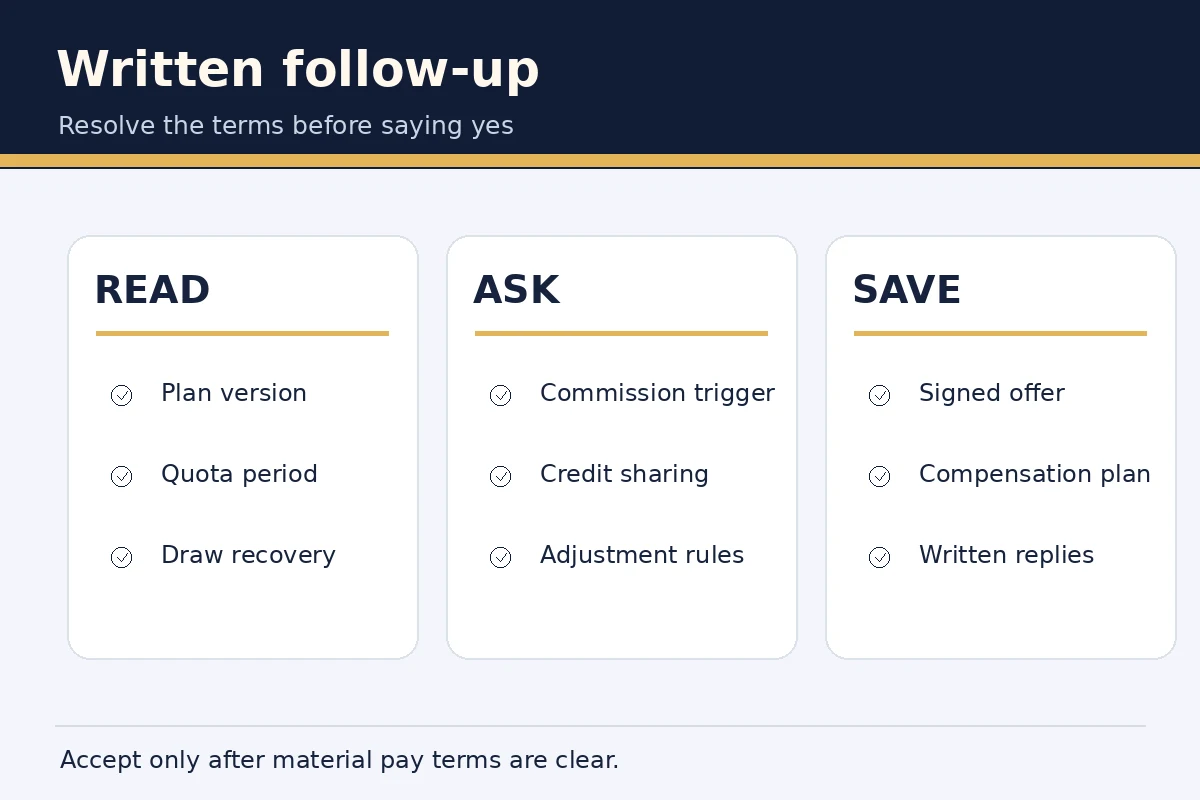
Save the signed offer, dated compensation plan, and any follow-up email in a private folder. Confirm the onboarding contact, initial sales training calendar, and the location of official policy documents. When you receive a first commission statement, compare its categories with the plan rather than projecting annual earnings from a single pay period. If a detail changes before your start date, request an updated written record of that change.
A cautious acceptance can still be positive and concise. You do not need to restate every commission clause in your reply, and you should not send your confidential prior employer’s sales reports to demonstrate readiness. The useful goal is a clear final commitment to a role whose pay mechanics and responsibilities you have actually understood.
How We Research This Offer Decision
We checked the current relevant primary and professional sources on 2026-11-04: U.S. Department of Labor (Department of Labor explains that commissions can supplement or replace salary and are not mandated by the FLSA.); U.S. Department of Labor (Department of Labor explains that overtime calculations can incorporate commissions under applicable FLSA requirements.); USC Career Center (USC Career Center recommends carefully reading the written offer, clarifying the decision deadline, and negotiating before accepting.); Federal Trade Commission (FTC describes fraudulent recruiters who request money or sensitive financial information before a genuine hiring process.). Examples in this guide are hypothetical, not employer policies, promises, or legal advice. Verify the actual employer agreement, local rules, licensing status, and official procedures before acting. See our affiliate disclosure; no paid partnership or guaranteed outcome is implied.
Related Workplace Guides
Usually it is a projection tied to stated performance assumptions, not proof of future earnings. Confirm which portion is guaranteed and read the written compensation plan.
A draw is an advance or guarantee arrangement, but recovery and reconciliation terms vary. Ask whether the draw is recoverable and what happens if commissions are lower.
Request the current plan first when commissions materially affect pay. If it is unavailable by the deadline, explain what you need and ask whether the employer can extend it.
They can, depending on the employee’s work and applicable wage rules. The Department of Labor provides general guidance, but individual classification requires a fact-specific assessment.
Ask who can change it, when changes become effective, and how notice is given. Preserve the plan version you accepted and request any subsequent revisions in writing.