
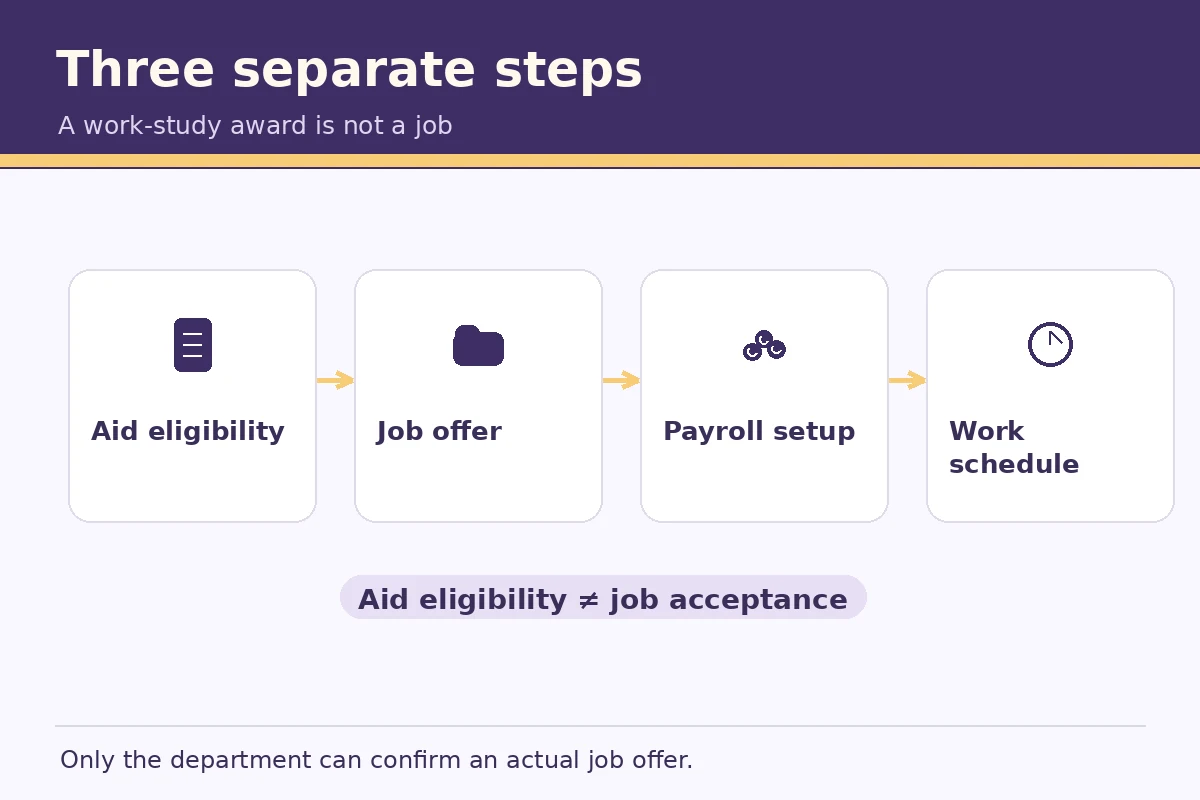
Before accepting a campus job, check whether it is a Federal Work-Study position or regular student employment, how many hours you may work, and whether the actual shift schedule fits your classes. A work-study award in your aid package is not itself a job offer. You may still need to apply, interview, and receive a hiring decision. Confirm the employing department, supervisor, position title, start date, and payroll steps before telling the department you will be available.
Separate aid eligibility from an actual hiring offer
Federal Student Aid explains that qualifying for Federal Work-Study is only part of the process; many students must separately find and apply for an eligible job. A school financial aid offer tells you about funding eligibility, not automatically where you work or who supervises you. Ask whether the department has actually selected you for a named role, and whether the offer remains subject to school employment approval or verification of your work-study status.
If you do not have a work-study award, ask whether the opening also supports regular student employment. Do not tell an employer you are work-study eligible unless the school has confirmed it. If the department needs an award letter or eligibility verification, use the school’s approved process rather than emailing financial documents to an unfamiliar address.
Check the academic calendar before offering availability
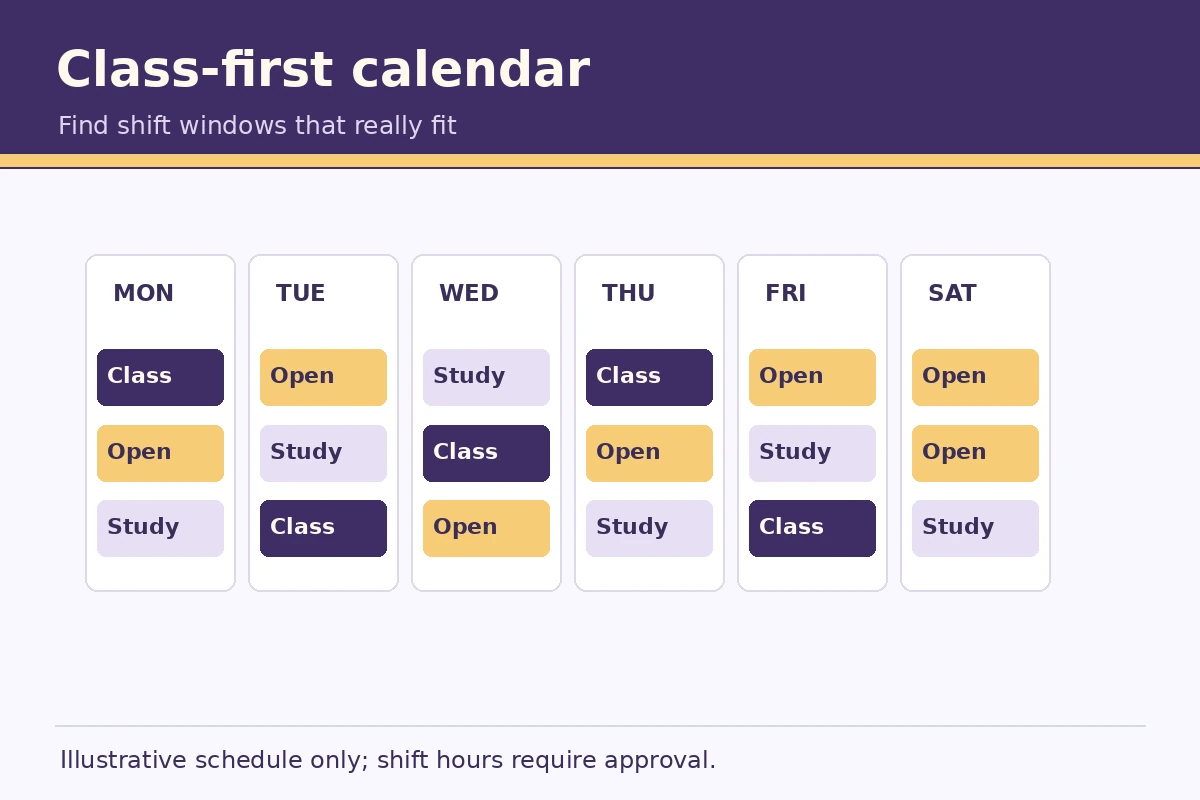
Put required class meetings, laboratory periods, examinations, and regular travel time on a weekly schedule before filling remaining windows with potential work hours. Include a realistic buffer for commuting across campus and breaks that are too short for a productive shift. Ask whether the department expects opening, closing, weekend, or holiday coverage, and whether shift changes are possible during midterms or finals.
Federal Student Aid explains that work-study schedules are meant to be arranged around classes and may be limited by the school’s rules and the student’s award. Avoid treating your maximum eligible hours as a guarantee that those hours will be offered. If you cannot meet a department’s minimum scheduling needs, explain that before acceptance, rather than accepting and repeatedly cancelling shifts.
Verify the total hours and pay arrangement
Check the hourly rate, timekeeping method, pay frequency, and where to direct payroll questions. For Federal Work-Study, ask how many hours or earnings your school currently authorizes and what happens if you approach that limit. Confirm whether orientation and required training are paid according to the school’s rules. A job might continue as regular student employment after work-study funds are exhausted, but that requires actual employer approval; it is not automatic.
Separate the work-study amount on a financial aid offer from earned wages. Federal Student Aid notes that students receive work-study pay through a paycheck and earn it by working. Do not subtract the entire award from a tuition bill as if it were a grant automatically deposited into your account. For individual aid questions, the school financial aid office is the correct contact.
Identify supervision, privacy, and job limits
A campus position might involve tutoring, library circulation, lab support, office scheduling, or IT assistance. Ask which tasks are part of this specific role, who trains you, and how to handle requests involving student records, payment information, restricted equipment, or confidential research. Student employment does not automatically permit access to protected records or independent use of specialized tools.
If your job is grant-funded, in a lab, or in a department with special safety rules, ask when training will take place and who confirms authorization. Describe yourself as available to learn, not already certified or cleared. Record who approves shift swaps and whom to contact if a class schedule changes unexpectedly.
Send a concise campus job acceptance email
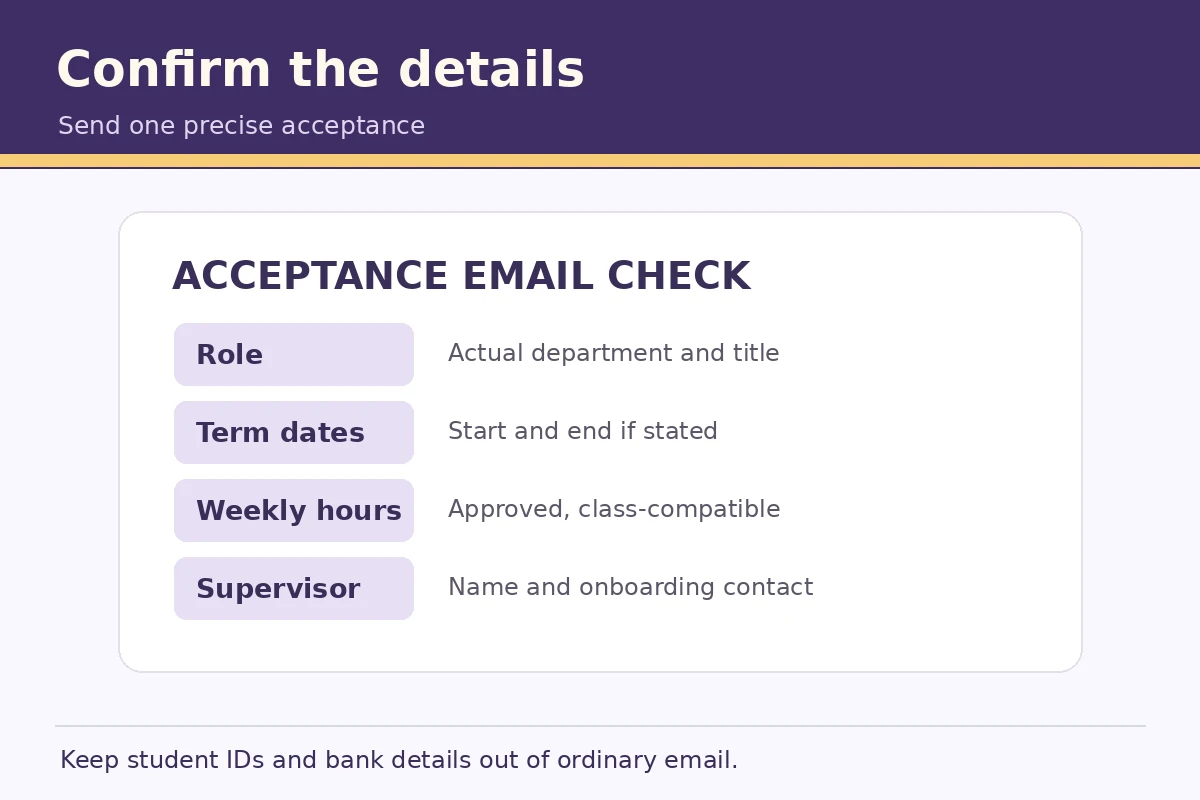
Illustrative acceptance: “Thank you for offering me the Library Desk Assistant position for the fall term. I am pleased to accept, pending any student employment eligibility steps noted in your offer. I can work the agreed [days and time windows], and my classes are scheduled outside those periods. Could you confirm my supervisor, first paid training shift, and payroll onboarding instructions?” Do not insert a schedule until the department has actually agreed to it.
If your work-study status is still under review, use a conditional clarification instead: “I would like to accept once my school confirms eligibility. Who should verify my award, and is there a response deadline?” This avoids representing a pending financial aid process as completed employment. Keep the reply separate from sensitive student identity or tax forms.
Avoid misleading recruitment and identity requests
Use the campus employment portal and your institution’s official directory to verify a department or supervisor. The FTC warns that job scams may imitate legitimate organizations and request financial information before real hiring. A person using a school logo in a message is not proof of authorization. If something looks unusual, call the department or student employment office using contact information from the official institution website.
Complete employment eligibility and payroll forms only through legitimate school processes after the role is confirmed. An acceptance email should not contain your Social Security number, bank-account number, financial aid portal password, or a photo of identity documents. If a role asks you to process personal payments for an unknown individual, verify it independently before proceeding.
Manage changes during the semester
Save your offer, supervisor contact, payroll instructions, and approved schedule. Recheck your availability each time a term or course load changes. Ask your supervisor early about examination weeks and report when you are approaching a school-mandated work-study or departmental limit. Never continue logging hours outside approved procedures because another student informally said it is allowed.
A campus offer can be a useful first professional commitment. The strongest acceptance is an accurate one: you know whether you have a job, which funding arrangement applies, when you may work, and who has authority to adjust the schedule if your academic obligations change.
How We Research This Offer Decision
We checked the current relevant primary and professional sources on 2026-11-04: Federal Student Aid (Federal Student Aid explains work-study eligibility, paid hours, finding a job, and scheduling around classes.); Federal Student Aid (Federal Student Aid explains that a work-study award does not guarantee a job or its earnings.); University of Pennsylvania Career Services (Penn Career Services advises gathering enough information and distinguishing a received offer from an actual commitment.); Federal Trade Commission (FTC describes fraudulent recruiters who request money or sensitive financial information before a genuine hiring process.). Examples in this guide are hypothetical, not employer policies, promises, or legal advice. Verify the actual employer agreement, local rules, licensing status, and official procedures before acting. See our affiliate disclosure; no paid partnership or guaranteed outcome is implied.
Related Workplace Guides
No. Eligibility or an award does not guarantee that a department has hired you. Confirm the named job and complete your school’s hiring process.
Arrange an approved schedule that respects required class activities and school work-study rules. Discuss conflicts with your supervisor before accepting.
Ask your financial aid office and employer. Continuing in another funding category is possible at some schools but is not guaranteed.
No. Some departments hire regular student employees separately. Ask which funding and eligibility process applies to your particular offer.
Use only the information required by the school’s approved process. Keep sensitive identifiers and financial details out of ordinary email unless the institution directs you to a secure channel.