
Home-based travel agent work can mean an employee handling client itineraries, a travel coordinator booking business trips, or an independent seller working through a host agency. Do not assume these are interchangeable. Before applying, identify who provides clients, who owns booking systems, who handles refunds and changes, how the worker is paid, and whether any fee is required. Travel agents assess itineraries, reservations, prices and client needs; working at home does not remove those responsibilities.
The strongest applications show accurate scheduling, customer follow-up, careful comparison of travel options and comfort learning reservation tools. A background in hospitality or service can be relevant, but it is not a substitute for employer-specific booking authorization. State registration or business rules may apply to some independent operations; check the state where you would operate rather than assuming a nationwide credential.
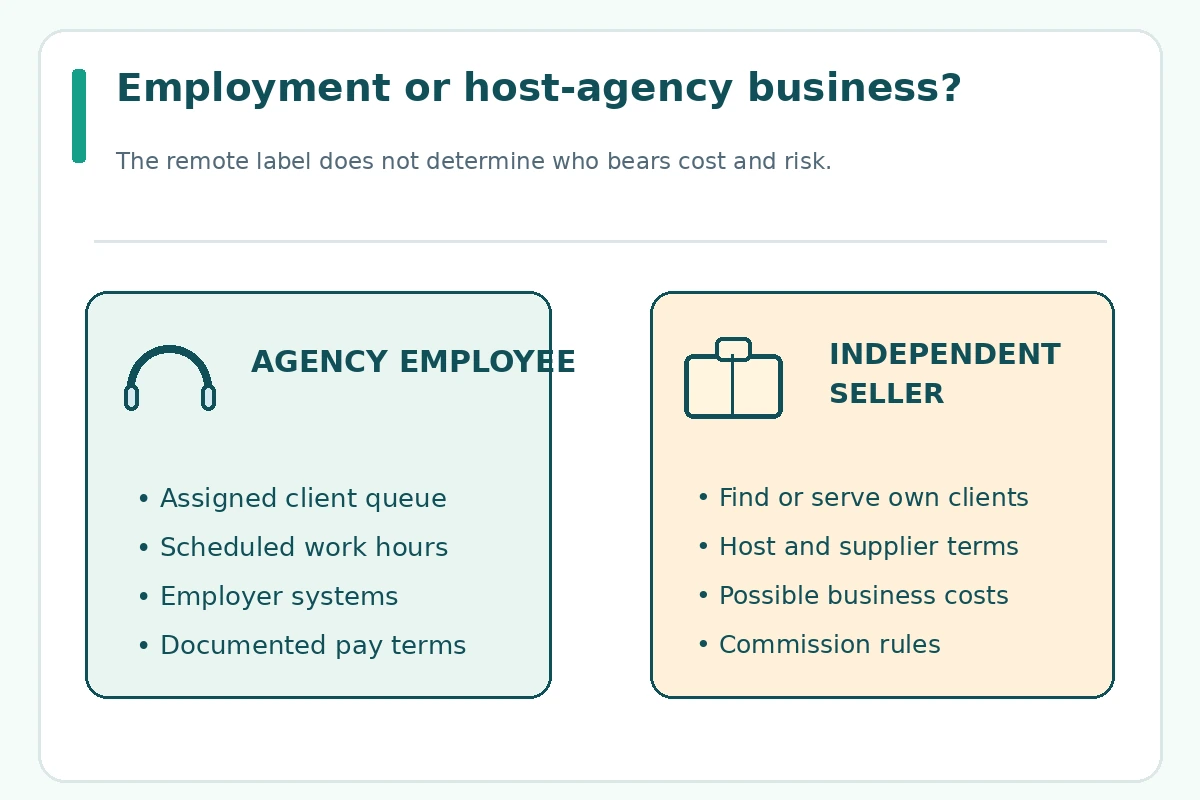
Distinguish agency employment from independent selling
An agency employee may receive assigned leads, documented schedules and established procedures, while an independent seller may need to find customers, maintain records and manage business expenses. A host agency may offer access to booking systems, suppliers, training or marketing tools, but arrangements differ. The phrase ‘work from home’ tells you where work occurs, not who bears business risk. Do not infer a guaranteed salary, customer base or commission from a recruitment headline.
Create two columns for every offer: employee or independent contractor, and record the pay basis, minimum hours, equipment, expected sales activity and who approves bookings. Ask for the agreement before paying or making commitments. A legitimate business model can still be a poor fit if income is uncertain or start-up costs outweigh likely work volume.
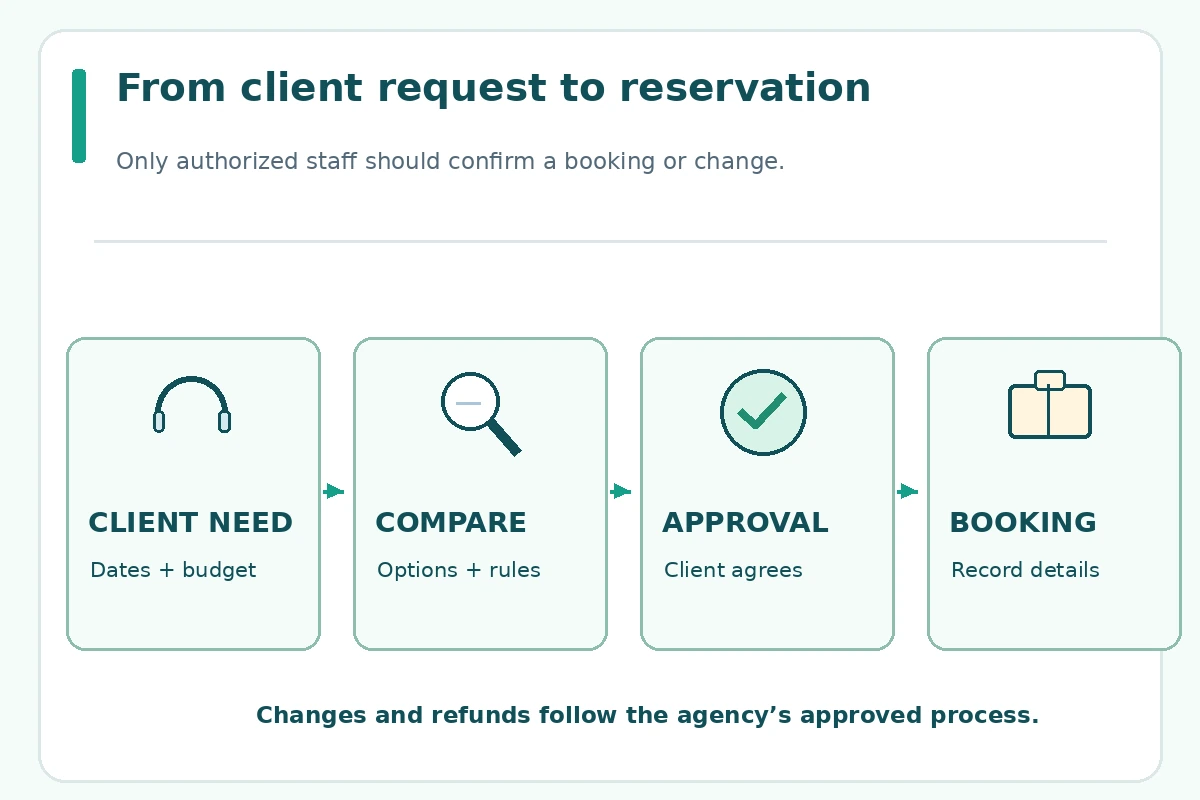
Map the real reservation workflow before accepting tasks
A client typically provides dates, traveler details, constraints and budget; the agent compares suitable options, confirms the chosen itinerary, arranges reservations through authorized systems, and records confirmations. If a route changes, a client may need alternative options rather than an unapproved rebooking. Distinguish presenting choices from committing a client’s funds or altering tickets: only act with the permissions the agency and customer provide.
Ask which software and supplier credentials you will actually use, how changes and cancellations are handled, and who answers urgent traveler calls. Do not copy a sample itinerary containing customer names into a public portfolio. Practice on fictional trips and label them clearly as exercises rather than client bookings.
Verify training and state-specific requirements
BLS describes on-the-job training for many travel agents, including the systems used to arrange travel. Training may help you learn fares, reservation codes and supplier policies; it does not automatically grant authority to issue tickets or make travel-document decisions for a customer. Some states impose registration or business requirements on travel sellers. The employer or host should explain where compliance responsibility rests.
Ask whether a course is mandatory for the particular role, who supplies it, and whether it is tied to a specific reservation platform. Independently verify any claimed licensing requirement through the appropriate state authority. Avoid recruiters who use an invented nationwide license as an excuse for an urgent upfront transfer.
Investigate payments, commissions, and recurring fees
A salaried job, a commission-only contract and a membership arrangement can involve very different cash flow. Request written details about payment timing, cancellations, commission reversals, service fees, marketing obligations and expenses. When someone promises large earnings just for buying a starter kit, that is not a verified employment outcome. Compare the actual agreement with the description in the posting.
The FTC warns that scammers imitate real employers and seek money or personal information. Search the employer’s official site independently and confirm the role through a known contact method. Do not cash a supposed equipment check and send funds to a third party. A business expense may exist in legitimate self-employment, but it must never be confused with proof that a job has been offered.
Show travel-service evidence without invented bookings
If you have organized an actual community trip, coordinated hotel reservations in a permitted role, or responded to schedule disruptions, state exactly what you did. You might have compared published options, relayed confirmations or helped a customer understand an itinerary. Do not say you issued tickets, negotiated supplier contracts or resolved refunds unless those actions were genuinely yours.
For a beginner, create a mock weekend itinerary with real publicly available schedules but fictional traveler data. Document how you evaluated restrictions, travel times and alternatives. Describe it as a practice project; no supplier or customer accepted it. The hiring manager can still see how you organize information and distinguish facts from assumptions.
Ask five questions before applying or enrolling
First ask whether the work is employment, contract sales or business ownership. Next ask how clients are sourced, how the worker is compensated, what booking permissions come with training, and what happens after a cancellation. These questions reveal whether the opening is fundamentally customer service, sales or operations support.
Read the written agreement and check the listed location and schedule. If an advertisement invites you to an orientation but never describes duties or an actual opening, investigate before providing identification. Keep screenshots of the posting and written terms privately for comparison, not as publicly shared proof of an employer’s wrongdoing.

Use a two-step search and application process
Start with established employers’ career pages and search for travel consultant, corporate travel coordinator, reservations agent or travel advisor. Confirm remote eligibility and schedule before tailoring your resume. Use job boards for discovery, not as the only proof that an agency is recruiting. The final application should match an independently verified employer process.
Tailor your resume around actual customer service, scheduling, accurate records and complex follow-up. For each application, record the employer, classification, training obligations and genuine submission status. Do not submit a second application after an apparent error until you check for an existing receipt.
Worked Example: A Decision Based on Real Evidence
Hypothetical comparison: Candidate A sees ‘remote travel advisor’ with commission-only pay, a monthly platform fee and responsibility for finding clients. Candidate B finds an agency’s remote reservations role with assigned customer requests and scheduled shifts. Neither arrangement is automatically illegitimate. A asks for the host agreement and commission terms; B asks about booking credentials, training and escalation for cancellations. Each decides based on written facts, not the headline or promised lifestyle.
This is an illustrative scenario, not a real placement or employer testimonial. Replace invented details with your actual experience, and do not infer a guaranteed acceptance, income, client outcome or work schedule. The goal is to separate evidence that has been verified from assumptions that still need a direct employer answer.
Application Checklist Before You Commit
Keep a private record of the employer and exact position, independently verified careers-page link, worker classification, start date, schedule, training, payment structure, required equipment, permissions and interview contact. Compare each claim with the written role description. Check that the actual upload or application status says submitted before treating it as received; a saved form is not evidence of delivery.
If an unfamiliar recruiter insists on private financial details, surprise deposits or an urgent equipment purchase, verify identity using a known official channel before proceeding. Do not pay to receive a job offer. If a legitimate contract involves optional business costs or licensed tools, distinguish them from a promise of employment and review the full written terms first.
How We Research This Guide
We reviewed current Bureau of Labor Statistics occupational descriptions and US Federal Trade Commission advice about remote-employment fraud, and compared this intent with the supplied JobAsk WordPress article list and previously prepared batches on November 2, 2026. BLS describes occupations, not particular live openings, guaranteed home-work arrangements or salaries for these roles. Sources below substantiate role characteristics and safety checks; job postings may impose stricter rules. Our affiliate disclosure explains our editorial relationship policies.
U.S. Bureau of Labor Statistics occupational reference: BLS describes travel agents’ client needs assessment, reservations, changes, training and varying state requirements. Accessed November 2, 2026.
Federal Trade Commission advice: FTC warns about job impostors, fake checks, up-front purchases, and premature disclosure of financial data. Accessed November 2, 2026.
Related Job Search Guides
No. Some are employee positions and others involve independent selling or host agency contracts. Verify classification and written terms.
Some independent business arrangements have fees, but paying is not proof of employment. Compare the agreement carefully and independently verify the company.
Do not assume so. Follow the agency’s actual reservation permissions, policies and supervision requirements.
Requirements can vary by state and business model. Verify applicable rules with the appropriate state authority.
Accurate schedules, customer communication, documentation and approved follow-through can be useful, if you describe what you actually did.