
Remote travel agent jobs can involve genuine client planning and reservation work, but an advertisement may instead be selling access to an independent travel business or a paid training program. Before applying, distinguish employment from a self-employment arrangement, confirm which booking systems you may use, and verify who manages changes, client payments, and complaints. A home office is only one part of the role.
Separate employee openings from agency membership pitches
Start with the working relationship: are you applying to be an employee, an independent contractor, or an owner of a separate travel business? Those terms should not be inferred from the attractive phrase “work from anywhere.” Ask who provides clients, sets service expectations, handles payment processing, and supplies the written agreement.
An employee role may include structured hours, company-supported tools, and assigned client cases. A separate business model may require finding customers and managing your own expenses. Neither is defined solely by remote location. Do not treat an invitation to purchase an agency package as proof that a salaried job exists.

Check the actual itinerary and booking tasks
BLS describes travel agents as researching options, arranging transportation and lodging, estimating trip costs, and helping with changes. Search for words like reservation support, corporate travel coordinator, itinerary specialist, or leisure travel consultant, but inspect what the listing actually expects. Some jobs are sales-heavy; others focus on traveler service.
Ask whether you present proposed itineraries, issue confirmed bookings, amend reservations, or only collect client preferences. Who validates prices and supplier restrictions? A hypothetical itinerary worksheet can show dates, route options and change-contact fields, but never claim that an invented trip is a real booking.
Find out who can modify or cancel reservations
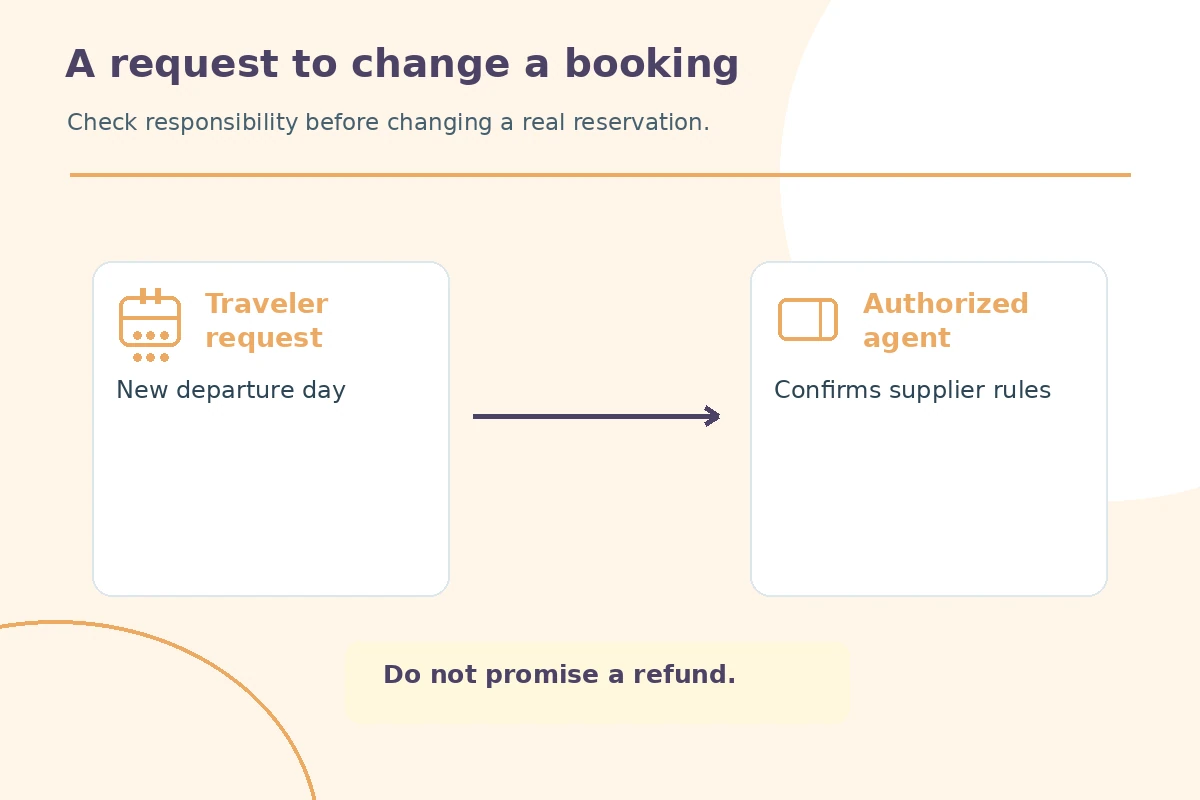
Booking changes can affect supplier policies, fees, and client deadlines. Ask whether approvals are needed for refunds, flight changes, and payment disputes. An entry-level support worker may record requests and route them to an authorized travel counselor rather than making irreversible changes without review.
For a fictional client whose trip moves one day, a safe workflow is to check the reservation status, identify any supplier rules that require review, explain what remains unconfirmed, and obtain authorization before changes. Avoid promising fee waivers or refunds that a supplier has not agreed to.
Clarify customer data and payment channels
Travel work may involve names, dates, itineraries, passport-related details, and payment information. Ask where client records are stored, whether a secure payment tool is used, and who may access or update sensitive fields. Do not request card details through personal messaging apps or keep copies of documents in your home computer without explicit employer authorization.
A sample travel plan can use fictional travelers and destinations. Show clear follow-up notes and an escalation route rather than screenshots of real customer accounts. A genuine employer should describe its approved systems and how staff respond to a mistaken booking or an urgent traveler request.
Check the authority boundary in this role
| Task or issue | What to verify | Person or process |
|---|---|---|
| Employment offer | Reporting, hours and written terms | Authorized employer |
| Independent agency | Clients, costs and agreement | Agency owner / agreement |
| Booking changes | Supplier rules and sign-off | Authorized travel counselor |
| Training fee pitch | Is there a real paid job? | Independent verification |
Research agency, state requirements, and training claims
BLS notes that travel agent requirements can vary by state. Check relevant state requirements and the actual agency terms instead of treating a national advertisement as a universal permission to sell travel. Ask whether any credentials, vendor access, or supervised training are prerequisites for this particular position.
Be skeptical of “pay today to become hired tomorrow” messages. The FTC warns that remote-job scammers use starter kits and purported training to obtain money. Voluntary professional education is not itself proof of fraud, but it should not be misrepresented as an employer-funded job offer. Verify the legal business and contract independently.
Show credible service and planning evidence
Transferable experience includes real customer service, reservation support, calendar accuracy, comparing clearly stated options, and responding to schedule changes. Explain what you personally handled. If you have not issued tickets or processed travel payments, do not claim airline-system authority based on a tutorial.
A useful practice sample is a labeled fictional itinerary showing two route alternatives, the questions you would ask a traveler, and fields that require supplier confirmation. Use real travel planning experience only where you can explain your role and avoid sharing someone else’s confidential travel information.

Use a remote travel-job comparison before applying
Track the verified employer, work relationship, clients provided, booking tools, compensation basis, shift coverage, state or location limits, training conditions, and fees. Search multiple role labels but avoid ranking advertisements solely by income promises. A real hiring process can explain who supervises work and who bears booking liability.
Confirm every material condition with the appropriate written terms. If the role is an independent business opportunity rather than a job, evaluate it as such and do not assume employee protections or guaranteed bookings. Apply through independently verified agency channels and keep financial information out of unsolicited chat recruitment.
Practice the workflow before you submit an application
A realistic application exercise can compare two invented itinerary options without assigning any fake booking confirmation numbers. Include traveler priorities, travel dates, key supplier questions, and a clear “not yet confirmed” state. If a schedule change arises, document the request and the approver rather than assuming the fee or refund. This illustrates organized remote customer support. It also shows the applicant knows the difference between planning a trip and legally committing a traveler to a purchase.
How We Research Remote Job Roles
We reviewed the following US occupational and consumer-protection resources on November 7, 2026: www.bls.gov (Travel agents plan trips, coordinate reservations, quote costs and manage changes; requirements vary by state); consumer.ftc.gov (Work-from-home scam patterns including fee demands and fake training offers); consumer.ftc.gov (Verification of unexpected remote-job messages). Occupation profiles explain typical work, not a guarantee that a specific advertised position offers remote work, a particular credential pathway, or employment. The checklists and hypotheticals are JobAsk editorial examples. Confirm eligibility, authority, schedules, and terms with the employer.
No employer paid to be featured in this guide, and no job offer, income, or hiring result is promised. See the JobAsk affiliate disclosure. We do not recommend paying a stranger or sending personal credentials to obtain an advertised remote position.
Related Job Search Guides
No. Some are employee positions, others are contract arrangements or independent business offers. Verify the legal relationship in writing.
An upfront payment framed as the price of getting a job is a serious warning sign. Verify the employer and distinguish optional education from a genuine paid job offer.
Not automatically. Booking system permissions and supplier rules govern actions. Ask what training, review and authorization are required.
Requirements vary by state and business arrangement. Check applicable local requirements and the advertised role rather than using one blanket answer.
Use a fictional itinerary with decision notes and questions for supplier confirmation. Avoid real customer records or invented booking numbers.