
A scheduled shift and an on-call window are not the same thing. To accept this particular type of job offer responsibly, check the written terms against actual work conditions, ask targeted questions, and confirm the result through the employer’s official channel. This guide gives you a practical review tool for accepting an on-call job offer without assuming that an informal conversation creates a permanent guarantee. Examples are hypothetical and should be adapted to your real offer.
Check the offer against practical working conditions
Start with the employer’s written offer, the job posting, and any notes from interviews. Identify the legal employer, job title, start date, main location, and contact for questions. Record the offer deadline so you can request clarification in time. Read important policies instead of relying on general assumptions or a recruiter’s shorthand. A short set of factual questions is usually more useful than a broad request to explain every benefit.
For this role, put these four items in a review sheet: coverage, response, escalation, records. Mark each one CONFIRMED, NEEDS ANSWER, or DOES NOT APPLY. If the offer document and hiring discussion contradict each other, send one email listing the discrepancy. Do not answer with a final, unconditional yes while assuming that the employer will interpret an unstated condition in your favor.
Distinguish standby time from scheduled working hours
“On-call” can describe anything from a phone carried occasionally to a rotation requiring immediate travel to a worksite. Before accepting, ask how many evenings, nights, or weekends are assigned and how often actual calls occur. Is standby added to a regular shift or does it replace part of the schedule? Does training include supervised call responses? A precise rotation example tells you much more than the employer saying “we all pitch in when needed.”
Draw one typical week with your normal work blocks and on-call blocks in different colors. Add a third color for actual call responses. Do not count every standby hour as ordinary scheduled work without checking the arrangement. The DOL explains that on-call pay depends on factual restrictions; being required to remain on employer premises can be different from being allowed to use time at home. State and local rules may also matter.

Clarify response time and physical constraints
Ask how quickly you must answer or acknowledge a notification, when you must start remote work, and whether you may need to report in person. Some jobs require you to remain within a geographic area, keep an approved device powered, or stay able to travel safely. Others allow a response from home and require only an occasional site visit. If the employer states a response time, ask how it is measured and what exceptions are approved.
If a rotation affects your ability to travel, arrange childcare, or sleep, decide whether it is realistic. Do not promise a response time you have never tested against real transport. For a technical role, also ask who decides whether an issue requires escalation or an onsite visit. A new hire should not improvise safety-critical fixes beyond training. The written expectation should identify an appropriate supervisor or backup contact.
Understand how actual work is tracked and compensated
Ask HR for the applicable on-call and timekeeping policies, including how to record remote troubleshooting, phone conversations that qualify as work, call-outs, travel related to a call, and minimum reporting increments if any. Avoid universal statements that all standby time is paid or never paid. Federal law distinguishes engaged-to-wait situations and other restrictions; the actual facts and legal framework determine the outcome. The DOL Fact Sheet #22 is a useful starting point for that distinction.
A practical question is: “Do technicians record time from the initial work call until the issue is handed off, and where is that recorded?” Keep personal notes consistent with the official timekeeping process. If a manager offers an informal interpretation that conflicts with HR’s written policy, ask HR to clarify. Never edit a timesheet to omit real required work or log standby as worked time without authorization and a valid basis.

Ask about safety, fatigue, and backup coverage
On-call rotations can be difficult when repeated overnight contacts disrupt rest or when a response requires driving late at night. Ask who takes the next shift after a prolonged call, how urgent incidents are prioritized, and who relieves a worker who is sick or unavailable. In clinical, electrical, public safety, or other regulated work, a call may require a licensed or specially trained person. A beginner must not imply that accepting on-call status authorizes tasks beyond their scope.
Consider a hypothetical outage: a new support assistant receives an alert but has no permission to change server settings. The correct process is to record the event, perform only approved checks, and escalate to the designated administrator. If the employer cannot explain its escalation path, that is a question to resolve before starting. Your goal is not zero calls; it is an understandable, safe system for answering them.
| Area | What to verify | Useful question |
|---|---|---|
| Coverage | Hours and rotation | Which days and hours are part of the on-call rotation? |
| Response | Expected reach and arrival | How quickly must I acknowledge a call and arrive or connect? |
| Escalation | Backup and emergencies | How are call responses and related work recorded and paid? |
| Records | How time is logged | Who covers my window if I am unavailable or a situation escalates? |
The table is a working aid, not a standardized employment form. Replace its descriptions with the particular employer’s documents, and do not assume an unknown term is favorable. If a question affects compensation, a legal obligation, required credentials, or a protected employment right, ask HR for the applicable policy and obtain qualified advice when necessary. Keep the conversation factual and avoid inventing claims about what the law guarantees.
Write a role-specific acceptance after reviewing the rotation
After you confirm coverage and the applicable policy, send a concise acceptance that names the position, start date, and agreed rotation or attached policy. If you still do not know how response expectations work, ask for a clarification rather than accepting on an invented assumption. An employer may require a formal signature through an official portal; follow that process rather than relying only on email.
Hypothetical wording: “I’m pleased to accept the On-Call Support Technician offer beginning June 15, including the on-call rotation described in the June 2 schedule and the attached timekeeping policy.” Replace the sample date and policy reference with actual documents. Save the offer letter and the clarification. If the on-call requirement changes after acceptance, ask for an updated schedule and role expectations.
Illustrative clarification email: Subject: On-Call Technician Offer — Coverage and Response Details. Hello Hiring Team, thank you for the On-Call Support Technician offer. Before accepting, could you confirm the standard rotation and the response expectations? I would appreciate details about the usual standby window, how quickly a call must be acknowledged, when a site visit is required, and the process for recording time spent on actual responses. Please also let me know who provides backup coverage. I can respond by the offer deadline after reviewing these details. Thank you. This sample is not a message sent by a real applicant and contains no verified employer promise. If you already have clear written terms, simplify it into a brief acceptance instead of unnecessarily reopening agreed points.
Set up a practical handoff for your first rotation
Before the first standby period, confirm the contact number, secure system access, escalation chart, supervisor contact, authorized tasks, and how to document work. Test only what training explicitly permits. Ask who covers the rotation if your phone fails or connectivity is unavailable; do not create a private workaround using insecure personal accounts. Know where to find incident procedures without placing sensitive customer data in personal notes.
After the first rotation, compare the number and timing of actual calls with what you were told. Raise specific patterns respectfully. A phrase such as “I received three overnight call-outs this week; how is rest between shifts handled?” is more useful than a general complaint. Where pay or legal classifications are disputed, consult the relevant labor agency or qualified adviser rather than treating this article as a ruling on your case.
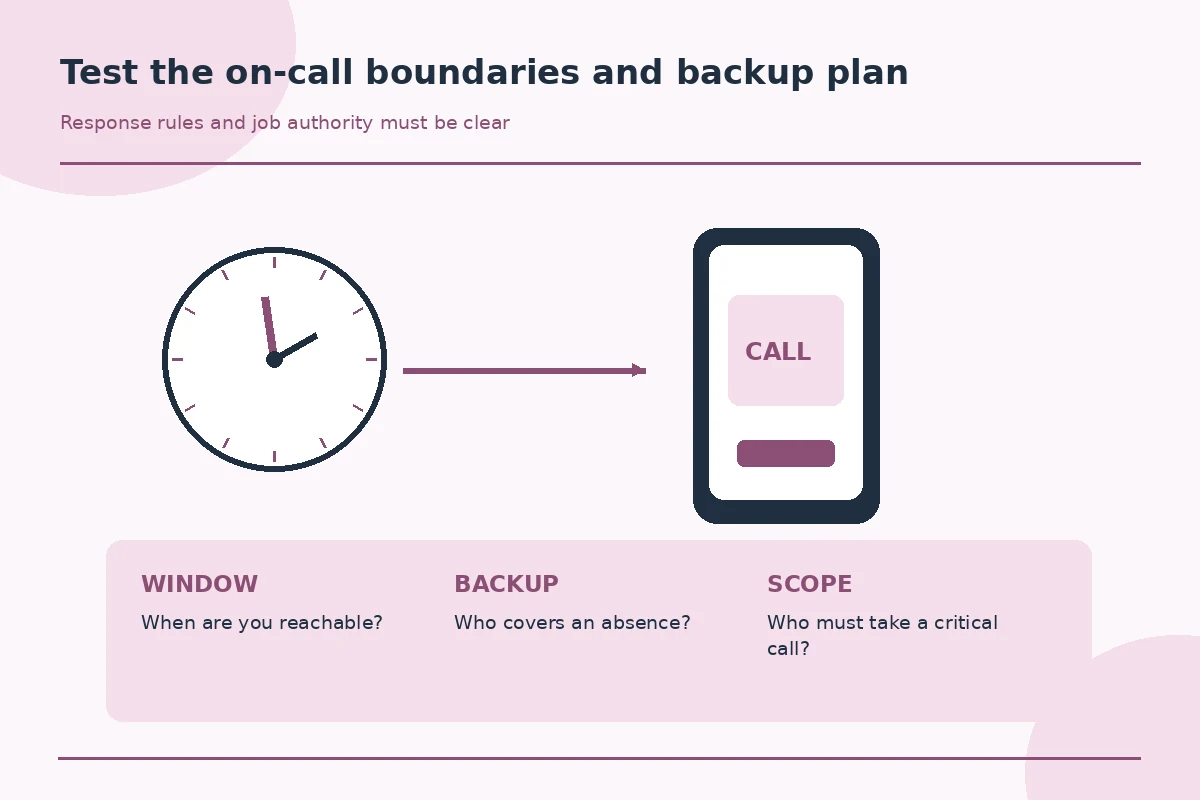
How We Research Job Offer Decisions
JobAsk compared this intent with the WordPress title list provided for the project, read the existing production plan, and reviewed primary public guidance relevant to the specific scenario. Official publications explain some general practices and federal standards; they do not replace the employer’s own terms or professional advice for an individual dispute. The suggested questions, email wording, and diagrams are editorial examples, not verified hiring outcomes. The site’s affiliate disclosure explains editorial and commercial relationships.
Source: www.dol.gov — The DOL states that compensability of on-call time depends on circumstances, including whether employees must remain on premises and restrictions on free use of time.
Source: www.dol.gov — DOL examples distinguish waiting on call from actual responses and emphasize the facts of the arrangement rather than an automatic paid/unpaid label.
Source: consumer.ftc.gov — The FTC explains how to verify recruiters and recognize requests for sensitive financial information in fake job offers.
Related Workplace Guides
Not automatically. The DOL says the answer depends on the restrictions and actual circumstances; state laws and the role may add requirements.
Some roles include response requirements, but the precise expectation should be communicated. Ask about travel, backup and safety.
Actual job duties performed over the phone can count as work. Ask about the official timekeeping rules and refer to DOL guidance if unsure.
Ask who covers absences, how swaps are approved and which escalation contact must be notified. Do not quietly abandon coverage.
Only within documented training and authorization. Ask which situations must go directly to qualified staff or supervisors.