
For an accounting internship interview, prepare to explain one real class exercise or supervised project from source document to checked result. You do not need to pretend you have closed company books. Show what you calculated, how you checked the numbers, what you could not verify, and when a reviewer would make the final decision.
Prepare evidence for the duties actually advertised
Start by opening the employer’s own announcement and separating must-have requirements from responsibilities described as trainable. For this accounting intern applicant role, relevant activities include trace a document, classify the item, check differences, ask for signoff. Mark the skills you have actually practiced, the ones you have only studied, and the ones that would require workplace instruction. A clear interview preparation sheet prevents you from borrowing impressive language from a posting without having examples to support it.
Make a small evidence table with the task, one past situation, your exact contribution, and what you would ask your supervisor to review. For instance, A labeled course ledger or fictional data exercise can support basic reconciliation skills without exposing client records. Where a project was shared, do not claim the entire result as your own. Where you had no permission to complete a decision, describe your verification, notes, or referral instead. This is useful preparation because interviewers can ask you to unpack a specific action.
Translate coursework into job-relevant evidence
Start with the exact internship posting. Is the position in accounts payable, receivable, audit support, payroll, tax, general ledger, or a rotational team? The interview will be stronger if you can connect a class project to the actual work instead of reciting every course you have taken. Record the source document, the arithmetic or spreadsheet task, the check you performed, and the limit of your responsibility.
If you completed a bookkeeping simulation, say it was simulated. If you worked under a supervisor, explain which records you entered and who checked them. If a project involved a team, separate your own contribution from a team report. A hiring manager can value accurate data entry, careful questions and repeatable checks without expecting an intern to certify statements or make policy decisions.

Rehearse a basic reconciliation explanation
You may be asked what you would do when an invoice list and a ledger total do not match. Describe a method: verify the period and documents, check for missing or duplicate entries, compare coding and amounts, confirm formulas, record exceptions, then request review according to procedure. Do not assume you can change a live balance without signoff. The objective is to demonstrate a reliable checking habit.
Use real coursework as your example if possible. A fictional exercise might contain a duplicate invoice line or a mistyped date, but be explicit that it is hypothetical. Avoid citing a fabricated savings amount or accuracy percentage. If you cannot find the discrepancy, say you would document where you checked and ask for a second review instead of forcing the books to balance.
Turn one work situation into a clear answer
Consider this hypothetical practice scenario: A practice spreadsheet total does not match the supporting invoice list. A strong rehearsal answer is: Recheck each input and formula, isolate the mismatch, document the correction, and ask for review before treating the entry as final. Replace it with a real event before using it as proof of experience. State what the request was, what you checked, what you could decide yourself, and how you communicated the next step. Never add a fabricated employer result just to make the story feel complete.
Compare an overclaim with an accountable statement. Too broad: “I managed all financial reporting and eliminated every accounting error.” Better as a hypothetical process example: “In a class ledger exercise, I traced a mismatch to a duplicated line, corrected the formula, and wrote down the check for the reviewer.” A concrete action lets the listener understand your limits and strengths. Practice the answer once aloud, then remove unnecessary details, unexplained acronyms, and any personal information you do not have permission to share. A good interview example is a short explanation of judgment, not a performance of confidence.

Explain spreadsheet work at the right level
Interviewers may ask about pivot tables, lookup functions, filters, or formula audits. Name only the features you have actually used. Rather than announcing “advanced Excel,” describe how you validated the input range, checked units, reconciled a subtotal, or prevented a copied formula from drifting. If you used another spreadsheet tool, name it accurately and explain the transferable method.
Prepare a safe, synthetic workbook for your own practice. It can demonstrate an invoice register, a simple matching column, and a review checklist without including real employee payroll data or client bank details. Do not upload an internal file just to look impressive. Your interview should communicate the method and judgment behind your spreadsheet, not the amount of private data you can access.
| Practice focus | Evidence to bring | Authority check |
|---|---|---|
| SOURCE | Trace a document | Confirm required permission |
| ENTRY | Classify the item | Confirm required permission |
| RECONCILE | Check differences | Confirm required permission |
| REVIEW | Ask for signoff | Confirm required permission |
Use control language without claiming approval rights
An intern may assist with preparing data, documenting exceptions, matching receipts, or supporting audit requests. Final classification, posting, approval, or release may be controlled by other team members. If you have never worked with internal control procedures, do not claim you implemented them. Instead say you would learn who is permitted to make changes and how corrected information is documented.
For a mistake story, describe a time you caught an input error and took responsibility for correcting it through the proper channel. Avoid an answer that celebrates quietly editing someone else’s work without review. Show a clear separation of preparation and approval. That distinction is useful in accounting because sound records depend on traceability, not confident-sounding guesses.
Ask about systems, supervision, and the close cycle
Useful internship questions include: What types of reconciliations do interns assist with? Which system or spreadsheet tools are used? Who reviews proposed changes? Will the role involve month-end activity, and what tasks remain staff-only? These questions help you understand the daily job, training, and expectations. Do not assume that the internship title guarantees audit, tax, and financial reporting experience.
Before the interview, check whether the employer expects a transcript, schedule availability, or a portfolio. Bring your own academic examples with data anonymized or invented for illustration. After practicing, reduce each answer to the problem, the check you did, the result you truly know, and one lesson. Accuracy and humility are more persuasive than claims that an intern already has controller-level expertise.
Run an interview rehearsal that tests your boundaries
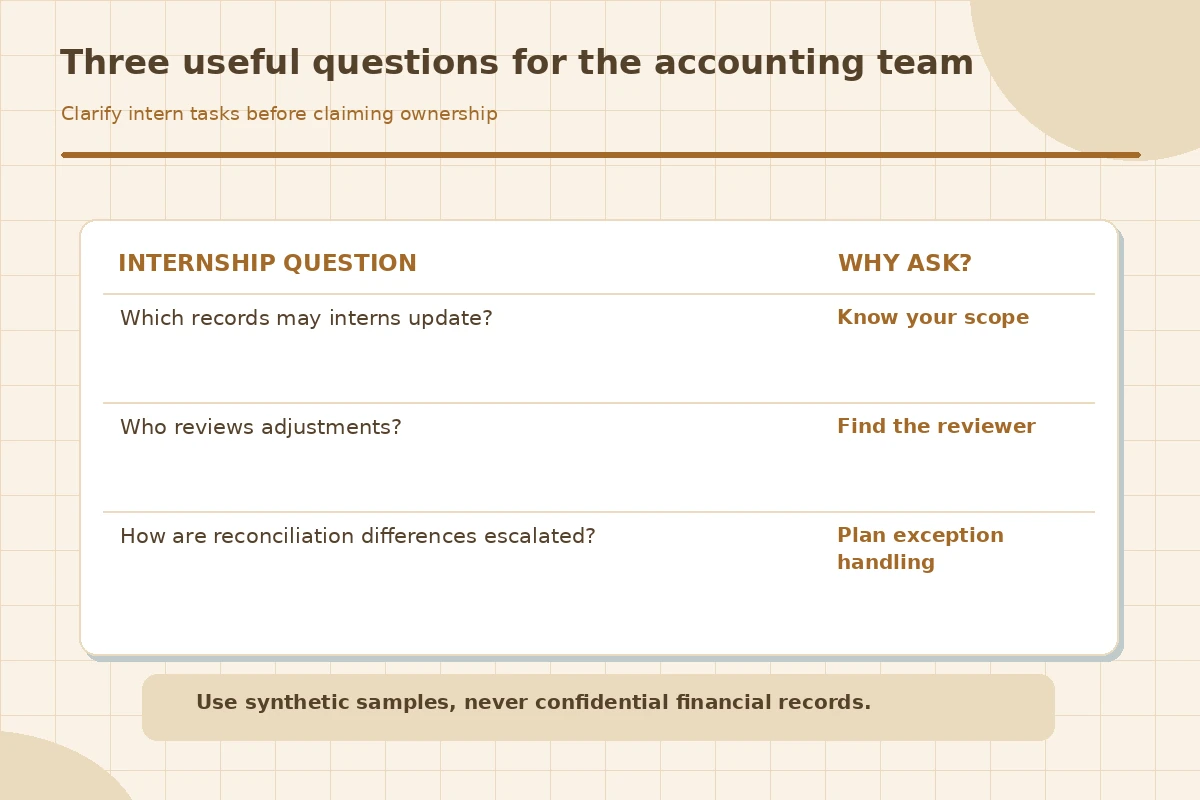
Read these three employer questions aloud and prepare short follow-ups: Which records may interns update? Who reviews adjustments? How are reconciliation differences escalated? Practice a positive answer and an honest limitation. For this occupation, check the following boundaries: no invented company metrics; reviewer approves corrections; keep client records confidential. These are not obstacles to hide; they help you learn what the organization actually expects. A good rehearsal partner should ask what you personally did and what you would verify before acting.
End each example with a truthful result or a clearly stated unresolved handoff. Do not reveal private patient, client, patron, financial or emergency information. Ask whether the interviewer can follow the sequence without knowing your old employer’s internal system. If the answer depends on an assumption, change the wording: “I would check the written procedure or ask the authorized staff member.” That is particularly important when applying for a accounting intern applicant position where trust is part of the job.
Review your notes before interview day
Prepare the job posting, interview location or call instructions, a clean copy of your resume, and a few concise questions. Identify which experience examples have documentation you can safely discuss. Do not carry proprietary screenshots or sensitive logs into the meeting. If the interviewer asks you to solve an unfamiliar procedure, explain how you would verify the rules before responding. Keep the first answer short enough that you can pause and invite a follow-up question.
After practicing, test your final explanation against three questions: Is every experience real? Does it show accounting intern applicant duties rather than a different profession’s authority? Could you repeat it without violating confidentiality? If one answer is no, simplify the story. You can be motivated, skilled, and teachable while acknowledging that the employer provides essential procedures and onboarding. Interview preparation should help you assess fit, not just impress the interviewer.
How We Research Job-Specific Interview Preparation
JobAsk compared this topic with the supplied WordPress title inventory, the existing content plan, and previous locally prepared batches. We reviewed occupation-specific public guidance and primary sources on November 7, 2026. Example answers in this article are hypothetical unless explicitly described as personal examples to adapt; no candidate, employer outcome, credential, or hiring success is asserted. Local policy and training requirements take priority over broad occupational summaries. See our affiliate disclosure.
Source: cloudfront.careeronestop.org — CareerOneStop recommends researching employers, practicing aloud with real examples, and using the interview to assess fit.
Source: www.opm.gov — OPM describes competency-based questions that seek a situation, the applicant’s actions, and the result.
Source: www.bls.gov — BLS describes posting, checking, classifying, reconciling, and reporting accounting clerical records.
Source: www.opm.gov — OPM explains how structured questions evaluate job-related past or hypothetical behavior.
More Interview Preparation Guides
Yes. State that the example is coursework and describe your own calculation, validation and learning.
Prepare the concepts relevant to the vacancy and be candid about what you have not practiced.
Explain the source records, how you compare them, how you document differences and who reviews the result.
Only with permission and without protected financial or personal data; a synthetic example is safer.
Ask about training, review procedures, assigned systems, close-cycle exposure and who approves changes.