
Before accepting a job that requires moving, confirm the work location, first required on-site date, eligible moving costs, reimbursement timing, and any repayment obligation. “Relocation assistance provided” is too vague to budget from. Ask for the written relocation policy or the individual agreement that actually applies to you, and check it alongside the employment offer. This page is about organizing the offer decision, not choosing movers or offering personalized legal or tax advice.
Separate the job offer from the moving agreement
An employment offer may identify your position, compensation, and start date but mention relocation support only in a short sentence. Ask whether a separate benefit document or signed repayment agreement will follow. Identify the company, role, assigned office, expected in-person schedule, and whether any remote orientation period is authorized. Do not assume that a future hybrid arrangement means you can delay your move or permanently live in a different jurisdiction.
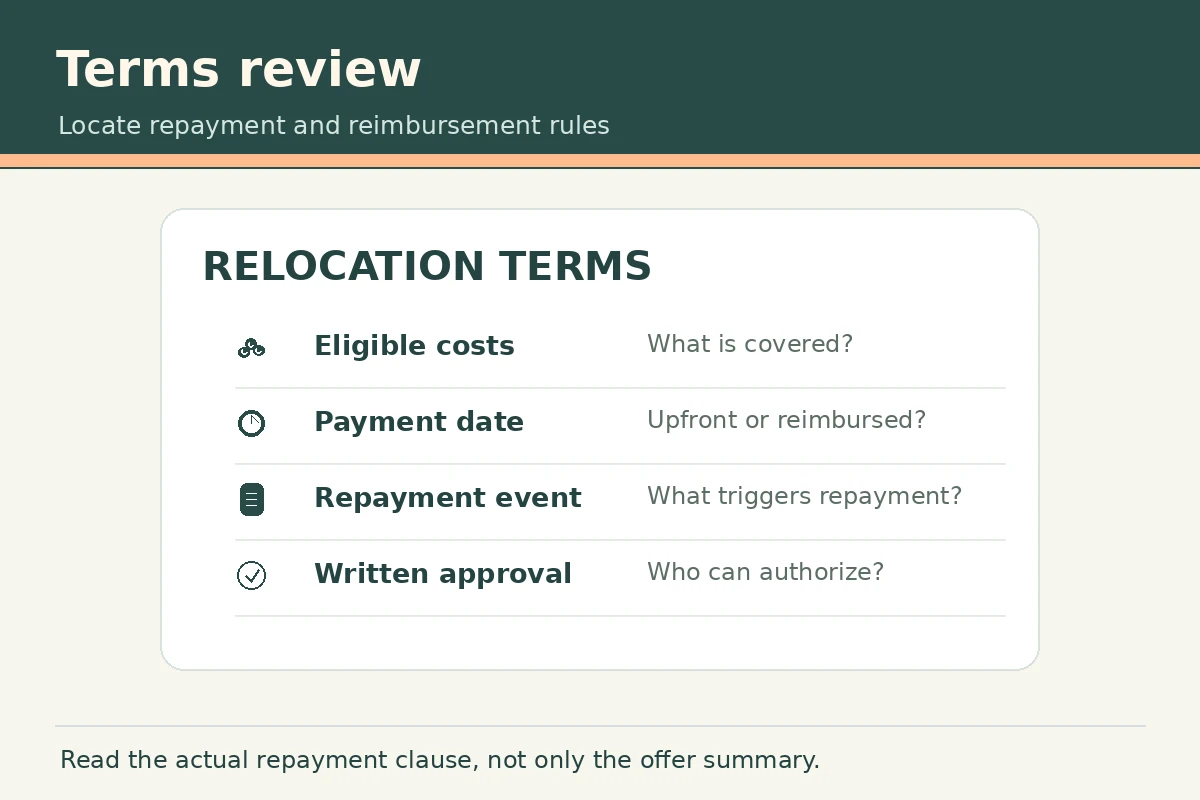
Create two files: Employment Terms and Relocation Terms. The first records the work you are agreeing to do; the second explains what expenses the employer has agreed to cover. If you are being transferred within a company, identify which internal policy applies to your position and location. Different employee groups may have different support arrangements. A generic recruiting brochure is not a substitute for the approval document.
Map eligible costs to the party responsible
List likely cost categories without assigning invented dollar amounts: transportation, movers, packing, storage, temporary lodging, travel for house hunting, lease-related fees, and household setup. Mark each Employer-paid, Reimbursable after submission, Employee-paid, or Unknown. Ask whether there are limits, required vendors, deadlines to submit receipts, or preapproval rules. A reimbursement is not the same as cash available before a move. Estimate your own cash needs accordingly.
Keep reimbursable expenses separate from any sign-on payment. A lump-sum allowance may have different documentation and tax treatment than a company-arranged service. Ask payroll or HR to explain what will appear on pay statements and what the organization can confirm in writing. Do not rely on an assumption that an expense is tax-free simply because the employer calls it a relocation benefit.

Read repayment conditions before signing
Some relocation agreements include repayment language if employment ends within a specified time or another defined event occurs. Look for the exact trigger, time period, calculation method, and any stated exceptions. Ask whether the repayment is prorated or all-or-nothing, who issues a demand, and how a dispute or billing error can be raised. Do not assume a clause is unenforceable, and do not claim it is automatically enforceable in every state.
If repayment is a major financial risk, request a copy before committing and consider qualified advice about the exact agreement and local law. If the employer states that a policy is “standard,” you can still request where the written policy can be read. Record the version date and preserve any approved exception or amendment in the same folder as your signed offer.
Check the calendar from offer to first workday
Start with the formal acceptance deadline, move approval date, lease or housing decision, travel, arrival, payroll enrollment, and required first in-person shift. Ask which dates are fixed and which can shift if a lease or shipment is delayed. A manager may say “we can be flexible,” but only an authorized contact can confirm a revised start date or temporary work arrangement. Do not give notice at your current job based solely on an expected reimbursement approval.
If the new role includes travel before the move, clarify whether those trips are business travel or part of the relocation package. Keep confirmation of any approved temporary lodging and who books it. Build a backup plan that relies on actual written permissions, not the most optimistic moving estimate. This reduces the risk of arriving late or paying for services that are not covered.

Write the right two-stage email response
Illustrative request: “Thank you for the offer for the Operations Analyst role. I am enthusiastic about the opportunity. Before I confirm, could you please send the relocation terms, including eligible expenses, reimbursement timing, any repayment provision, and the date I must be onsite? I can review the documents ahead of [deadline].” This is a request for information, not acceptance.
Illustrative acceptance: “Thank you for confirming the relocation arrangement and updated start date in the attached documents. I am pleased to accept the Operations Analyst position, starting [verified date] in [verified location]. Please let me know the next official onboarding steps.” Use only details that exist in the actual offer. Avoid suggesting the employer has promised expenses not included in the signed agreement.
Check tax and identity risks without guessing
The IRS 2026 Employer’s Tax Guide to Fringe Benefits explains that ordinary employee moving reimbursements generally do not qualify for the exclusion that some readers may remember from older guidance; narrow exceptions exist. The treatment of your own benefits depends on current federal rules and your circumstances. Request a payroll explanation or professional tax guidance rather than treating a blog’s historical example as current advice.
Use secure employer channels for identity, payroll, and relocation documentation. The FTC warns that fake recruiters sometimes use convincing paperwork to collect personal information or money. If a supposed relocation vendor asks for a fee through an unexpected payment link, verify that vendor directly with the real employer before responding. Never put a bank account number or identity document in a general acceptance email.
After you accept, keep one relocation record
Retain the final offer, relocation policy, approved amounts, receipts, submission dates, and correspondence in one organized record. Ask whom to contact for a denied receipt, a move-date change, or a different work location. Confirm that your manager and relocation administrator have the same first-day date. Avoid rebooking major expenses based only on an informal comment from a person who cannot authorize the change.
The goal is a feasible move plan rather than a flawless prediction. Treat unapproved expenses as yours until the written agreement says otherwise. A good acceptance email can be short because the important commitments are already documented and the remaining logistics have named owners.
How We Research This Offer Decision
We checked the current relevant primary and professional sources on 2026-11-04: IRS (IRS Publication 15-B for 2026 describes current federal tax treatment of employer-provided moving expense reimbursements and limited exclusions.); USC Career Center (USC Career Center recommends carefully reading the written offer, clarifying the decision deadline, and negotiating before accepting.); Federal Trade Commission (FTC describes fraudulent recruiters who request money or sensitive financial information before a genuine hiring process.). Examples in this guide are hypothetical, not employer policies, promises, or legal advice. Verify the actual employer agreement, local rules, licensing status, and official procedures before acting. See our affiliate disclosure; no paid partnership or guaranteed outcome is implied.
Related Workplace Guides
No. The arrangement may use approved vendors, expense reimbursement, or a cash allowance. Confirm the exact method and approved cost categories.
No. Federal rules changed, and IRS Publication 15-B for 2026 describes limited exceptions. Ask payroll or a qualified tax professional about your actual situation.
Read the exact conditions, amount calculation, and applicable period first. If the financial exposure is meaningful, seek qualified advice about the actual terms.
Tell the employer promptly and request written approval for any adjusted on-site date, temporary lodging, or alternative onboarding arrangement.
It is clearer to settle material relocation terms before sending final acceptance. If timing is tight, request an extension rather than assuming later discussions will change the signed agreement.