
An account executive resume summary should connect the selling motion you handled to evidence a hiring manager can verify. Name your market or customer type, the stages you owned, and one defensible contribution. A pipeline update, renewal conversation, or product demonstration is valuable; none automatically proves that you independently closed every opportunity.
Because “account executive” covers different businesses, interpret the posting before choosing language. The Bureau of Labor Statistics describes sales representatives researching prospects, learning customer needs, explaining products, preparing orders, and following up. Not every AE has the same contract authority, sales cycle, territory, or quota.
Specify the type of customer and sales motion
Start with the customer relationship you know: new business prospecting, account growth, recurring renewals, or sales support for an established portfolio. Business-to-business roles may require stakeholder discovery and a longer approval process than transactional selling. A useful summary gives this context without borrowing buzzwords from a different sales model.
For example, “B2B account executive supporting multi-stage software sales” is appropriate only if you held that title or genuinely performed the documented work. If you were an SDR, name your outreach and qualification contribution rather than silently promoting yourself to an AE.
Distinguish sourced, influenced, and closed opportunities
Sales reporting can assign multiple people to one opportunity. A representative may source a lead, schedule discovery, prepare an estimate, negotiate within a set policy, or close a contract with manager approval. Choose verbs tied to your actual responsibility: sourced, qualified, developed, supported, presented, renewed or closed.
Do not describe “managed $2 million in revenue” if the amount is a team forecast or a territory figure you did not control. If you have reliable CRM or approved performance records, a number can be useful with precise context. Otherwise a workflow-based statement is better than an invented conversion rate.

Use CRM knowledge as evidence not a keyword pile
A CRM can contain contacts, stage changes, next steps, quotes and activity histories. Specify the functions you performed: updating opportunity stages, keeping follow-up notes, documenting decision makers or preparing reports. Listing Salesforce, HubSpot or another product is useful only if you actually worked with it.
A strong summary might mention accurate pipeline records, then prove that in a bullet such as “Maintained discovery notes and follow-up dates for assigned accounts.” If you relied on a spreadsheet, say so rather than claiming mastery of a commercial CRM.
Write customer-discovery work without overstating expertise
Good customer discovery means listening for needs, constraints, approval paths and product limitations. Sales representatives frequently need to explain both features and limits of a product. In regulated or technical products, a product specialist may have final responsibility for technical claims or proposed specifications.
“Translated stakeholder requirements into documented options” can be accurate if that is what you did. Avoid “delivered guaranteed cost savings” unless a documented study actually supports it. A candidate who knows when to bring in an engineer or compliance reviewer can demonstrate judgment without pretending to be that expert.
Replace vague sales language with a role-specific summary
Weak example: “Top-performing closer with unmatched persuasion skills and industry-leading revenue.” It offers no verifiable scope, timeframe or attributable outcome. An honest alternative can focus on customer segments and demonstrable actions, and reserve numerical achievements for candidates who have their own records.
Illustrative revision: “Account executive with experience in B2B customer discovery, proposal coordination, and CRM follow-up. Tracks multi-stage opportunities, confirms buyer requirements, and collaborates with technical reviewers before quoting complex solutions.” Customize every noun and verb to your actual record; this sample is not a claim about any person.
Match the advertised role and compensation model
Some AE positions emphasize net-new prospecting; others emphasize renewals, channel relationships, account expansion or post-sale handoffs. Pull the specific requirements from the job description and reorder the first lines to match. For a renewal-heavy job, careful account records may be more relevant than cold outreach.
Do not imply you carried an individual quota if you were evaluated on team sales, customer activity or supporting tasks. If you mention attainment, give the measured period, target type and personal contribution in a supporting bullet rather than promising that the same result will recur.

Check every revenue statement for attribution and permission
Before submitting, confirm whether each figure is yours to disclose and how it was calculated. Distinguish booked revenue, recognized revenue, pipeline value and proposals outstanding; these are not interchangeable. Avoid confidential customer lists, specific account names, unpublished contract prices or internal forecasts.
Use categories or approved aggregate data if permitted, or replace sensitive figures with verifiable descriptions of deal stages and follow-up quality. A recruiter should be able to understand the contribution without receiving an internal sales report.
Worked Example: A Summary You Can Defend
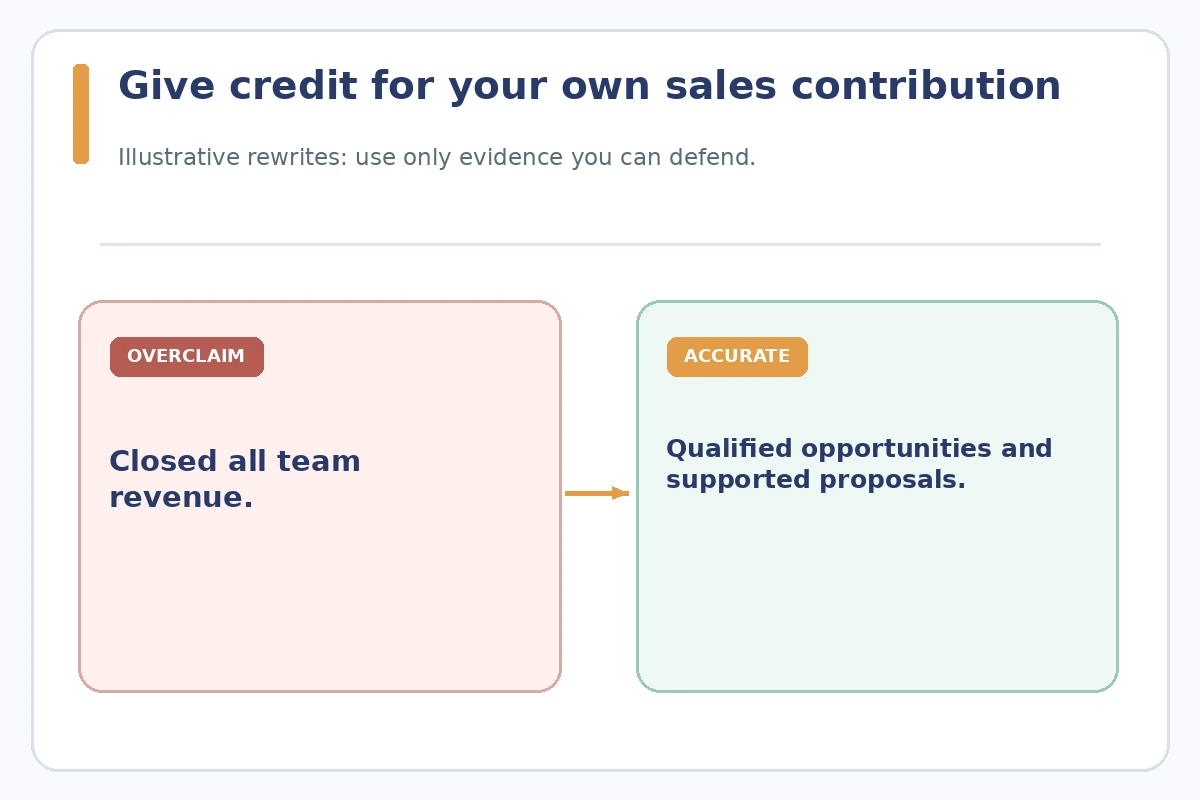
Illustrative scenario: A sales employee builds a lead list, runs discovery calls, and drafts proposals that a sales manager approves and signs. The first draft reads, “Closed every major deal and generated all regional revenue.” That claim confuses preparation with contract authority. A corrected summary reads, “B2B sales professional supporting account discovery, proposal preparation, and documented follow-up. Coordinates buyer requirements and internal approvals across multi-stage opportunities.” An accompanying experience bullet should show a specific customer-workflow example rather than fictitious revenue numbers.
This example is hypothetical, not a genuine employer testimonial or a measured hiring outcome. Keep the sentence structure if helpful, but replace every noun, title, tool, credential and claimed contribution with your own verified information. A useful test is whether you could explain the sentence to a hiring manager without adding a qualification that is missing from your resume.
Final Resume Summary Audit Before You Apply
Read the first three lines as a hiring manager would. Can you tell the occupation and work setting? Are the skills tied to observable tasks? Is an employer likely to mistake training for paid tenure, team participation for individual ownership, or a recommended action for final approval? Verify every date, credential, product name and numerical claim against your records.
Compare the summary with the target job advertisement and the evidence in your work-history or projects sections. Do not fabricate percentages, promote yourself to a higher title, or include confidential organizational details to sound impressive. Read the exported resume on a phone and computer so the summary does not become a clipped block of jargon.
How We Research This Guide
We checked official CareerOneStop resume guidance and the applicable Bureau of Labor Statistics occupation description on November 2, 2026, then compared the proposed topic with the supplied JobAsk WordPress list and previous local article batches. Occupational descriptions summarize typical duties; they do not certify any applicant’s skills or guarantee that every employer uses the same responsibilities. All example sentences in this guide are hypothetical. See our affiliate disclosure for site policies.
CareerOneStop resume guide: CareerOneStop explains when a brief 3–4-sentence professional summary helps and recommends relevant accomplishments rather than inflated claims. Reviewed November 2, 2026.
BLS occupational reference: BLS explains account prospecting, customer discovery, order processing and follow-up across business sales roles; job titles vary. Reviewed November 2, 2026.
More Resume and Cover Letter Guides
Only when it is a verified personal measure and appropriate to disclose. State the relevant period and avoid presenting team totals as your own.
No. Name real functions you used and connect them to work-history examples. A tool name alone does not establish ownership of deals.
Use verbs such as qualified, supported, prepared, coordinated or influenced, and explain what the closing owner handled.
Usually unnecessary. Describe the segment or account type without disclosing restricted customer names or contract values.
Lead with verified discovery, qualification and handoff experience. Do not imply a prior closing title or authority that you did not have.