
A translator resume summary should tell an employer which written language direction you work in, what types of text you have handled, and how you check accuracy. Saying “fluent in several languages” is not enough to show translation practice. In the first few lines, identify real document domains, terminology research, editing or review experience, and any relevant credential without confusing translation with live interpreting.
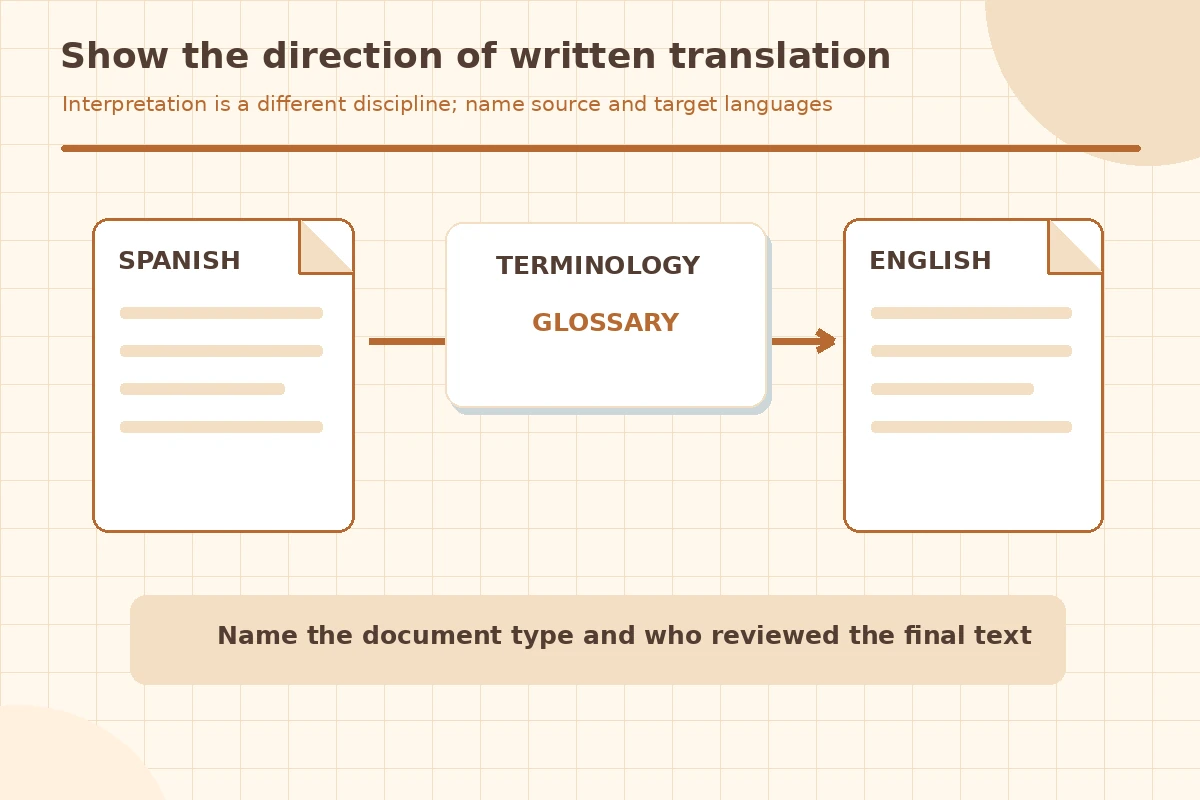
Name source language and target language explicitly
Language direction is more useful than a broad claim of bilingualism. “Spanish-to-English translator” describes a source and destination for written content; “English/Spanish bilingual” does not. If you translate in both directions, name each direction only when it is a service you genuinely provide at the necessary standard. Some applicants can read a language fluently but do not produce polished client-ready work in that language.
If your experience is mainly community interpreting, do not relabel it as a translation portfolio. The BLS distinguishes spoken or signed interpretation from written translation. You can describe relevant language expertise, but the summary should still identify the written deliverables you have completed. For multilingual work, avoid long lists that hide the strongest language pair; put the primary pair first and detail the rest in a skills section.
Show a document domain rather than broad fluency
Employers look for evidence that you can handle a particular kind of text: user help pages, instructional materials, product descriptions, public-facing notices, literary content or technical documents. The vocabulary and review needs differ considerably. Your top section should mention a domain backed by projects or client work instead of claiming proficiency in medicine, law, finance and engineering because those words appear in postings.
Be exact about high-stakes subject matter. Translating a general hospital appointment leaflet is not identical to providing certified medical or legal translations. Certain buyers require qualified vendors or specific credentials; requirements vary by setting and jurisdiction. Mention a certificate or professional membership only when you hold it, and do not claim that a tool or volunteer experience automatically grants professional authorization.
Separate drafting, editing, review, and post-editing
A translation workflow may include terminology research, drafting, use of a translation memory, bilingual comparison, proofreading, reviewer revisions, and delivery formatting. State the phases you personally performed. If a senior linguist approved your final output, say you revised translated drafts against a glossary and submitted them for review rather than asserting that you signed off on the published translation.
Machine translation post-editing is another distinct task. It can involve checking meaning, omissions, tone and terminology in machine-generated text. Describe that method honestly; do not imply the project was fully human translated from scratch if it was not. Conversely, familiarity with a translation tool is not proof of bilingual editorial judgment. Name a CAT platform only when you used its functions in genuine work.
Choose examples that protect client confidentiality
A portfolio excerpt should be public, your own, or shared with permission. Confidential contracts, patient details, internal correspondence and unpublished source material do not become suitable portfolio content simply because you translated them. When you cannot show the actual text, explain the document type, language direction, workflow and anonymized challenge without revealing protected information.
For example, hypothetical: “English-to-Spanish translator of public product instructions; built terminology notes and checked revised text against approved source versions.” This shows written work and quality control. If the work was academic, say it was a supervised course project. Do not invent clients, word counts, review scores, award nominations, or confidentiality agreements.
| Area | Good evidence | Common overclaim |
|---|---|---|
| Language direction | Source and target named | Generic bilingual equals translator |
| Domain | Relevant document examples | All industries specialist |
| Quality workflow | Glossary and revisions | Perfect accuracy promise |
| Authority | Issuer and credential status | Unverified certification |
Write a concise opening with verifiable specifics
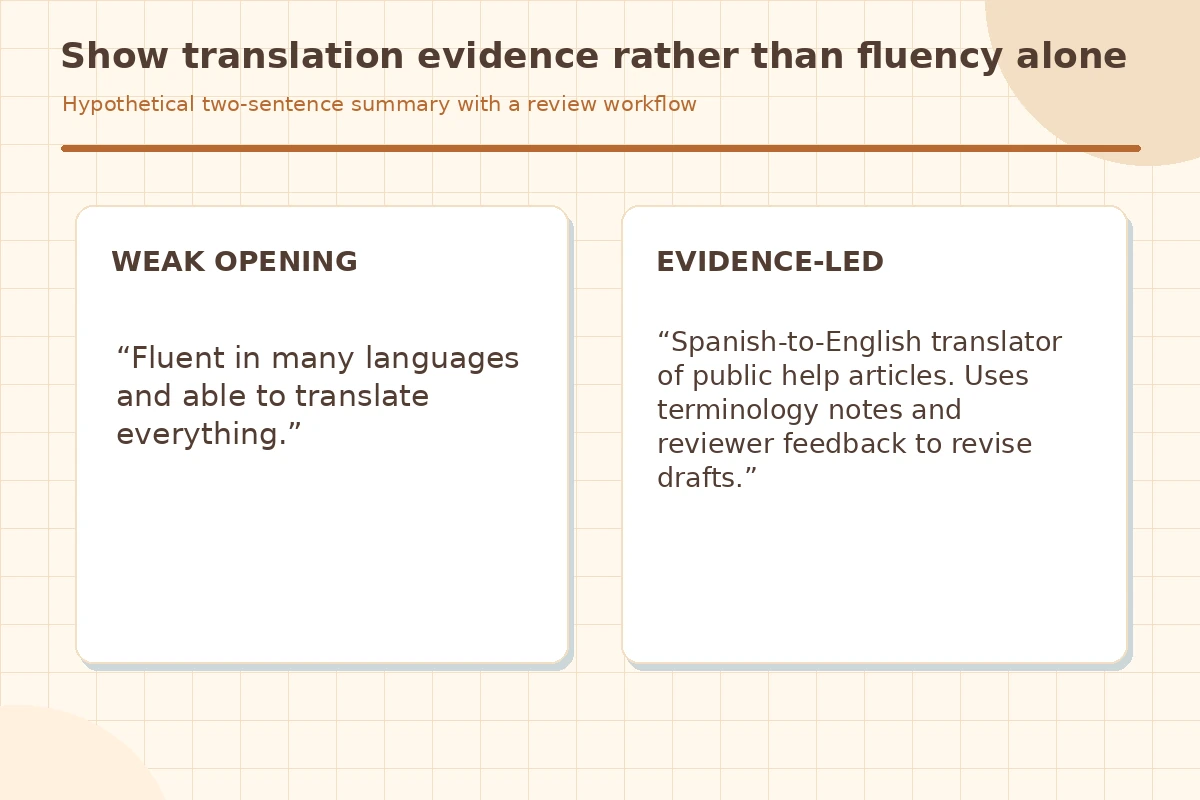
A resume summary can begin with a truthful role descriptor, a language pair, subject domain, and a quality process. Example, hypothetical: “Spanish-to-English translator with experience adapting product help articles and customer FAQs. Researches terminology, compares revisions with source documents, and documents editorial questions for reviewer approval.” The phrasing is useful because each part can be tied to a document or workflow.
Avoid “native in every language,” “perfect translation,” or “certified” unless supported by a current, accurate basis. If the applicant only translated a single student project, do not inflate it to many years of professional service. A project-based opening is acceptable: “Translation student with supervised Arabic-to-English public-information projects and glossary-building experience.”
Use quality evidence that you can explain
Relevant evidence includes terminology logs, style guide adherence, revision tracking, version control, and approval loops. A reviewer comment explaining a corrected ambiguous term can show more than a generic claim of perfection. If you can quote a measured project volume from records, clarify whether it represents source words, target words, your own work, or a team project.
The purpose is not to guarantee error-free output or produce impressive invented numbers. It is to demonstrate a repeatable practice. Describe who reviewed the translation and how you resolved inconsistencies. Keep private client files out of applications; substitute a portfolio link to authorized samples or a summary of methods.
Match language service work to the vacancy
A localization role may prioritize interface strings, glossaries, formatting constraints and collaboration with designers. A publishing role may favor voice, style and long-form edits. A technical-documentation translator may need controlled terminology and clear revision tracking. Adjust the summary around the actual deliverables rather than substituting a generic “communications professional” introduction.
Read words such as “interpret,” “translate,” “transcreate,” “proofread” and “post-edit” carefully. They are not synonyms. If a job combines written and spoken tasks, address each discipline separately only if you have evidence for both. Do not imply that verbal fluency alone satisfies a formal interpreter qualification requirement.

Perform a language and authority accuracy check
Before sending the resume, verify spelling of your language names, direction labels, software, course names, credentials and project dates. If you call yourself “certified,” specify who issued the credential rather than using the word as decoration. Consider whether any professional association has rules about how its membership or credentials may be described.
Finally, read the opening from the employer’s perspective. Can they tell which written languages you translate, what kind of content you handle, and how you check your work? If they would still need to ask whether you mean translation or interpreting, rewrite the first sentence. A precise translation summary is both a skills signal and a trust signal.
How We Research Resume Summaries and Professional Scope
JobAsk compared the candidate topic with the project’s supplied WordPress title inventory and earlier local batches, then reviewed role-specific government occupation descriptions and CareerOneStop resume guidance on November 7, 2026. The examples in this article are hypothetical: replace them with your own verified work, permissions, projects and credentials. Professional requirements vary by employer and jurisdiction. No job offer, software screening outcome, salary or training result is promised. Read our affiliate disclosure.
Source: cloudfront.careeronestop.org — CareerOneStop explains that an optional summary should highlight relevant skills and accomplishments, avoiding exaggerated claims and repetition.
Source: cloudfront.careeronestop.org — CareerOneStop recommends evidence-based descriptions grounded in actual tasks, context and outcomes instead of generic claims.
Source: www.bls.gov — BLS distinguishes written translation from interpreting and describes language fluency, terminology research, software and iterative review.
More Resume and Cover Letter Guides
Use “translator” when you have written-translation projects to support it, then specify the source and target language. Bilingual ability alone is less specific.
It can show language experience, but written translation and spoken interpreting are distinct. Identify which duties you actually performed.
Only with appropriate permission or if it is lawfully public and your use is authorized. Protect confidential source and translated documents.
Some positions request them. List only software you have used and describe what you did with terminology, translation memories or review features.
Only when you have a valid credential and can name its issuer and scope. Requirements depend on the employer and assignment.