
An accountant career development plan should distinguish preparing a financial record, researching an exception, reviewing someone else’s work, and authorizing a final accounting decision. Those are not interchangeable responsibilities. Start with the close or reporting tasks you genuinely own, choose the next skill your team needs, and ask who can review your work while you learn. A specific plan is more useful than a vague goal to become “more strategic.”
Accounting careers differ across public practice, industry, government, and nonprofit work. A credential such as CPA is subject to state and jurisdictional requirements; never assume one employer’s internal training authorizes a regulated title or attest function.
Choose a Direction Within Accounting Before Picking Courses
Compare the responsibilities of the position you have with several target job descriptions. An employee drawn to reporting may need stronger close schedules and financial statement explanations; someone interested in internal controls may need documented testing and exception follow-up. The BLS describes multiple paths within accounting and auditing, including progression through public accounting or management accounting. Do not assume every path requires the same assignments.
Record what you like doing, what your employer needs, and what the target role expects. For each skill, mark whether you have performed it independently, with review, in coursework only, or never. This is especially important for tax, audit, certification, and regulated work. A training plan can explore a specialty without suggesting that a staff accountant is already licensed or permitted to sign off on an assurance opinion.
| Development stage | Useful activity | Evidence or boundary |
|---|---|---|
| Prepare | Reconciliations and supporting schedules | Reviewed working paper |
| Explain | Trace differences and record exceptions | Supervisor feedback |
| Review | Test completeness of approved example | Documented scope and approval boundaries |
Use Reconciliations as Evidence of Judgment and Accuracy
Select an approved reconciliation you prepare or help maintain. Map the input, expected balance, timing, support documents, and procedure for differences. Your development target could be clearer exception notes or fewer unexplained handoffs, measured using records the department already permits you to access. Avoid inventing an error-reduction percentage or describing confidential account values in a public portfolio.
Ask a reviewer what distinguishes a useful reconciliation from a completed spreadsheet. The stronger answer usually explains why a difference exists, which source was checked, what remains unresolved, and who can post or approve a correction. A hypothetical resume-ready description might say, “Prepared monthly account reconciliation schedules and escalated unmatched items for controller review,” if that is accurate.
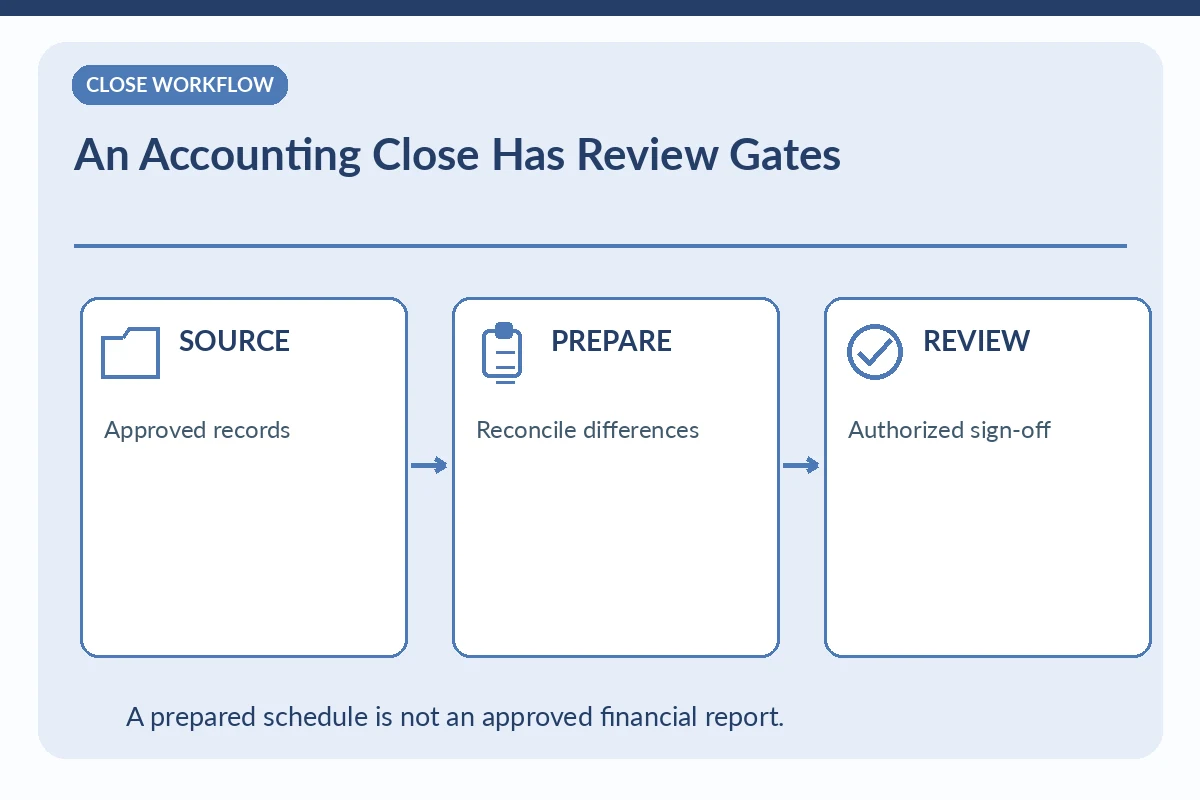
Understand the Month-End Close as a Sequence of Controls
An accounting close often involves source records, reconciliations, review, adjustments, reporting, and an authorized release. Your exact role may cover only one stage. Draw the handoff points for your team and mark deadlines, dependencies, and people responsible for decisions. A reliable plan acknowledges upstream data quality and downstream review instead of promising to speed up the entire process alone.
Request permission to observe an adjacent stage or prepare a draft support schedule. If you spot an unexplained variance, document what you checked and ask who can determine the journal entry or correction. The career skill is not merely spreadsheet speed; it is the ability to recognize a control issue and leave a traceable record that someone with proper authority can evaluate.
Build Technology Skills Without Faking System Ownership
Accounting tools differ among employers, so learn only what your team uses or what authentic job descriptions require. A useful small project may involve validating an export, documenting a spreadsheet control, or rebuilding an approved report with a clear source reference. Keep company datasets inside permitted systems and avoid copying transaction records to personal accounts, cloud notebooks, or portfolio websites.
Document the application, task, and review status. “Used Excel to prepare an approved schedule that the controller reviewed” is precise; “implemented automated controls for the finance department” needs proof and actual authority. Distinguish internal procedure knowledge from public credentials. A software badge or course completion can be named if actually earned, but neither alone proves real close-cycle judgment.
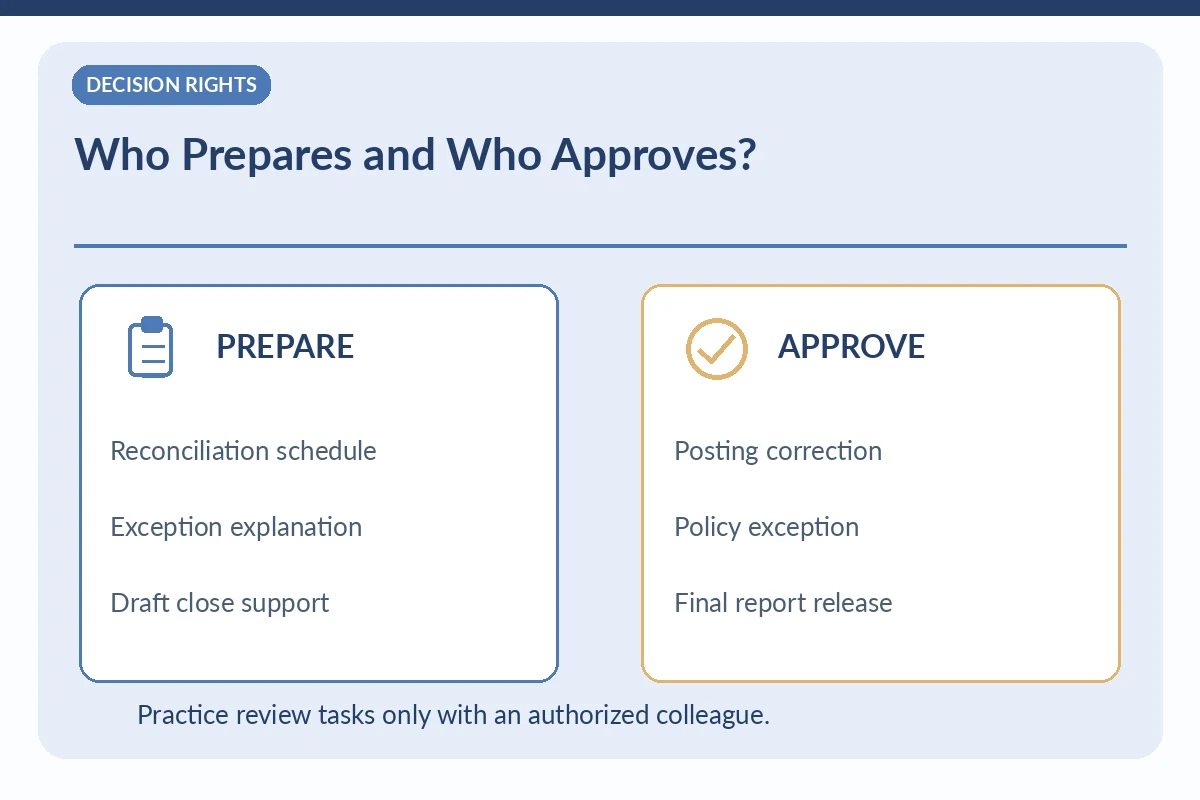
Prepare for Review Responsibilities Through Feedback
The next growth step may be learning to inspect supporting documents or explain a variance before a senior colleague signs off. Ask what a reviewer checks: source completeness, cutoff, sign conventions, reasonableness, and evidence of approvals. Practice annotating a fictional or approved sample rather than real confidential financial statements. A reviewer should be able to see your reasoning without guessing.
Seek feedback on the quality of your explanation and on when you involve the right person. If a line is inconsistent with an approved policy, escalate; do not treat a career practice assignment as permission to post a journal entry, change a control, or release a report. The strongest promotion evidence may be that you know where your independent work ends.
Build an Action Plan With a Real Reviewer and Review Date
Set one short-term target for accuracy, another for a cross-functional handoff, and one longer-term target tied to a realistic target role. For each, name the approved activity, the person who can provide feedback, the evidence you will retain, and when you will reconsider the plan. OPM describes individual development plans as records of activities and check-ins rather than a substitute for performance evaluation.
At review, decide whether the skill is demonstrated, still supervised, or blocked by missing access or training. If CPA licensure or a new specialty is a goal, verify the current requirements with the relevant official body before paying for preparation. A career plan should give you better choices, not certify that you can perform duties the employer has not assigned.
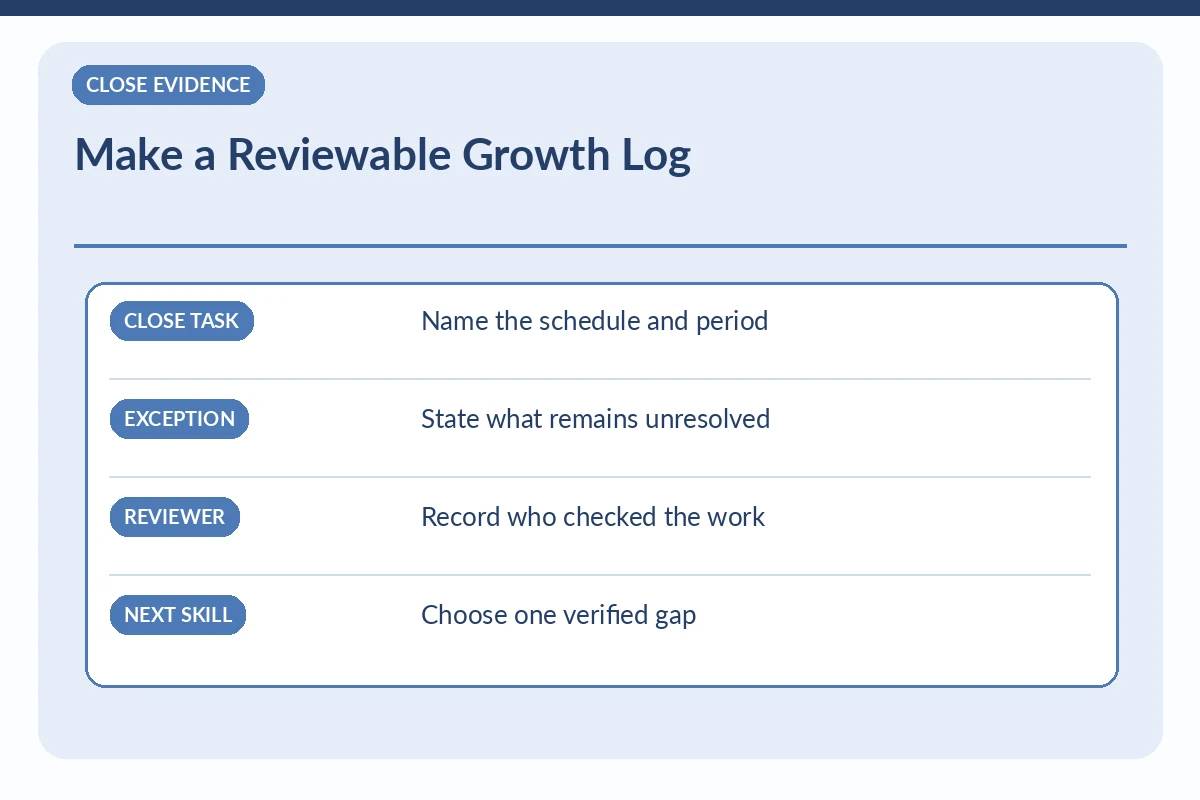
Use a Sample Review to Check Your Accounting Reasoning
Before requesting broader responsibility, ask an authorized reviewer to inspect how you explain a supported variance. Present the source, period, proposed classification and unresolved points; do not alter live reports simply to create a training example. A good reviewer should be able to reproduce your conclusion or identify missing support. If the problem involves tax, compliance, audit or reporting disclosures, follow the proper specialist process. Your plan can then record the exact skill to practice and the evidence of review, without exposing confidential balances or claiming the authority of a licensed professional.
How We Research Career Development Guidance
Checked 2026-11-15: www.bls.gov (accountants analyze and maintain records, examine accuracy and can develop into more responsible roles); www.onetonline.org (accountant tasks and tools for reconciliations, reports and documentation); www.opm.gov (how individual development plans connect employee goals, activities, and supervisor feedback). These occupational descriptions identify common work, not automatic permission to perform regulated tasks or decide for an employer. Career plans and examples are illustrative, not real personal or organizational outcomes. Verify the specific job posting, current training requirements, workplace policies, and authorized reviewers before acting. No paid endorsement is confirmed in this guide; see the JobAsk affiliate disclosure.
Explore Related Career Guides
One example is improving documented reconciliation and exception explanations with feedback from an authorized reviewer.
No. CPA licensure follows jurisdiction-specific education, examination, and other requirements.
Only with explicit authorization and appropriate confidentiality protection; fictitious examples are safer for public learning portfolios.
Describe the stage you handled, the reports or reconciliations involved, and who reviewed or approved the result.
Compare target role requirements with independently confirmed experience and ask a supervisor for a supervised practice opportunity.