
A teaching assistant development plan works best when it focuses on support activities you actually perform under a teacher’s direction: preparing materials, reinforcing an assigned lesson, helping students follow routines, and reporting observations appropriately. Choose one classroom skill, ask the supervising teacher to define the permitted practice, and document progress without exposing student records. This is a professional-learning worksheet, not a substitute for school policy, special-education plans, professional licensing or a teacher’s instructional judgment.
Start with the classroom’s actual support needs
Ask the supervising teacher which predictable moments create friction for learners: transitions between activities, instructions for independent practice, material distribution or keeping a small group engaged. Choose a problem you can influence as an assistant. ‘Help students start assigned work after a transition’ is a clearer target than ‘improve academic outcomes’ because the latter depends on many teaching decisions outside your scope.
Observe the routine as instructed and note the general process, not private student details. For example, identify whether children wait for supplies or misunderstand which task comes next. If a learner has an individualized support plan, follow the staff procedures and your assigned responsibilities; do not independently change accommodations, discipline procedures or learning targets.
Select a skill the supervising teacher can observe
A useful first goal may involve giving concise directions exactly as agreed, preparing a visual schedule, using a consistent handoff phrase or reporting when a student needs the teacher’s attention. Discuss what success looks like before practicing. The teacher may want you to reinforce an existing explanation rather than inventing a new lesson. The distinction matters for accurate performance reviews and future applications.
Frame the goal as a bounded practice: ‘During approved small-group work, I will use the teacher’s instructions and ask for feedback on clarity.’ This is better than ‘I will independently teach reading’ if the role does not permit independent instruction. Training in a strategy also does not authorize using it with every student regardless of individualized needs.
Plan observation, rehearsal and feedback
Arrange a short observation of the teacher or an experienced assistant using the existing procedure. Rehearse with sample materials and ask for two specific pieces of feedback: what made the directions clear and where you should pause or refer back to the teacher. Then use the strategy only in an assigned context. A development plan should fit the real classroom schedule rather than taking attention away from supervision.
A practice log can record the task, date, adult feedback and a next adjustment. Avoid evaluative labels about students, names, behavior diagnoses or personal details in a private notebook. If the school has approved forms for observation, use those instead. Keep the focus on your own actions and the teacher’s feedback, not on unsupported conclusions about an individual learner.
Recognize when a question belongs to the teacher
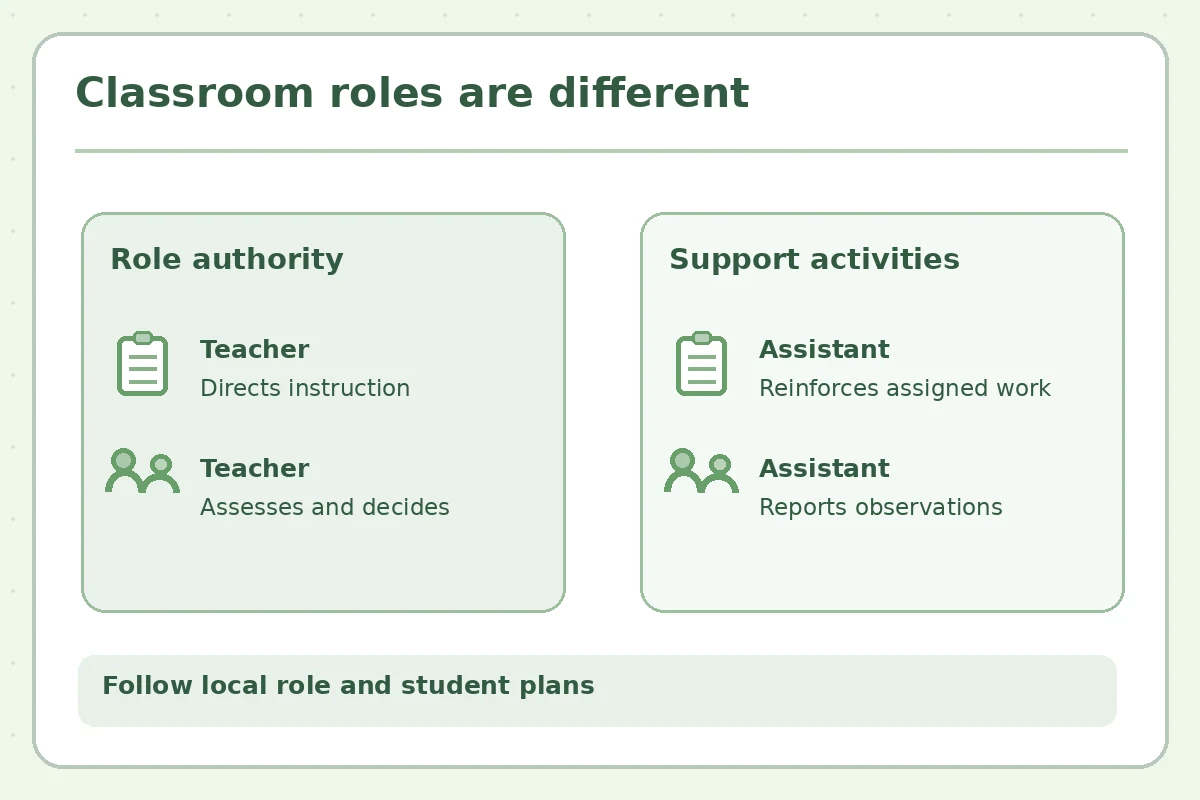
Teacher assistants frequently support explanations and routines, but decisions about curriculum, assessment, individualized instruction and formal reporting may rest with licensed teachers or other authorized specialists. When asked to make such a decision, use the established referral route rather than guessing. An assistant should not alter a grade, change student support services or promise a parent a new plan without authority.
This boundary also applies in a resume or performance evaluation. You can describe ‘reinforced teacher-led literacy practice and organized materials for assigned groups’ if true. Do not turn that into ‘designed the literacy curriculum’ unless you actually had the responsibility and authority. Accurate scope is a professional strength, not an omission to hide.

Choose evidence that protects student privacy
Possible evidence includes a blank template you created with permission, a supervisor’s feedback note, a checklist of material preparation steps or a reflection on a classroom transition. Avoid screenshots of student records, identifiable work samples and unapproved photographs. School policy, family consent requirements and applicable rules determine which artifacts may be retained or shared.
Suppose you learned to prepare a teacher-approved visual instruction sheet. Your portfolio can show a generic sample that has no identifying class data and was cleared for sharing. It should say ‘prepared materials to support assigned practice,’ not imply that the sample was a new instructional program you independently developed. Keep a short description of the teacher’s role in review.
Set a modest review interval and next skill
Choose a review point connected to the activity, such as after several approved practice sessions or the next staff meeting. Ask whether your instructions are clear, whether materials are ready when needed, and whether escalations happen promptly. A teacher may decide to adapt the procedure for the class; your role is to contribute observations and follow the agreed approach.
The next skill might be smoother small-group transitions, accurate clerical records or support with accessible materials. If you want to become a licensed teacher, separately research the education, training and credential requirements for your state. Assisting in a classroom is valuable experience, but it does not itself award a teaching license or guarantee admission to a program.

Use a concrete sample plan without invented outcomes
Hypothetical plan: ‘With the teacher’s approval, prepare the assigned activity materials before the first small-group rotation, use the posted task sequence and request weekly feedback on transitions.’ Evidence could be a teacher-approved checklist and a brief reflection on your preparation. The example does not claim that student test scores increased or that the school introduced a new official program.
When reporting the result, state only what you personally verified. ‘Prepared all assigned packets for observed sessions and revised the checklist after feedback’ is defensible if you kept the records. If a routine was interrupted or a goal was too ambitious, describe what changed in the process rather than turning a partial attempt into a completed accomplishment.
How We Research and Verify the Guidance
We reviewed role-specific source guidance, compared the intended reader decision with previously prepared JobAsk topics, and distinguish illustrative scenarios from official employer or institutional policy. Source references checked on 2026-11-10: BLS: Teacher Assistants (BLS describes teacher assistants as reinforcing lessons under teacher direction and helping with materials and records.) U.S. Department of Education: FERPA (The U.S. Department of Education explains when school personnel may access student education records in their official duties.) We do not imply that training completion guarantees authority, hiring or a workplace benefit.
This page is independent informational guidance, not a statement of any employer’s policy or a paid endorsement. Review the affiliate disclosure and verify local policies, job qualifications, and any individual benefit or licensing details before acting.
Explore Related Career Guides
You can propose professional-learning goals, but practice involving students should be agreed with the supervising teacher and consistent with school policy.
Only if your role and supervising teacher permit the activity. Creating a draft resource does not transfer instructional responsibility or licensure.
Record teacher feedback, correct preparation of assigned materials, clarity of approved instructions and whether you followed referral procedures.
Do not retain identifiable student work or records without authorization. Prefer approved blank examples and non-identifying reflections.
Not by itself. Teaching licenses and educational requirements vary by state and position; check the relevant credential authority.