
A postdoc career development plan should track two connected but different things: the research you are responsible for now and the roles you may want next. Use an individual development plan (IDP) to record skills, interests, evidence and mentoring questions. A research milestone does not by itself guarantee a faculty position, and an interest in industry does not mean you have already worked in a regulated or commercial setting. The sample IDP below is an adaptable planning tool, not an NIH form required from every individual or a substitute for your institution’s policies.
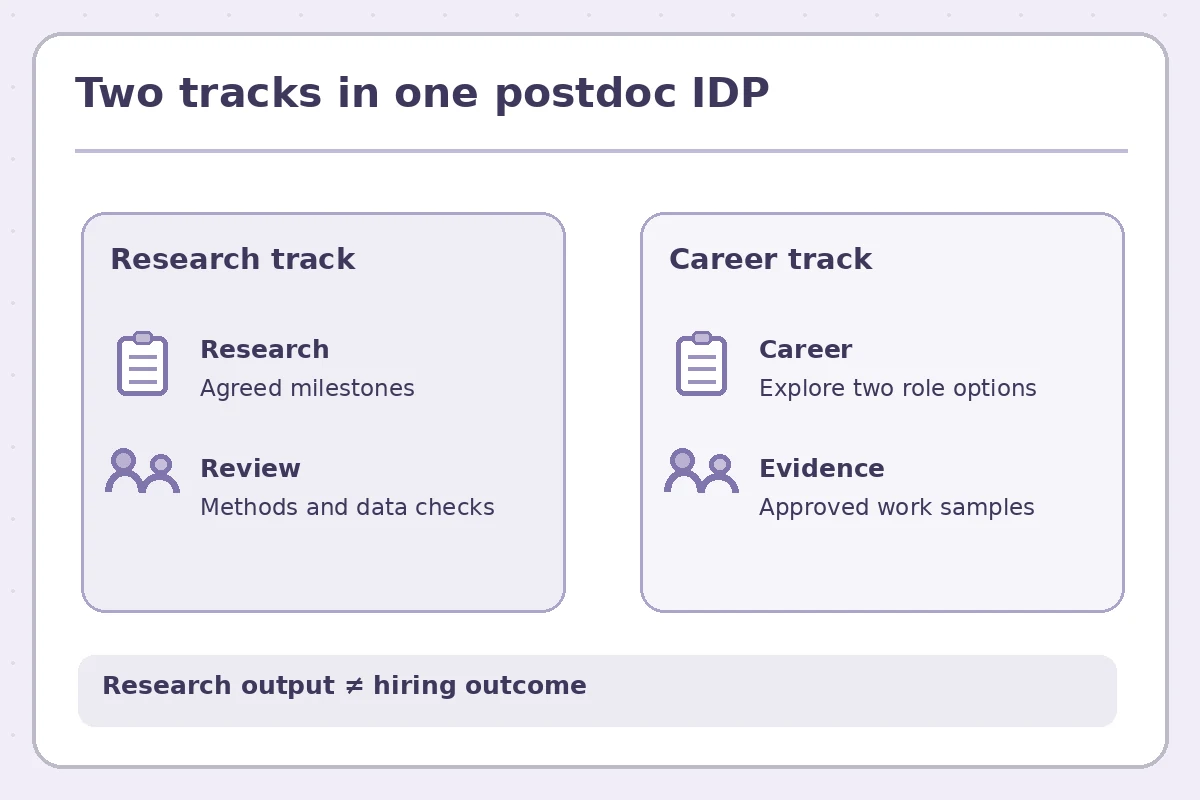
Keep research commitments and career exploration distinct
Start with an inventory of your actual research duties: study design contributions, protocols you are authorized to use, data analysis, documentation, collaboration and publication stages. Separate those responsibilities from prospective destinations such as faculty work, research operations, scientific communication, core facilities, policy support or industry research. The same skill may travel between paths, but the workplaces can require very different qualifications and decision authority.
Write two columns. The research column tracks agreed deliverables and dependencies; the exploration column tracks conversations, training and evidence you need to test an option. A manuscript in preparation is not a published article, and a supervisor’s preliminary feedback is not a completed project outcome. Accurately representing stages will help mentors give useful advice.
Use an IDP as a working document, not an outcome claim
An IDP can include a self-assessment, medium-term career options, specific learning actions and periodic reviews. NIGMS and NIEHS describe such plans as tools for mentoring and intentional training, with templates that can be adapted. NIH’s historic policy concerns institutional descriptions of IDP use in certain progress reports; it does not mean your private plan should be submitted as a manuscript or publicly posted.
Choose a scope you can maintain. A plan that lists every possible academic and nonacademic career rarely guides action. Pick one primary option and one alternative to investigate, note what is still uncertain, and set a review tied to a real event such as a mentoring meeting or project checkpoint. Revise the plan when priorities change rather than treating the first draft as a promise.
Find evidence of transferable skills without exaggerating
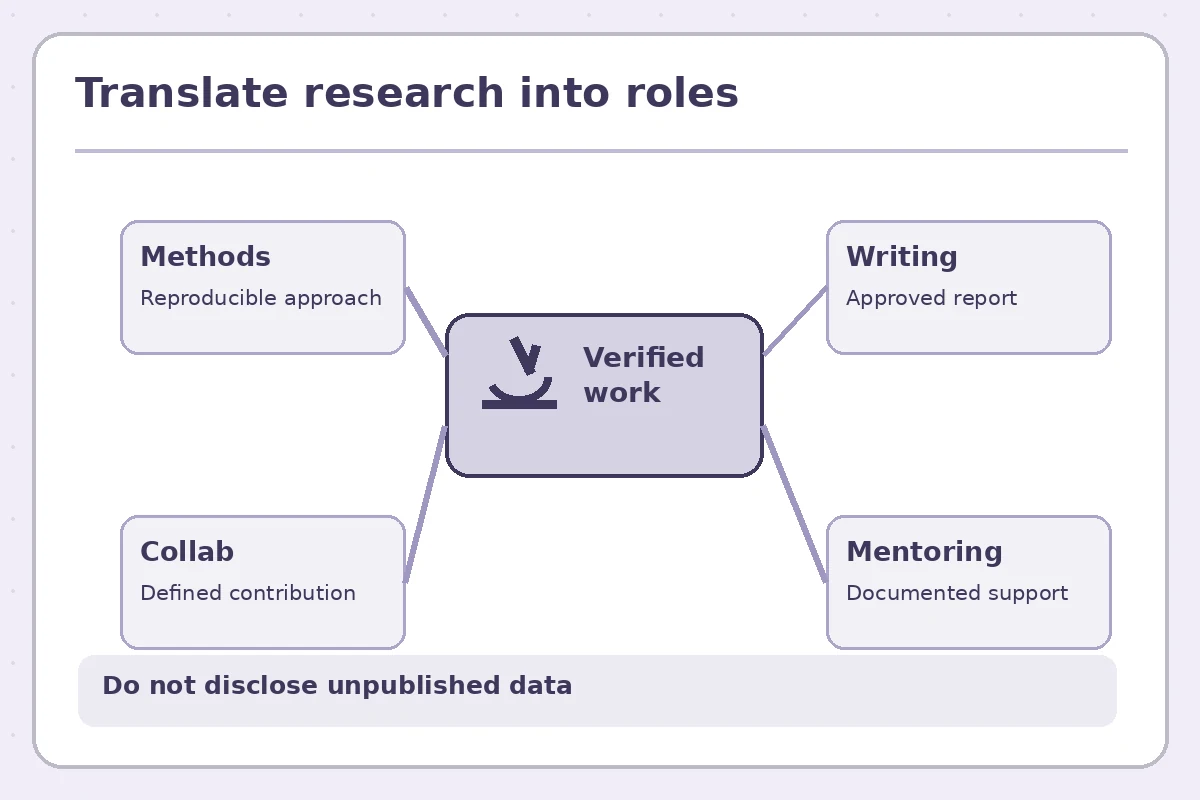
Describe what you directly did. If you designed a data-cleaning procedure, note your contribution, methods and review process. If you coordinated a meeting or trained a new lab member under an approved protocol, distinguish your support role from formal supervision or credentialed oversight. Avoid converting ‘collaborated on’ into ‘led’ or describing an unpublished result as validated by outside experts.
Build an evidence table with three fields: activity, verified product and next role where it matters. For example, an approved reproducible analysis notebook may support a data-quality role; an accessible methods presentation may support research communication. Confidential datasets, unpublished partner results and identifiable participant information do not belong in a public portfolio without explicit authorization.
Plan mentoring conversations for different decisions
Your primary research mentor can advise on project priorities and disciplinary expectations, but may not know every alternate career. Consider a career counselor, alumnus, core facility leader or other appropriate professional for exploratory conversations. State the purpose clearly: ‘I am learning how research documentation differs in academic and applied teams, and would value your perspective.’ Do not ask them to promise a referral or guarantee a position.
Prepare role-specific questions: what decisions are made independently, how work quality is reviewed, which tools are essential and how people enter the field. Compare those answers to formal job descriptions. One person’s career path is useful evidence, not a universal route. Document general insights and follow up respectfully, without publishing private conversations.
Choose development activities that fit the lab
Possible next steps include a methods course, a supervised presentation, peer review of documentation, an approved teaching assignment or a conversation with another department. Each activity should have a connection to a skill gap you can name. Ask the appropriate supervisor about time, data access, authorship, intellectual property and training requirements before committing to outside work or public samples.
Avoid treating workshops as automatic certification or proof of competence. A course completion may show exposure to a method; an approved reproducible deliverable or observed practice can show what you applied. If a new role requires formal credentials, verify them from relevant institutions and actual job postings. Your IDP should preserve research obligations while making room for deliberate exploration.
Put timelines, dependencies and review points in one place
A realistic research career plan records factors you control and factors you do not. You may schedule a draft analysis, an application, or a mentoring conversation, but a journal decision, hiring outcome or grant approval is not yours to promise. Add dependencies such as data access, coauthor review or institutional approvals. This makes delays visible without turning uncertainty into failure.
At each review, ask what evidence changed: did a career conversation reveal a different skill requirement; did a project produce a shareable work sample; did your interests shift? Update one action at a time. An IDP can accompany an annual review if your institution uses it, but do not copy restricted project notes into a broadly distributed document.

Write a sample postdoc IDP entry honestly
Hypothetical entry: ‘Explore research operations roles by comparing three relevant job descriptions, interviewing one professional with permission, and identifying how my existing protocol-documentation experience aligns with their workflows.’ Evidence would be the comparative skills notes and an approved, nonconfidential writing sample if available. Nothing in this example guarantees an interview, an opening, or a completed industry credential.
For a research milestone, a separate entry might read ‘Prepare an analysis report for supervisor review using approved project data; document assumptions and outstanding quality checks.’ At a review, report whether the draft was submitted for internal comment, revised or approved. The distinction between work in progress and accepted results strengthens your credibility across both academic and nonacademic paths.
How We Research and Verify the Guidance
We reviewed role-specific source guidance, compared the intended reader decision with previously prepared JobAsk topics, and distinguish illustrative scenarios from official employer or institutional policy. Source references checked on 2026-11-10: NIGMS: Individual Development Plans (NIGMS describes IDPs as dynamic, periodically reviewed career and mentoring tools.) NIEHS: IDP Forms (NIEHS provides adaptable IDP formats and career planning resources for research fellows.) NIH: IDP Policy (NIH distinguishes institutional reporting about IDPs from submission of actual private plans.) UC Berkeley: Informational Interviews (Berkeley separates informational interviews for learning from job interviews and offers preparation and follow-up steps.) We do not imply that training completion guarantees authority, hiring or a workplace benefit.
This page is independent informational guidance, not a statement of any employer’s policy or a paid endorsement. Review the affiliate disclosure and verify local policies, job qualifications, and any individual benefit or licensing details before acting.
Explore Related Career Guides
No. A research proposal defines scholarly work; an IDP also addresses skills, mentoring, career options and development actions.
NIH policy discusses institutional use and progress-report descriptions for relevant awards. Check your institution and award requirements; private IDPs are not automatically submitted.
Only with explicit permission under applicable institutional, sponsor and collaboration rules. Use nonconfidential approved examples when available.
Schedule targeted informational conversations and learning activities around agreed lab commitments, with approvals when time or resources are involved.
No. Publications are part of research evidence, but hiring depends on many role-specific factors. Do not describe outcomes as guaranteed.