
A sales professional may enjoy explaining products and solving customer problems but dislike prospecting, variable compensation, or pressure to close. Those preferences suggest different destination roles. Customer success, customer service, onboarding coordination, and sales operations are not identical. Some customer success jobs carry renewal or expansion targets; some operations jobs focus heavily on data, processes, and reporting. Choose which responsibilities you want more of before picking a fashionable title.
Write two lists: duties you already perform and duties you no longer want. Then read several postings to determine whether the supposedly new job still owns a quota, requires weekend coverage, or includes cold outreach. Ask what success looks like in the first quarter and which team is responsible when an account needs urgent help. An adjacent title is not automatically a clean break from sales targets.
Translate customer communication into a verifiable result
BLS describes wholesale and manufacturing sales representatives as contacting customers, explaining products, negotiating, and responding to questions. Some of that background may help with onboarding or service coordination, especially when you can document discovery calls, accurate product explanations, or handoffs. But selling a product does not itself prove you managed adoption, resolved support tickets, or implemented a customer’s system. Use the actions you performed, not the job duties you hope to do next.
For example, a hypothetical salesperson might have documented client requirements and passed them to an implementation team. A truthful bullet would name that handoff and whether the salesperson tracked unanswered questions. It would not say the salesperson “led deployment” if implementation staff owned the configuration. Redact client names and confidential account details before showing any notes or examples.

Distinguish customer success, service, and operations
Customer service representatives typically answer questions, process requests, record contacts, and refer issues beyond their authority. Customer success can involve ongoing business relationships, but employer scope differs widely and may include commercial targets. Operations support may require spreadsheet accuracy, workflow documentation, CRM administration under approved permissions, and data reporting. Management analyst roles, by contrast, often expect a degree and significant related experience; they should not be treated as a universal entry-level option for salespeople.
Build a comparison table from actual postings: goal, daily tasks, metrics, system access, and who approves exceptions. Notice the difference between being allowed to update a routine account record and independently changing contract terms. A job description that emphasizes renewals or upsells may recreate the part of sales you hoped to leave, even when it carries a relationship-oriented title.
Use account handoffs as your strongest bridge
Draw a simple journey from customer question to sale, implementation, support, and ongoing review. Mark only the segments where you personally worked. If your contribution ended with the signed order, do not claim ownership of adoption or retention. If you supported post-sale coordination, note what you tracked, which team resolved issues, and what information you passed on. This produces a credible story without taking credit for another department’s work.
A good hypothetical interview example could describe recognizing a mismatch between the promised delivery scope and a customer’s expectation, documenting it, and involving the authorized account owner. Explain what was clarified and how the record was updated. Avoid citing a reduction in churn, a renewal rate, or a customer satisfaction increase unless you can verify it and establish your actual contribution.

Prove the missing systems skills with a safe sample
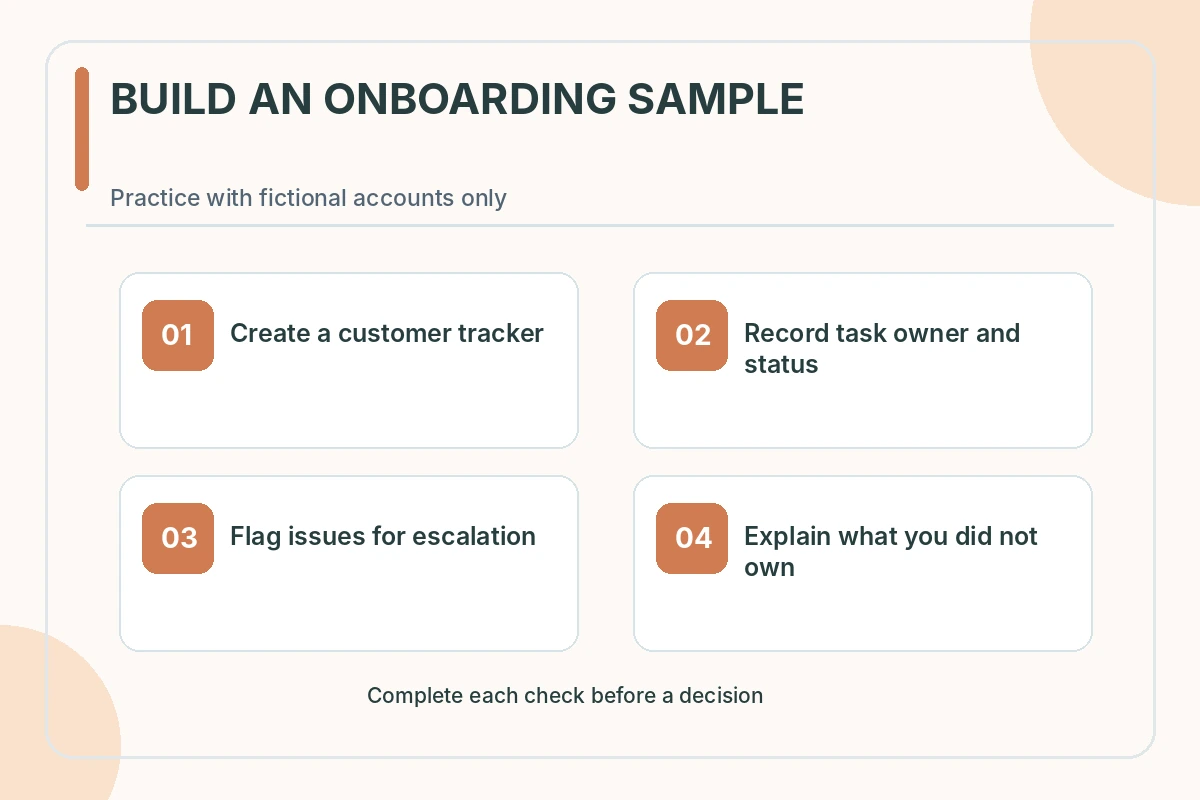
Many adjacent roles use a customer relationship management system, ticket queue, knowledge base, or dashboard. User-level CRM familiarity does not automatically mean you can administer permissions, automate workflows, or analyze a production database. Identify one technical gap that appears repeatedly in your target ads. Create a synthetic customer onboarding tracker showing status, owner, next contact, and unresolved question; add a simple escalation decision when the request exceeds your role.
Use fictional account names and label the data as practice. You might add an example of how to summarize an issue without assigning a confidential customer a public case study. If you study reporting, demonstrate how you checked duplicated entries and defined a metric; do not assert that a dashboard increased revenue without real evidence. Keep the project small enough that you can explain every column and decision in an interview.
Compare offers by control, coverage, and incentives
Ask whether the new role has a sales quota, renewal responsibility, variable compensation, assigned accounts, urgent support shifts, or weekend work. Compare base pay, commission structure where relevant, benefits, and expectations using actual written offers. A role that appears to be “customer success” may still require prospecting or upselling; a support role may measure call volume and strict handling time. Evaluate whether those conditions meet your goals.
Do not rely on an occupational median as the salary you will receive. Ask whether the company provides onboarding, product training, and escalation support. Review which decisions you can make independently versus those requiring a manager, technical team, or account executive. The change is meaningful only if daily work and decision rights differ in ways that suit you.
Tell the transition story without rejecting your experience
Your resume should still identify the real sales titles and employment dates. Select bullets that show careful needs discovery, accurate recordkeeping, cross-team coordination, or approved follow-up. A sample introduction might be: “B2B sales representative experienced in documenting client requirements and coordinating handoffs, now targeting an onboarding support role.” Treat it as a template to adapt, not a verified biography.
In interviews, explain the work you want to perform rather than apologizing for being “too sales focused.” Provide a real example of an accurate handoff, describe a relevant practice project, and state a capability you are building. When the interviewer asks about experience you lack, answer plainly and offer a plan to learn. Credibility and clear boundaries make a better transition case than renaming quota-driven achievements as service outcomes.
How We Research and Verify This Guide
This article uses occupational guidance and work-role descriptions from primary public sources, checked on November 2, 2026. Examples are hypothetical and illustrate how to assess responsibilities; they do not predict hiring results, eligibility, salary or legal rights. Check a specific employer and applicable licensing body before acting. The site policy is described in our affiliate disclosure. We do not claim a verified affiliate relationship in this guide.
BLS source: BLS sales roles, prospecting, product explanation, and customer communication. Consult the official source and the individual job posting for any role-specific requirement.
BLS source: BLS service representative responsibilities and escalation practices. Consult the official source and the individual job posting for any role-specific requirement.
BLS source: BLS business analyst-style management consulting scope and typical experience. Consult the official source and the individual job posting for any role-specific requirement.
CareerOneStop source: CareerOneStop Skills Matcher for comparing existing skills with occupations. Consult the official source and the individual job posting for any role-specific requirement.
Explore Related Career Guides
Often, but not always. Some customer success roles include renewals or expansion targets. Review the employer’s duties and compensation structure.
Yes, depending on the employer’s requirements. Show accurate communication, problem documentation, and escalation behavior rather than treating closing deals as support experience.
No. Using records is different from configuring permissions, workflows, and integrations. Describe precisely what you did.
Use only metrics you can verify and explain your contribution. If another team owned renewals, describe your handoff or coordination work instead.
A synthetic onboarding or account-handoff tracker can demonstrate ownership, escalation, record accuracy, and next-step communication without exposing client data.