
Administrative assistant career goals should improve a real office workflow—not simply promise to “be more organized.” Choose a process you can observe, such as calendar changes, meeting preparation, record retrieval, or visitor handoffs. Define what an accurate output looks like and what happens when a decision needs someone else’s approval. Administrative roles differ by employer, and some involve specialized systems or confidential records. The examples here show how to make a modest, auditable development plan without pretending you control budgets, personnel decisions, or other responsibilities beyond your assigned scope.
Pick the office workflow with the clearest friction
Look for a repeated difficulty that you are authorized to improve. Calendar invites may lack a consistent agenda, shared files may use inconsistent names, or meeting decisions may be hard to locate afterward. O*NET describes scheduling, filing, correspondence, and information routing as common administrative activities, but not every assistant handles all of them. Start from the actual work request and the users who rely on it. A useful goal changes a process, not a job title.
Illustrative goal: “Over the next eight weeks, trial a standard agenda-and-location check for recurring meetings I coordinate, and review corrections with my supervisor twice.” Do not set a false zero-error target. Ask who can approve a change to the calendar process before enforcing it across a department. The improvement should make it easier to find or confirm information, not add paperwork for its own sake.
Make scheduling goals about clear decisions
A better calendar is not merely fuller. It records the correct meeting owner, time zone, attendees, location or video link, and required prework. When there is a conflict, an assistant may propose alternatives while the meeting owner decides the priority. A good goal is to use an approved confirmation checklist for selected meetings and log recurring reasons for corrections. The log can contain process categories without revealing private meeting content.
If you support multiple leaders, define how urgent requests are routed. “I will escalate competing schedule requests to the named owner with two viable alternatives” is more defensible than “I will personally resolve every conflict.” The assistant can standardize information gathering while leaving executive decisions to the authorized person. In a review, describe the practice and actual feedback rather than claiming a guaranteed time savings you never measured.

Improve document retrieval without weakening privacy
Recordkeeping goals may focus on folder structure, naming conventions, retention instructions, or version identification. Before reorganizing shared records, verify ownership, access permissions, and the organization’s retention rules. Do not move personnel files, medical information, or financial data into convenient but unauthorized locations. A useful first activity is to map the current approved location for commonly used forms and identify broken links or duplicate filenames.
An illustrative objective is to document a standard naming convention for one approved document category and test whether colleagues can retrieve the current version. Report the number of files reviewed only if it is accurate, and do not claim the entire archive was cleaned when you handled one folder. Ask the records owner to approve deletions or policy changes. Better organization should preserve traceability rather than erase history.
Develop accurate meeting notes and handoffs
Meeting notes are useful when they distinguish decisions, proposed actions, owners, and open questions. An assistant who records a decision is not necessarily the person who authorized it. Set a goal to use a consistent draft-notes template for assigned meetings, send notes for approval, and track whether recipients can identify action owners. Avoid inserting confidential discussion into a development portfolio. Examples should use invented, non-sensitive facts.
A handoff checklist can include the request, date, pending item, documents stored in an approved place, decision owner, and next contact. If the handoff crosses departments, clarify what you may share. One useful milestone is to prepare a handoff for a supervisor to review, revise confusing fields, and repeat the process with a second authorized task. This is more concrete than the promise to “communicate better.”

Build software skills through approved tasks
Learning an office tool should solve a real problem and fit the employer’s security requirements. You might learn more reliable calendar search, accessible document formatting, spreadsheet validation, or mail-merge review. Do not download workplace records to a personal account or feed confidential documents to an unapproved service. Ask what the organization permits, then practice with sample information before using the method on live material.
Write an activity-based goal: complete approved training, build a fictional sample, demonstrate the workflow to a supervisor, and use it in one authorized task after review. “Advanced Excel” is not a verified credential simply because you watched a tutorial. If you learn formulas, document what you can actually build and check. Software familiarity should support a workflow, not become a vague adjective disconnected from the job.
Separate preparation from approval and spending
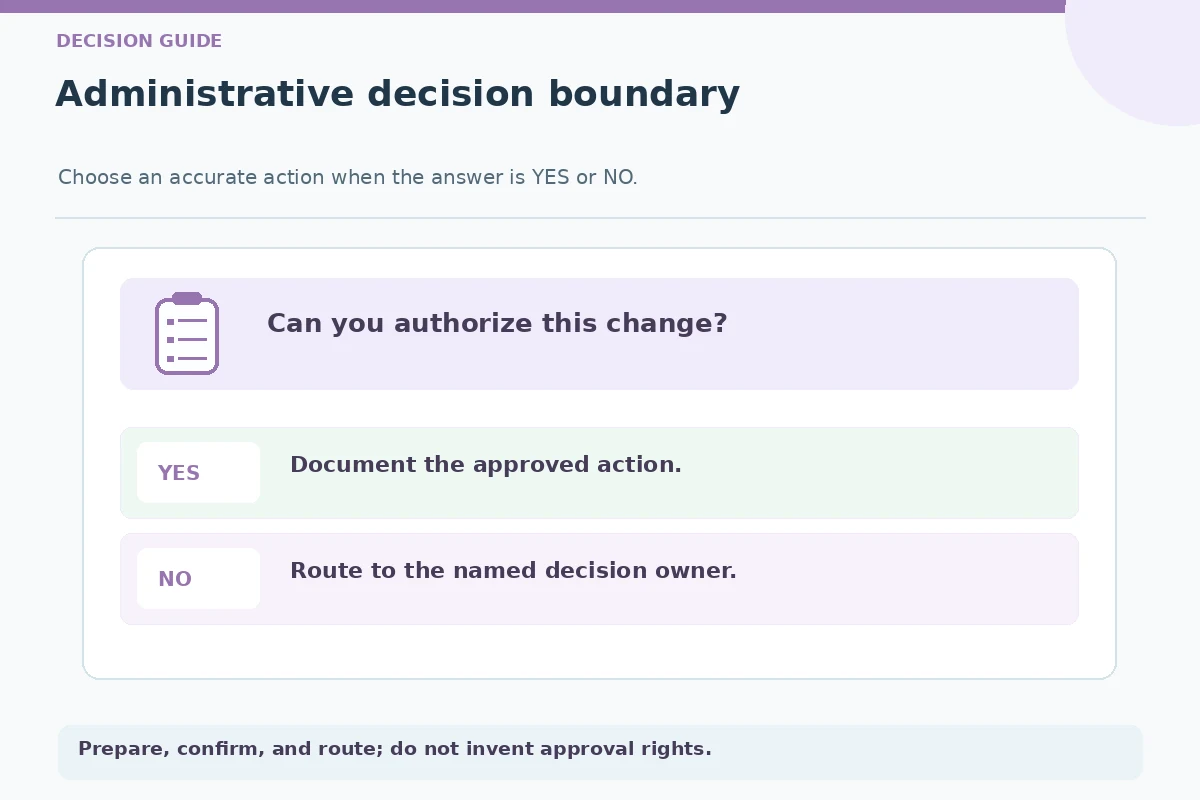
Administrative support may involve purchase requests, travel arrangements, invoices, or policy-related forms. Preparing the document is different from approving payment, changing an employee record, or making binding commitments. Map the approval chain before setting a stretch goal. A sound development objective could be to reduce incomplete submissions by adding an approved fields checklist—not to approve purchases independently.
When errors occur, record the kind of missing information and ask who should clarify it. If a request crosses a financial or HR boundary, escalate rather than improvising. In a performance review, “prepared and routed complete request packets to the authorized approver” demonstrates coordination without claiming final control. This distinction is especially important when a job description bundles many administrative duties under a single title.
Bring an evidence log to the development review
Use a small log with task type, approved change, reviewer, artifact, and next adjustment. Evidence might include a blank meeting template, an anonymized handoff, or an approved screenshot containing no private information. Do not reproduce actual meeting details, client contact records, or employee data in a public work sample. Ask whether your manager prefers examples, routine quality checks, or a short narrative.
The next goal may be more complex administrative coordination, better records practices, or a different specialization such as office operations or project support. A useful development conversation asks which tasks you can learn with supervision and how success will be evaluated. There is no need to invent a promotion target if the real objective is to become more reliable in your current role.
How We Research These Career Development Goals
We reviewed occupation-specific primary sources and professional-development guidance, including www.onetonline.org; www.opm.gov, on November 4, 2026. We distinguish typical occupational tasks from what any one worker may actually do. All sample goals are hypothetical and need adaptation to employer policy, supervision, privacy obligations, and available training. JobAsk may offer independent informational resources; see our affiliate disclosure for the site-wide policy. This article provides career-planning information rather than a guarantee of promotion, certification, or a particular performance outcome.
Explore Related Career Guides
Start with accurate scheduling, records retrieval, or handoff notes in tasks you are assigned. Ask for a short review cycle.
Only when the time comparison is real and measured consistently. A documented process change can be enough evidence.
Only if the organization has explicitly delegated that authority. Preparation and routing are not the same as final approval.
Use blank templates, fictional examples, or approved de-identified process notes; avoid sharing private workplace information.
No. Greater process competence and a broader authorized skill set are meaningful development outcomes.