
For an administrative assistant interview, answer “Tell me about yourself” with a short account of the office support you actually performed, one concrete example, and why that work matches the vacancy. Mention scheduling, accurate records or clear handoffs if those tasks are true of your background. Do not recite your entire resume or introduce yourself as a manager when your role was support. Aim for roughly one minute, adjusting to the interviewer’s cues.
Identify which office tasks the employer actually needs
Read the posting before drafting an answer. One administrative assistant role may center on scheduling multiple calendars, while another may emphasize document preparation, visitor communication or supply records. The Bureau of Labor Statistics describes a wide range of clerical and organizational work, not one universal duty list. Pick the two tasks you can discuss honestly and connect them to the employer’s stated needs rather than trying to mention every software tool on your resume.
Look for the boundary of your responsibility. “Coordinated meeting rooms and sent calendar invitations” is different from “decided executive priorities.” If a supervisor set the schedule and you maintained it, say so. That precision makes the answer easier to defend when the interviewer asks who approved a change, how you checked conflicts or what happened when two people requested the same time slot.
Choose one scheduling or records example with proof
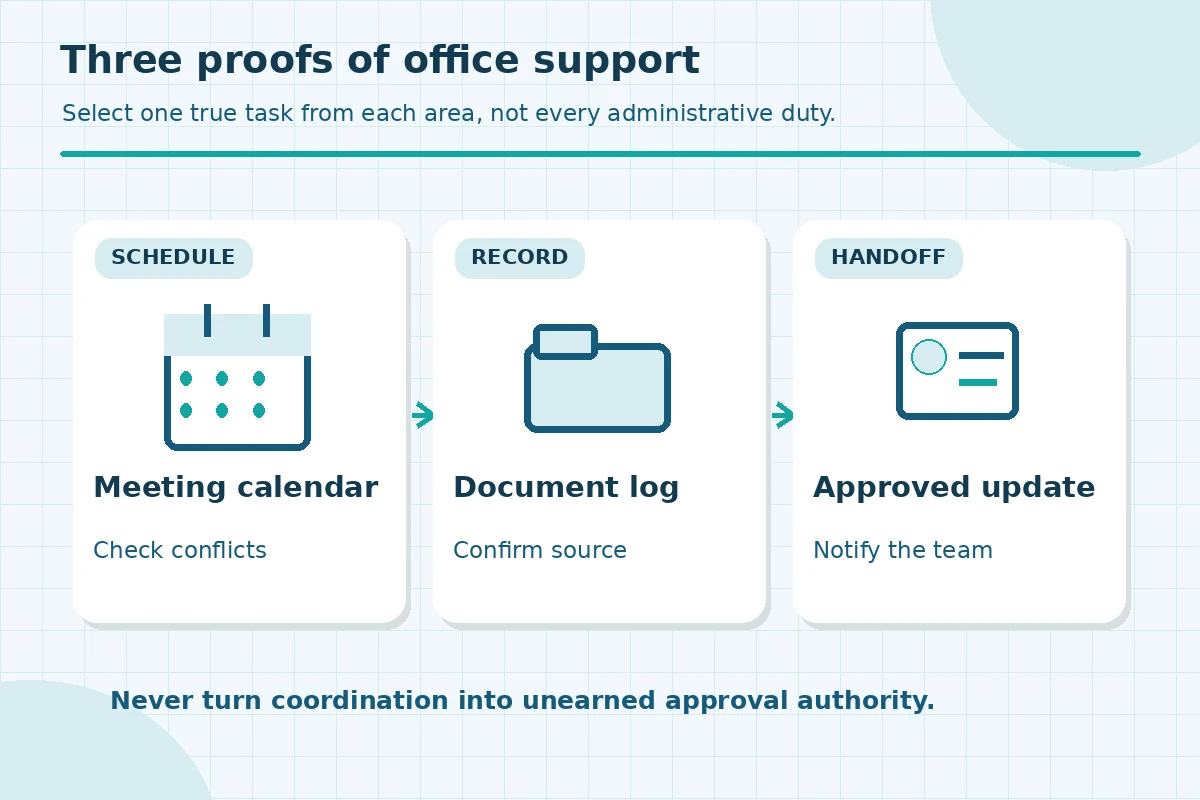
Find a true episode that illustrates orderly work. Perhaps you compared three calendars before confirming a meeting, corrected a duplicate contact entry or followed a document naming convention that helped your team retrieve files. You do not need a dramatic achievement. A credible description of the task, your check and the resulting handoff often tells an interviewer more than a broad claim such as “I am extremely organized.”
Avoid numbers that you cannot verify. If you did not track how many hours a calendar change saved, do not invent a percentage. You can describe the control you used: a shared calendar, confirmation email, approved request form or supervisor review. Keep confidential meeting names, personnel files and client information out of the answer. Concrete process details show judgment without exposing information the organization entrusted to you.
Build a clear opening in three short moves
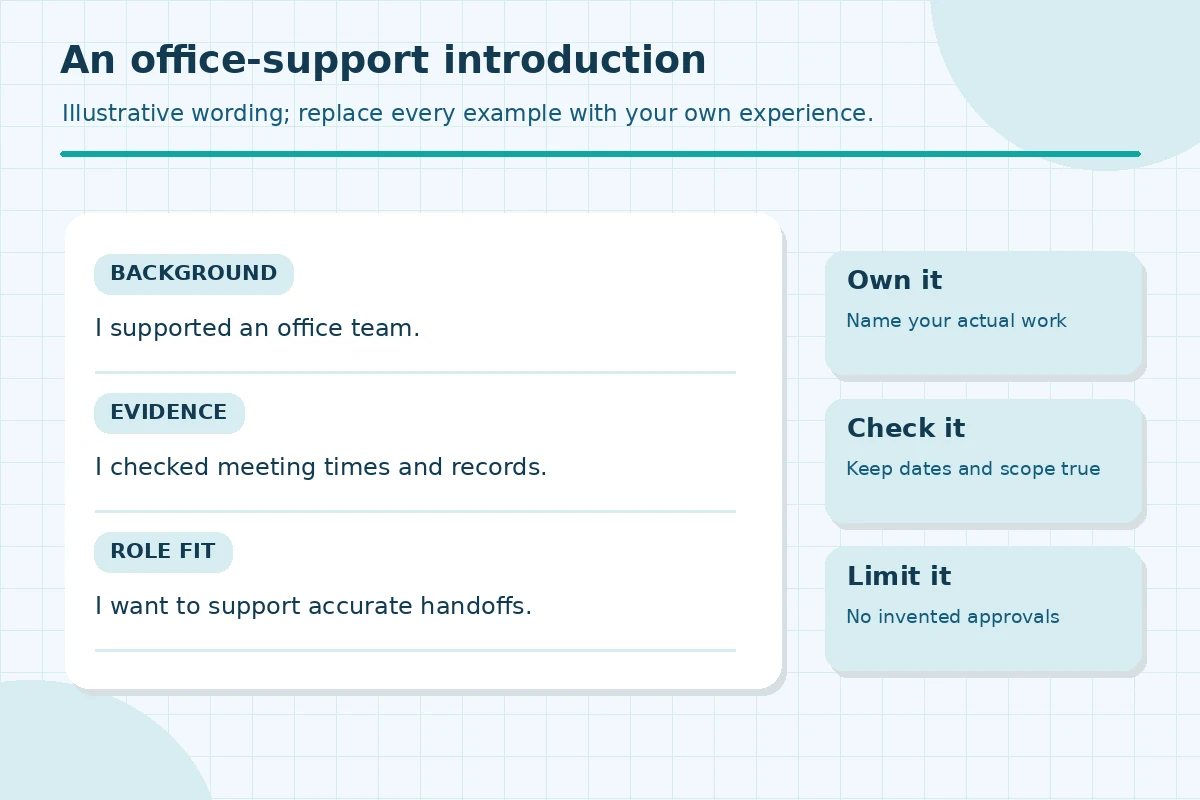
Start with your actual background: “I have worked in front-office and administrative support, where I kept records up to date and coordinated routine appointments.” Next, add one task you can substantiate: “I checked calendar changes against the team’s shared schedule and confirmed details before sending invitations.” Finish with a reason the posted role fits: “I would like to bring that careful scheduling and communication to this office.” These lines are illustrative, not a script to claim as your own history.
Applicants who are new to paid office jobs can replace the first sentence with a truthful school, volunteer or community project. For example, organizing a student club schedule may show relevant planning, provided you label it as student experience. Do not make a class assignment sound like formal employment. Connect the scale of the example to the vacancy and explain what you personally handled rather than what the entire group completed.
Distinguish routine duties from independent decisions
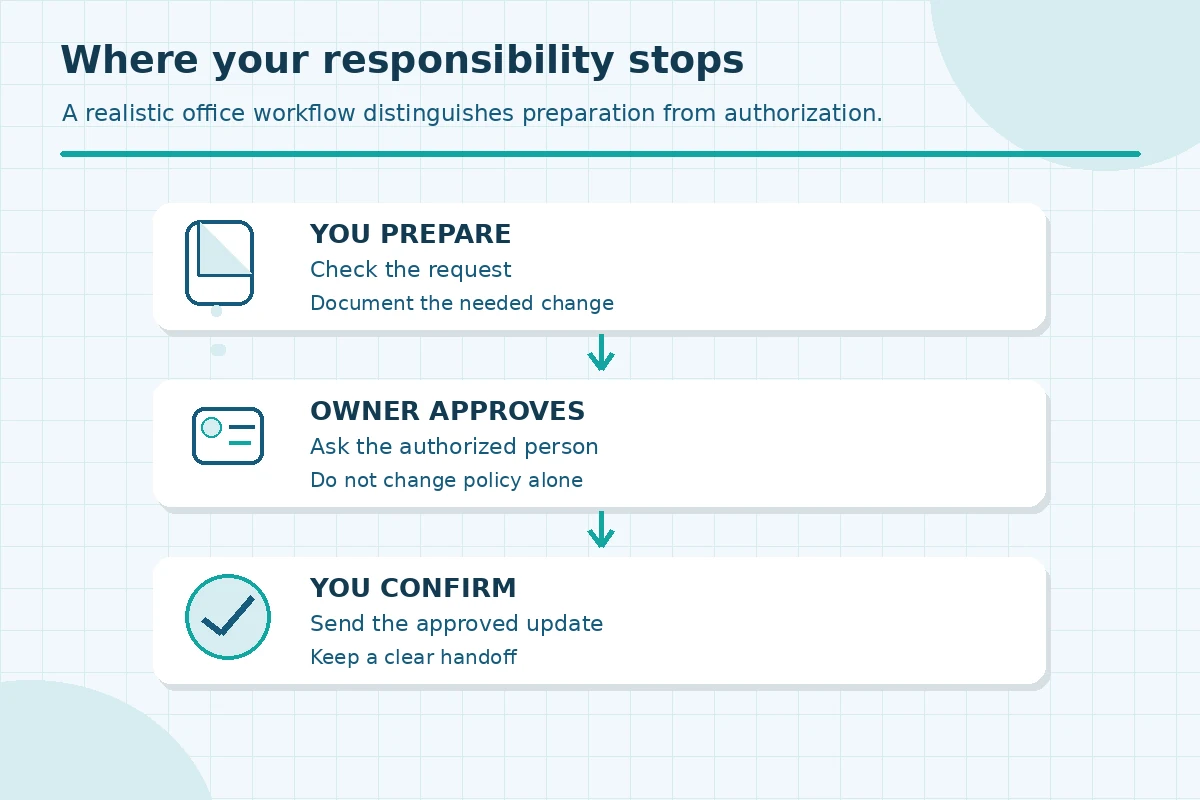
Administrative assistants often coordinate work without having final authority over spending, hiring or policy changes. If you routed supply requests to a budget owner, “prepared purchasing information for approval” is more accurate than “approved all office purchases.” The same distinction applies to calendar invitations, confidential files and visitor access. Explain when you asked a supervisor for a decision and how you kept the request moving afterward.
An interviewer may probe your example with “What did you do when the information was incomplete?” Be ready to explain a responsible sequence: stop the incorrect update, confirm the source, contact the right owner and document the correction according to established procedures. You are not required to know the employer’s internal systems before joining. What matters is describing a reliable process you have actually used.
Adapt the answer for different administrative settings
A medical office may prioritize scheduling accuracy and privacy, while an educational office may emphasize families, staff requests and deadline coordination. A corporate team may rely on shared documents, presentation logistics and meeting follow-ups. Do not imply that these settings have identical rules. If you are changing industries, lead with transferable administrative work and acknowledge that you will need to learn the organization’s particular tools and policies.
Use a short evidence table to decide what deserves space in your introduction: the vacancy request, the matching task you performed and the detail that proves your involvement. For scheduling, that proof might be checking room availability. For records, it might be validating an entry before filing. For communication, it might be notifying attendees of an approved change. Select one or two, not a list of every possible responsibility.
| Posting asks for | Truthful proof to mention | Avoid implying |
|---|---|---|
| Calendar coordination | Confirmed availability and sent approved updates | Final control of executive priorities |
| Records accuracy | Checked source entries and corrected errors | Authorization to release private records |
| Team communication | Routed requests and documented handoffs | Policy ownership or managerial sign-off |
Practice how the answer sounds out loud
CareerOneStop recommends practicing answers with real examples, not only writing them. Say your introduction once while timing it, then check whether a listener can identify your work, your specific contribution and your reason for applying. A natural answer usually needs fewer adjectives and more verbs. “I tracked requests and confirmed meeting details” is clearer than “I am driven, dynamic and uniquely exceptional.”
Listen for a confusing job title or unexplained acronym. If you mention a scheduling product, the interviewer should still understand the task without knowing the brand. Stop after the role connection rather than adding unrelated personal history. If the interviewer asks about another skill, offer a separate example. The introduction opens the conversation; it does not have to answer every future question in advance.
Review a sample answer and tailor it carefully
Illustrative answer: “My background is in office support and team coordination. In a recent volunteer office assignment, I maintained a shared appointment sheet, checked requests for missing information and passed schedule changes to the staff member responsible for approval. I learned to keep details accurate while communicating clearly with different people. This opening interests me because it emphasizes organized records and dependable support.” Use the example only as a model of structure; substitute your genuine work and status.
Run a final accuracy check before the interview. Can you identify the exact assignment, date range and supervisor or group? Did you personally prepare, check or send the item? Are you attributing approval to the correct person? Does the example align with the position advertised? If any answer is unclear, simplify the claim. A restrained and verifiable introduction gives the interviewer useful follow-up questions.
How We Research and Verify Interview Guidance
JobAsk compared this role-specific question with the user-provided WordPress inventory, original content queue, relevant public search results and US occupational and career guidance on November 7, 2026. The sample responses are hypothetical writing models, not employee testimony or promised hiring outcomes. Follow the employer’s current instructions, describe your own verified experience and see our affiliate disclosure.
Source: cloudfront.careeronestop.org — CareerOneStop recommends researching the job and employer, practicing truthful examples aloud and asking informed questions.
Source: careerservices.fas.harvard.edu — Harvard career guidance describes a brief, job-relevant introduction with background, current strengths and a next-step connection.
Source: www.bls.gov — BLS describes office support duties including scheduling, document preparation, files and communication.
More Interview Preparation Guides
Start with a concise answer of about a minute, then adjust to the interviewer and the complexity of the role.
Yes. State clearly that it was a school or volunteer role and describe real scheduling or documentation work.
No. Mention a relevant tool only when you can explain how you used it for an actual task.
Describe your own preparation and handoff, and identify the approval boundary accurately.
It is a useful quality, but a specific example of organizing schedules, records or communication is stronger evidence.