
An alumni informational interview works best when the shared school connection opens a focused discussion about the move from education to real work. Ask for a short conversation, not a job or referral. Your goal might be to learn which student projects actually helped someone enter their field, how their first role differed from expectations, and which skills they developed after graduation. The useful result is a clearer plan for your own next semester, internship search, or career exploration—not access to an alumnus’s employer.
Choose an Alumni Contact for a Specific Question
Do not search only for alumni with impressive titles. Select people whose path can answer a question you genuinely face: a graduate who moved from a humanities major into operations, one who entered a regulated profession, or someone who started in a small organization before moving to a larger team. A current title alone hides the first step. Look at a public bio or alumni directory entry and identify the transition you want to learn about. Use only contact channels made available for networking.
Build a shortlist with three columns: shared connection, career decision you want to understand, and one evidence-based reason for contacting this person. A relevant connection could be the same major, a campus organization or a work-study experience, but never invent one. If an alum’s public profile does not support a shared interest, make a straightforward request based on their role rather than pretending to know them. Respect alumni platform rules and the person’s communication preferences.
Write a Short Request That States the Purpose
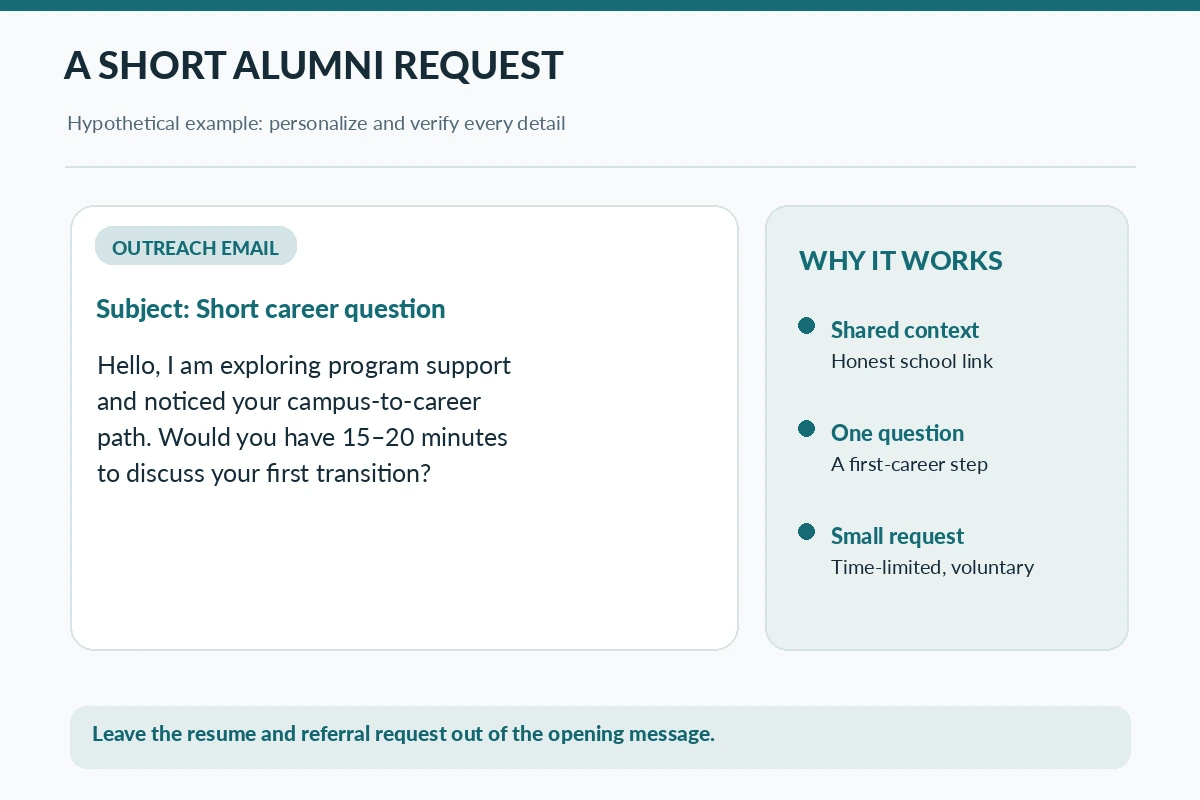
An outreach note should identify you, name the real school link, and explain one narrow topic. A practical hypothetical message is: “Hello, I’m a current student at [school] exploring research operations. I saw your public profile describing your transition from campus research to program support. Would you be open to a 15–20 minute conversation about what helped with that first move? I’m seeking perspective, not an opening. I can work around your schedule.” Replace every bracket with accurate information before sending.
Keep the message free of attachments unless requested. A resume sent without context can turn a learning conversation into an implied application. Do not demand an introduction or ask the recipient to evaluate your entire career plan. If there is no response, one respectful follow-up can be reasonable; the person owes you neither a meeting nor an explanation. Try a different contact rather than escalating to personal channels or sending repeated messages. A concise message is courteous and easier to answer.
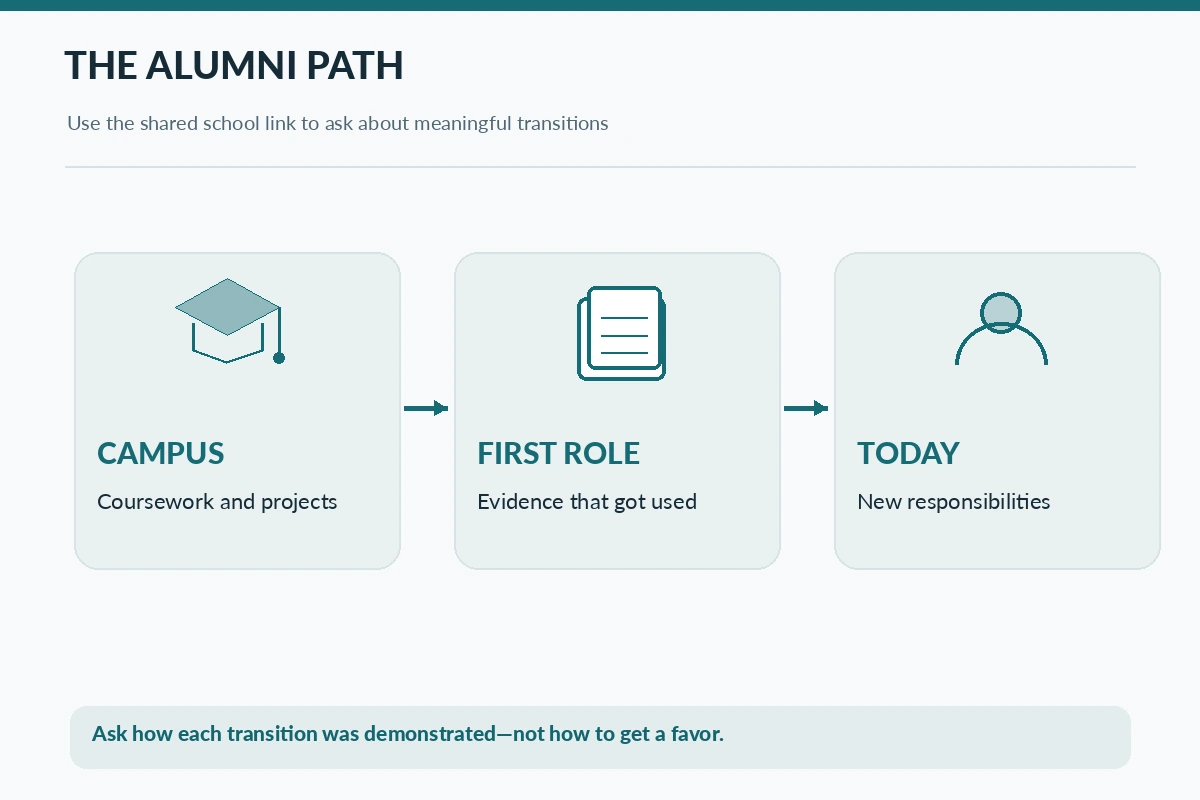
Ask About the First Transition, Not Just Today’s Job
Organize questions around before, during and after graduation. Before: “Which classes or projects proved useful in your first role?” During: “How did you demonstrate skills when you did not yet have the job title?” After: “What did you have to learn during your first six months?” These prompts uncover pathways without implying the same route will work in today’s labor market. Ask for examples of transferable work rather than ranking majors or expecting promises about the value of a particular degree.
A productive next layer explores trade-offs. Ask what surprised the graduate about the daily schedule, feedback cycle, reporting relationships or required training. Compare their account with current postings and program descriptions instead of treating one history as universal. If the person entered through an internship or referral, ask what responsibilities they actually performed and how the application process worked; do not assume that access to the same alumni community guarantees a similar outcome.
Separate Career Advice From Hiring Requests
The alumnus may be a generous source of context without being connected to recruiting. Keep the distinction explicit. Appropriate questions include: “What evidence would you look for in someone applying to an entry-level role?” or “Which job titles should I research?” Avoid “Can you send my resume to your manager?” or “Do you know of a secret vacancy?” If they voluntarily offer a public recruiting resource, thank them and use the official application route.
Do not ask about private coworkers, confidential business plans, applicant ranking or a former student’s personal details. If the conversation moves toward sensitive information, steer back to general workflows. For example, ask how teams typically train new staff instead of who failed probation. Good informational interviewing respects professional boundaries as much as it demonstrates curiosity. It should leave the person comfortable continuing the relationship even when they have no employment advice to offer.
Turn a Conversation Into an Evidence Plan
After the call, write three separate entries: what the alumnus experienced, what a current job description states, and what you can verify about your own background. Suppose the alum mentions that coordinating volunteer shifts helped with a program-assistant role. That is a suggestion to investigate transferable scheduling evidence—not permission to claim that volunteering always qualifies applicants. Check actual role requirements, then identify one project, course, volunteer assignment or internship that would produce honest evidence.
Make a two-week action plan that includes one resource to read, one skill to practice and one question that still needs another perspective. Record source and date so an anecdote does not turn into a universal fact. You may discover that the alumnus’s pathway has changed or that their organization uses different job titles. Such differences are valuable: they indicate that you should sample another viewpoint rather than depend on a single account.
Follow Up Without Turning the Contact Into a Recruiter
Send a brief thank-you that refers to something the person actually explained. A hypothetical note could read: “Thank you for explaining how your campus research experience became a useful project log in your first job. I’m going to review current assistant roles and document what I did on my lab team. I appreciated the distinction between the academic and workplace responsibilities.” A tailored observation feels more sincere than a stock message about “amazing insights.”
If you act on the guidance, a concise later update may be appropriate. Do not assume recurring access or ask for weekly check-ins. Keep a private contact log with the person’s preferred channel, one takeaway and any next step they expressly agreed to. Never add the contact to a promotional mailing list. The relationship is a professional exchange, not an entitlement acquired through a shared institution.

| Question focus | What to capture | Your independent check |
|---|---|---|
| First transition | Earliest responsibilities | Current entry-level postings |
| Useful campus work | Real project or record | What you personally completed |
| Skills learned later | Training or supervision | Current requirements |
| Recommended next resource | Named public source | Verify before relying |
How We Research and Check These Examples
We reviewed independent career-services guidance on the purpose and etiquette of informational interviews, and compared any profession-specific claims with relevant official occupational or federal guidance. All outreach notes, questions and practice examples are illustrative; no contact, meeting, candidate result or employer response is represented as real. Sources reviewed on 2026-11-05. One worker’s experience cannot replace current job announcements, credentialing rules or an employer’s official hiring policy. Read our affiliate disclosure for the site policy.
Research sources: www.career.berkeley.edu guidance — UC Berkeley distinguishes informational conversations from hiring interviews, recommends respecting agreed time and following up.; careerservices.fas.harvard.edu guidance — Harvard advises short, specific requests and open-ended career questions instead of asking for a job.; elc.middlebury.edu guidance — Middlebury suggests opening with shared educational context and tracing career transitions.; alumni.stanford.edu guidance — Stanford alumni guidance recommends preparing prioritized questions and researching the contact.. Check the full primary source and the current vacancy before making a career or education decision.
Related Job Search Guides
Not as the opening purpose of an informational interview. Seek insight first; any offer of a referral should be voluntary and should not replace an employer’s official process.
State the genuine school connection without implying a personal relationship. Ask about one career decision the person is well positioned to discuss.
Generally leave it out unless the contact or program explicitly asks. Offer relevant background in a sentence and request a short informational conversation.
Choose a manageable shortlist of relevant people and personalize each message. There is no guaranteed response rate and no reason to pressure nonresponders.
Record a skill gap, a source to check and a small evidence-building action. Compare an alumnus’s personal history with present-day requirements.