
A museum collections internship cover letter should identify the collection or project you want to support, connect one real research or documentation example to the duties, and clarify what you have learned versus what you can already do independently. Smithsonian internship descriptions distinguish cataloging, provenance research, object care, digital access and conservation-related work. These are not interchangeable qualifications. Read the individual project instructions before sending any materials: some placements ask for a letter and résumé; others use an essay or a different application package.
Choose the collections function before choosing examples
A collections team may need help locating records, checking object descriptions, entering approved catalog details or organizing digital images. A conservation placement may involve condition documentation and re-housing under staff direction; archives may emphasize finding aids, patron requests or digitized files. Start by copying the duties from the current project listing into a working note. Circle two tasks that match something you actually completed in class, a library project, volunteering or supervised employment. If a project is not relevant, leave it out rather than offering a broad claim that you love art and history.
Smithsonian’s National Museum of American History describes different projects across curatorial practice, archives and conservation. That variety explains why generic letters underperform: ‘museum experience’ may mean visitor services to one recruiter and careful location records to another. Name the particular unit or collections theme only after checking the announcement. If you are applying to several projects, create different evidence paragraphs and follow each project’s document instructions instead of submitting one letter with the museum name replaced.
Turn a class catalog into verifiable collections evidence
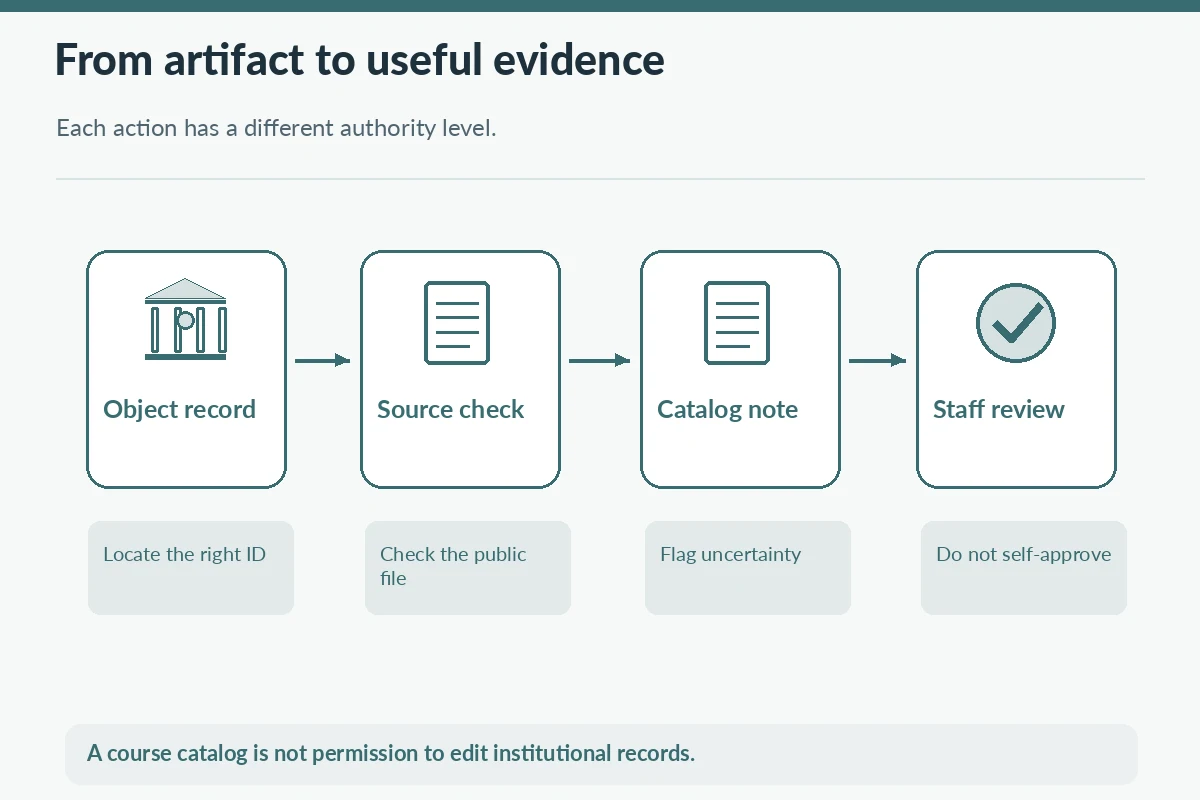
Suppose you prepared a small annotated catalog for a course. You can explain how you recorded source references, compared conflicting dates and flagged uncertain attributions. Be precise about scale and authority: a student catalog exercise is not the same as updating an institutional collections database. A trustworthy sentence is: ‘For a public-history class, I documented artifact descriptions against assigned archival sources and logged unresolved date discrepancies for instructor review.’ This shows a method the reader can imagine repeating while honestly identifying the setting.
When you write about a spreadsheet, archival database or digital collection, describe what fields you checked and who reviewed the result. Avoid naming collection-management software merely because it appeared in a course syllabus. If you have handled special collections, confirm what materials you were allowed to touch and whether staff supervised. Do not include restricted donor records, acquisition valuations, unpublished provenance files or photographs of objects from spaces where sharing is not permitted.
Keep object handling and preservation within your experience
Museum internship descriptions may mention re-housing, condition reporting and object care. A new applicant should not imply professional conservation treatment skills after reading about them. If you observed museum staff make handling decisions, say you observed; if you performed supervised housing tasks, describe that supervision and the material. It is appropriate to emphasize attention to detail, following procedures and asking questions when an object’s status is uncertain. Conservation recommendations or treatment approvals belong to the relevant professional, not to an applicant’s speculative claim.
For example, a volunteer who checked labels and shelf locations may describe reconciling inventory lists with staff-approved records. That person should not write ‘certified all objects as properly preserved’ unless such a determination was truly part of an authorized role. Make the letter convincing by explaining the traceable workflow: reference record, item identifier, discrepancy note, then supervisor review. This approach avoids adding impressive-sounding but unverified outcomes.
Use a museum-specific four-paragraph letter
Illustrative letter: Dear Collections Internship Selection Team, I am applying for the Museum Collections Internship described on your project page. I am especially interested in the documented work of connecting object histories to accurate, accessible records. In an undergraduate public-history course, I created a source log for a small catalog exercise and compared labels with the original reference material. When descriptions conflicted, I noted the discrepancy and asked my instructor to review the entry rather than choosing an unsupported answer.
In a separate campus archive assignment, I organized a set of permitted digital photographs and recorded consistent file identifiers so the class could locate the correct source. That project was academic rather than institutional cataloging, but it taught me to preserve the link between a claim and its evidence. I would welcome the chance to learn your approved collections procedures, contribute to record checking and follow staff direction on object handling. Thank you for reviewing my application. Sincerely, [Applicant]. This is a hypothetical example; replace every experience, institution and task with your own verified facts.

Show interest in a particular collection without inventing access
A useful motivation sentence refers to a public exhibition, collection guide or project description that genuinely interests you. State what caught your attention and how it relates to your research question. Do not claim to have inspected unpublished objects or consulted internal accession files because a museum webpage mentions those collections. If you mention an object’s history, confirm the public source and represent uncertainty accurately. Curatorial projects often involve careful interpretation, so intellectual humility is more useful than certainty about a disputed attribution.
If you have no museum experience, choose one relevant learning task, such as describing sources consistently or maintaining a searchable reference list. Explain what part was yours and what remains a learning goal. A letter should not apologize repeatedly for having no formal placement. Instead, give the selection team a realistic view of your preparation and the procedures you are ready to learn. This is especially important where an internship combines research, document handling and public-facing interpretation.
Check schedule, application documents and recommender consent
Some museum placements request a cover letter and résumé, a reference, and a statement about part-time or full-time interest; other programs request essays, transcripts or supporting materials through their own portal. Check the precise listing for what to upload and whether its deadline has passed. Do not copy a year-old application checklist into a current submission. Smithsonian’s Archives of American Art collections processing example illustrates why project-specific eligibility, expected hours and application route matter.
If a letter of reference is required, ask the person before adding contact details or triggering an automated request. Confirm that your proposed dates are compatible with classes and any credit agreement; the museum does not automatically grant your college credit. Name availability accurately without volunteering private health or family details. Follow the project’s file naming, word limit and portal instructions. An elaborate letter is less helpful than a complete, accurately routed application.
Run a record-accuracy pass before submitting the letter
Read the final draft as a museum staff member checking an accession note would: every title, collection name, date and claim needs an evidentiary basis. Compare your wording to the project description and your résumé. If you wrote ‘digitized the archive,’ determine whether you scanned material, indexed digital files or merely observed a demonstration. Replace the vague verb with the actual action. Verify that any portfolio link shows only items you have permission to share and that a reviewer can access without restricted credentials.
Export the required file type and inspect it at normal reading width. The reader should see why the exact collections project fits your interests within the opening paragraph, a concrete example in the middle, and a realistic learning goal at the close. Do not attach object photos, personal reference contact details or documents that the museum did not request. Save the original posting or a factual note of requirements for your own records, not as an extra attachment.

Decide whether the letter supplies unique evidence
Compare the letter against the résumé line by line. The résumé may say ‘Prepared a source log for a catalog project.’ The letter should add how you handled an ambiguous date or improved a record’s traceability. That difference justifies the second document. If the application supplies a required short essay instead, honor its prompt rather than attaching an unrelated full letter. Where a letter is optional, use it to answer a question the résumé cannot answer, such as why a specified collections theme matters to your training.
After sending, record which program and project received which version. Wait for the program’s published timeline before asking for status updates. The selection committee needs evidence of care, accurate records and learning readiness, not invented curatorial authority. A strong final sentence offers to discuss how you would learn the institution’s procedures, leaving decisions about treatment, access and interpretation with its professional staff.
| Area | Useful evidence | What not to imply |
|---|---|---|
| Catalog records | Verified fields, sources | Staff approve changes |
| Object care | Supervised handling or observation | No implied treatment authority |
| Public materials | Permitted examples and links | Do not expose restricted records |
How We Research Internship Cover Letters
We compared general career-center cover-letter guidance with role-specific institutional internship materials and the JobAsk topic inventory. We reviewed the sources listed below on 2026-11-05. Job and program descriptions illustrate tasks, not guaranteed current openings or universal eligibility. All sample letters and candidate histories in this guide are hypothetical. Follow the current official posting and protect sensitive records. For affiliations and funding transparency, see our affiliate disclosure.
Sources checked: Smithsonian Archives of American Art — Smithsonian Archives of American Art describes collections processing applications and the requested cover letter, résumé and reference.; Smithsonian National Museum of American History — Smithsonian National Museum of American History distinguishes cataloging, archives and conservation internship tasks.; Berkeley Career Engagement — Berkeley Career Engagement advises tailoring experience to an actual internship listing and employer.. Verify the latest instructions for the exact internship you are considering.
More Resume and Cover Letter Guides
Yes, when the internship listing permits it. Use accurate coursework, archives assignments or volunteering to show relevant research and recordkeeping habits.
Describe the specific supervised activity or observation. Do not imply independent conservation treatment or professional credentials.
Only if you have permission and the application requests them. Restricted images and institutional records should not be shared.
Not always. Follow the actual program prompt and format; some internships request an essay rather than a standard business letter.
Name it only if you really used it, and explain your actual task and training level rather than claiming full system proficiency.