
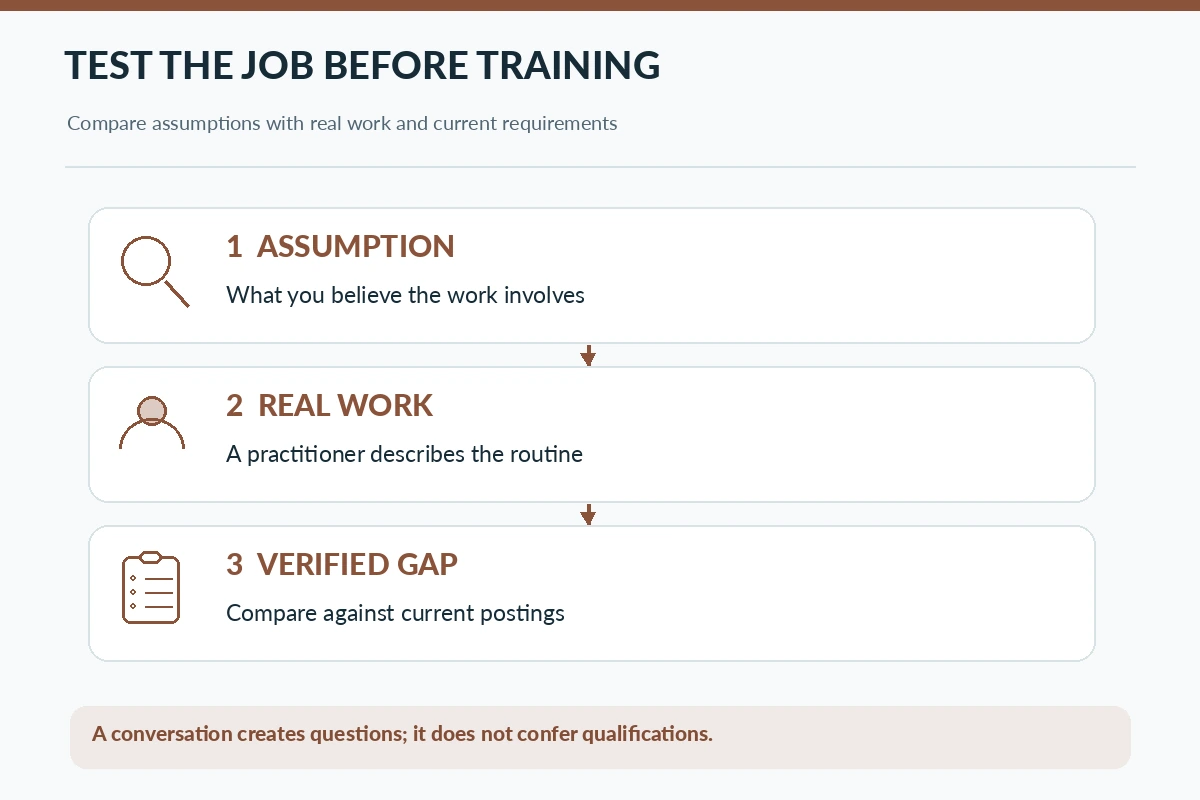
Before paying for a certificate or rewriting your resume for a different profession, talk with someone who does the work. A career-change informational interview should test three hypotheses: what the job actually involves, which parts of your prior work translate, and what training or supervised experience the target roles require. Ask for information, not permission to enter the field. A useful conversation can tell you which of two adjacent job titles deserves more research and which costly assumption you should verify independently.
Define a Career Hypothesis You Can Disprove
Start with a claim, not a vague aspiration. For example: “My customer-support escalation experience may transfer to operations analysis because both involve investigating exceptions.” Break the claim into tasks: recording issues, reconciling records, recommending changes and approving decisions. An informational interview should reveal where those tasks overlap and where the authority, data or training differs. This is especially important when an attractive job title conceals work you may not enjoy.
Write three test questions: what tasks fill an ordinary week, which tools or approvals a beginner uses, and what an applicant with your background would still need to demonstrate. If you cannot explain the specific decision these answers will influence, narrow the scope further. The other person’s experience is a single perspective; treat it as field research, not as a hiring standard, guaranteed career pathway or individualized licensing advice.
Find Contacts Who Know the Level You Could Enter
The most senior person is not necessarily the best informant. A director may be far removed from the daily work of an entry-level analyst, technician or coordinator. Look for someone performing the target work, a recent entrant from another field, and perhaps a supervisor who can describe training boundaries. Contrasting two perspectives is more useful than collecting three identical success stories. Verify titles through public professional information and reach out through suitable channels.
A short request might say: “I currently work in customer support and am researching operations coordinator roles. Your public experience with process reporting caught my attention. Would you be available for a short career-information conversation about day-to-day duties and training? I am not asking about job openings.” Avoid implying that the person should provide free consulting or review a full course plan. Let them decline without consequences.
Ask About a Real Work Week and Constraints
Career promotional materials tend to foreground interesting projects. Ask what happens on a typical Tuesday when nothing exceptional is happening: which records are reviewed, which meetings recur, what deadlines cannot move, and what requires another person’s authorization. Follow up with “Which parts of the work would surprise someone from my background?” This helps assess fit beyond a title. The goal is not a personal performance score or a promise that every employer has the same workflow.
Explore context: Is the work independent or tightly reviewed? Does the role interact with clients, records, equipment or the public? Are hours predictable, or determined by shifts and incident coverage? If the contact describes an unfamiliar tool, ask what a beginner must be able to do with it rather than requesting access to a real employer system. A public job description can confirm whether a tool is a minimum requirement, a preferred qualification or simply one person’s preference.
Separate Transferable Evidence From Missing Authority
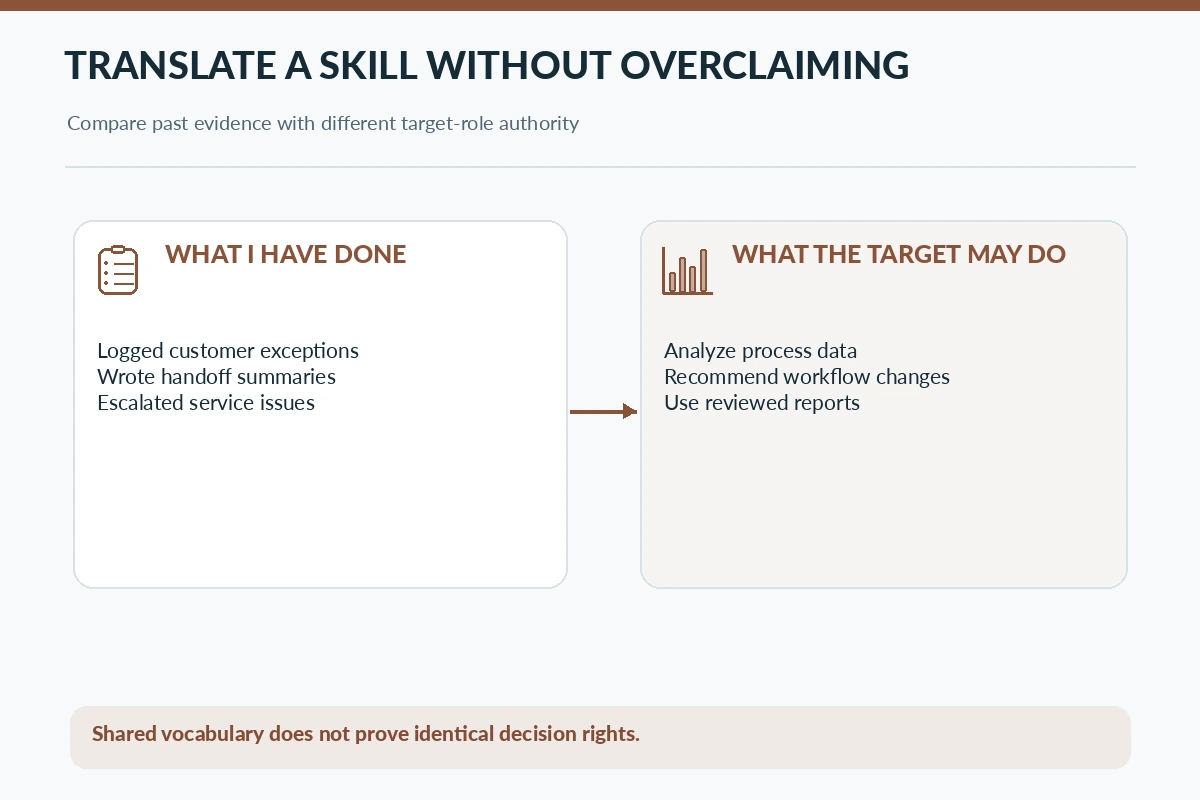
Create two columns after the call. The left records work you truly performed; the right records responsibilities of the desired role. An overlap needs proof at the level of actions, inputs and decisions. For example, writing customer issue summaries may demonstrate documentation, but it does not establish that you built predictive models or signed off on a financial report. Using a shared vocabulary should never obscure a real skill gap.
Ask: “What would count as credible evidence for the part I have not done?” Answers may include a small synthetic-data project, practical coursework, supervised experience or a portfolio with redacted information. Do not manufacture results, collect private datasets or label a classroom exercise as paid employment. Compare the suggestion with current vacancy requirements and, where relevant, certification or licensing authorities before investing money.
Evaluate Training Costs Without Promises
Training may be necessary for a specific role, useful but optional, or poorly matched to the level you can target. Use the conversation to generate questions about relevance: what new employees are expected to know on day one, what is learned after hiring and what proofs employers actually evaluate. Ask about common beginner mistakes and the support available for correcting them. A contact may have entered by a route no longer offered; do not buy a course solely because one person liked it.
Make a decision table comparing at least two target job titles. Record the duties, credential requirements, evidence you already have, gaps you can test cheaply and facts still unknown. Obtain credential information from an official issuer and hiring criteria from actual employers. If a role would require a license, authorization or supervised practice, an informational chat cannot waive those rules. A low-cost exploration project should not imitate regulated work on real people or clients.
Decide Whether to Explore, Pivot, or Pause
After the meeting, distinguish observations from interpretations. “This contact spends half the week coordinating stakeholders” is a report of one experience; “all analysts spend half the week in meetings” is an unjustified conclusion. Write a next action that could change your decision: compare three announcements, speak with another practitioner in a different organization, or attempt a publicly documented practice task. Mark your confidence rather than forcing an immediate yes or no.
If your previous experience transfers only to a related support role, that is useful information, not a failure. A phased transition may begin with records coordination rather than an analyst title. Conversely, if the routine tasks are unlike your interests, you can redirect your search before investing heavily. Close with a thank-you explaining which assumption you will test; do not ask the contact to sponsor your decision or guarantee employment.

| Current proof | Target role task | Unverified gap |
|---|---|---|
| Support ticket log | Process exception tracking | Data definitions |
| Shift coordination | Operational scheduling | Decision authority |
| Monthly status report | Analysis and recommendations | Methods and validation |
| Training course | Employer-required skill | Current posting criteria |
How We Research and Check These Examples
We reviewed independent career-services guidance on the purpose and etiquette of informational interviews, and compared any profession-specific claims with relevant official occupational or federal guidance. All outreach notes, questions and practice examples are illustrative; no contact, meeting, candidate result or employer response is represented as real. Sources reviewed on 2026-11-05. One worker’s experience cannot replace current job announcements, credentialing rules or an employer’s official hiring policy. Read our affiliate disclosure for the site policy.
Research sources: www.career.berkeley.edu guidance — UC Berkeley distinguishes informational conversations from hiring interviews, recommends respecting agreed time and following up.; careerservices.fas.harvard.edu guidance — Harvard advises short, specific requests and open-ended career questions instead of asking for a job.; careerhub.students.duke.edu guidance — Duke describes using informational conversations to test day-to-day work, barriers and skill needs before a transition.; www.onetonline.org guidance — O*NET management analyst profile distinguishes research, analysis, recommendations and workplace processes.. Check the full primary source and the current vacancy before making a career or education decision.
Related Job Search Guides
No. They help identify what to verify, but do not confer qualifications, a license, work authorization or supervised experience.
Compare multiple current vacancies and official credential information before paying. Ask practitioners what applicants must demonstrate at the entry level.
A career contact cannot reliably decide hiring eligibility for other employers. Ask what evidence supports the work and then review actual job postings.
Capture each person’s context, role level and employer type. A disagreement can reveal variation that deserves a third source or more targeted research.
Write a short evidence-gap table, choose one low-risk next step and thank the person without requesting a vacancy or referral.