
Ambiguity interview questions focus on what you do before a task is clear. You may be missing a deadline, owner, definition of done, or approved source of information. An effective response shows how you identified the unknown, asked the right question, stated a reasonable assumption only when appropriate, and confirmed the next action. That is different from adaptability after a plan has already changed.
Separate Ambiguous Instructions From Changing Priorities
An ambiguous assignment begins with uncertainty: “Please prepare this for tomorrow,” when the audience, format, or approval route is not stated. Adaptability usually involves responding to new requirements after an original plan existed. Both need communication, but the interview stories answer different questions. Try prompts such as “Tell me about a time instructions were unclear” or “What did you do when a task had more than one reasonable interpretation?”
The OPM flexibility definition includes dealing with ambiguity, while its decision-making definition considers information and implications. These are competency descriptions, not a universal sequence that every company follows. Choose a real example where the missing information mattered, rather than pretending that every minor uncertainty was a crisis.
Identify Exactly What Was Unknown
Start by naming the open variable. Did you lack a final due date, list of recipients, source file, quality standard, or owner for approval? Avoid the vague phrase “Nobody knew what was going on.” List what you knew and what was still needed to proceed responsibly. That distinction helps the interviewer understand the quality of your judgment before you describe your actions.
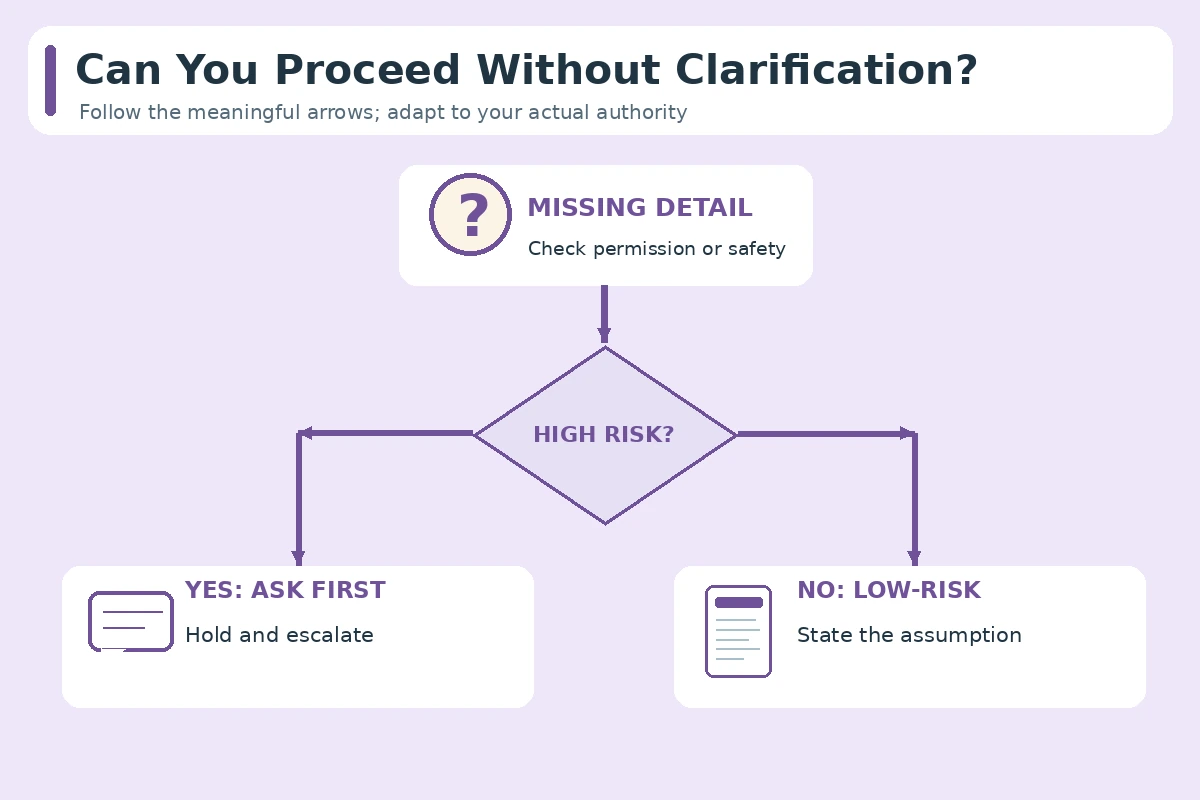
For a hypothetical office task, a manager might ask you to “send the updated schedule” without identifying which version was approved. The productive question is not simply “What do you want?” but “Which of these two versions is final, and who should receive it?” Do not guess when the difference could affect privacy, safety, payments, customer promises, or other consequential decisions.

Choose Clarify, Proceed, or Escalate
Use a simple decision test. If the unknown controls approval, access or safety, stop and ask an authorized person. If the information is available in an agreed source, consult that source and verify that it is current. If a low-risk formatting choice can be made within your role, state the assumption and leave an easy path for correction. Do not manufacture authority by saying you made an executive decision when you were only preparing a draft.
The NACE communication competency includes asking appropriate questions and requesting guidance when necessary. That provides a sound way to explain initiative without glorifying guesswork. After clarification, repeat back the agreed deliverable, date and reviewer. If a decision remains unresolved, record it as open instead of representing it as settled.
Use an Example That Shows the Clarification
Illustrative, hypothetical answer: “In a student club, I was asked to prepare a speaker announcement but the event title appeared differently in two drafts. I checked the approved event brief, found it did not settle the issue, and sent the club lead a short question with the two versions. I held the public post until the lead confirmed the wording. Then I updated the announcement and shared a final proof for approval.”
The story demonstrates careful uncertainty management, not heroism. The candidate could prepare the copy but could not approve official event wording. Your real example should name the unknown and describe how you secured an answer. A positive result may be a confirmed scope or corrected handoff, even if the entire project was not completed by you.

Show Why Your Question Saved Rework
A generic answer says, “I just ask lots of questions.” A clearer answer links a specific question to the risk of proceeding incorrectly. “I asked whether the report needed weekly or monthly totals before building the chart” explains the uncertainty and the cost of a wrong assumption. It is credible even without a claimed percentage of time saved. If you did need to work from a provisional assumption, explain how you labeled it and sought confirmation.
Questions should be concise and prioritized. First settle the information that determines whether the work may proceed. Next check dependencies, timing and the definition of complete. Smaller layout choices can wait. This prevents an answer from sounding like unnecessary escalation for every trivial detail. It also shows judgment about which decisions fall within your own remit.
Practice Alternative Versions of the Question
Interviewers may ask about incomplete instructions, lack of manager availability, unclear ownership, conflicting data or undefined expectations. Practice mapping each prompt to a genuine story instead of swapping generic sentences. The OPM description of behavioral interviewing distinguishes asking for observed past behavior from asking what a candidate would do in a proposed situation. Give a real past event when asked what you did; label a hypothetical approach when asked what you would do.
For an entry-level candidate, a group assignment or volunteer event can be relevant if you explain the setting. An experienced candidate may use a cross-functional handoff, but should avoid revealing internal process details. The size of the situation does not have to be impressive. A small example can reveal strong thinking when it has a real unknown, a specific question and a verified result.
End With the Confirmed Outcome and Learning
Say who answered the question, which requirement became clear and what you did next. If the manager never replied, state how you documented the hold or escalated appropriately, rather than inventing approval. An answer such as “We agreed on the current version, I circulated the approved file, and I added a version field to the checklist” is useful only if those actions happened.
Review your language for overclaiming. “Clarified the expected format” is not “redesigned the organization’s communications process.” Keep the outcome linked to your actions, give colleagues credit for their decisions, and avoid treating guesswork as independence. The strongest ambiguity story shows that you can move work forward without pretending uncertainty has disappeared.
How We Research Interview Questions and Examples
We compare the competency definitions and interview design guidance from the U.S. Office of Personnel Management with NACE career-readiness frameworks and use plain-language, role-limited hypothetical examples. We reviewed the available public topic index and live search results on October 27, 2026. Public results do not reveal unpublished WordPress content or guarantee that a slug is free. This is AI-assisted editorial work, not an independent human interview study or promise of hiring success.
Source: U.S. Office of Personnel Management. Defines flexibility and decision making in situations involving uncertainty.
Source: NACE. Describes communication and asking for guidance in unclear situations.
Source: U.S. Office of Personnel Management. Explains past-behavior versus hypothetical interview formats.
Every sample answer is hypothetical. Use only a situation that truly happened to you, respect confidentiality and the limits of your authority, and avoid invented performance numbers. We do not imply endorsement or affiliate relationships. Read the JobAsk affiliate disclosure.
More Interview Preparation Guides
- Leadership Behavioral Interview Questions: Show Influence and Real Scope
- Accountability Behavioral Interview Questions: Show Ownership and Follow-Through
- Behavioral Interview Questions: Answer With Real Stories and STAR
- Adaptability Behavioral Interview Questions: Explain a Changed Plan
- Attention to Detail Interview Questions: Explain Checks and Error Prevention
It means a past task had unclear instructions, expectations, ownership or information, and the interviewer asks how you handled that uncertainty.
No. Ambiguity concerns missing clarity; adaptability often concerns a known plan changing.
Clarify consequential issues first, especially approvals, privacy and safety. Low-risk assumptions should be identified and confirmed when appropriate.
Yes, if you can explain the unclear requirement, question asked and real result.
Explain how you documented the open issue, avoided unauthorized action and followed the applicable escalation process.