
Accountability interview questions ask how you follow through on responsibilities, make your progress visible, and respond when a commitment is at risk. The best answer is a real, specific experience: what you owned, what you checked, who needed an update, and how you closed the loop. A dramatic failure is not necessary. Ordinary, dependable follow-through can offer better evidence than a story in which you claim credit for an entire team.
Understand What an Accountability Question Is Testing
An interviewer may ask, “Tell me about a time you took responsibility for an outcome,” “How did you keep a promise to a teammate?” or “Describe when you realized a commitment was at risk.” Those versions focus on ownership of a defined obligation. They differ from the failure question, which usually centers on a setback and repair. In accountability answers, explain how you knew what was yours to deliver, and how others knew the status without chasing you.
The U.S. Office of Personnel Management competency model describes accountability using responsibility for results, objectives, priorities, and established controls. That is a professional competency definition, not a claim that every employer uses the same scoring rubric. Read your target posting for the deliverables actually involved: a customer follow-up, checked inventory, a monthly report, a team handoff, or completion of a student project.
Choose a Real Responsibility With a Visible Deadline
Look for an example where someone expected a specific output from you. Suitable stories include coordinating an event signup, maintaining a shared tracker, preparing your portion of a group report, or completing a service follow-up. Write down the request, deadline, person who depended on it, and your actual authority. An answer about supervising a process you only observed would be misleading. If the work was shared, name your assigned component.
Before drafting, use a four-box worksheet: commitment, tracking method, risk update, and final handoff. The tracking method can be simple, such as a shared checklist or email acknowledgment; it need not be specialized software. If an obstacle arose, explain how early you recognized it and whether you had authority to adjust the date. Do not imply that notifying a manager gave you permission to change a policy or approve work outside your role.

Build the Answer Around Your Personal Actions
Start with one sentence describing the situation and your task. Spend more words on the specific actions: confirming the owner, recording the due date, reviewing open items, checking a dependency, and informing the right person when a task was blocked. Finish with an honest outcome and one short learning point. The OPM STAR guidance frames interview examples around the situation or task, action, and result. It does not require that every result be a positive number.
Avoid vague language such as “We were responsible for everything” or “I always work hard.” A defensible example identifies your contribution: “I updated the volunteer roster each afternoon and notified the coordinator when two shifts remained unfilled.” If someone else decided how to cover those shifts, credit that decision to them. Clear scope helps interviewers ask useful follow-up questions rather than forcing you to defend inflated responsibility.
Study a Hypothetical Accountability Answer
Illustrative answer, not a real applicant: “For a campus event, I was assigned to maintain the volunteer check-in list. Two days before the event, I noticed one station lacked coverage. I checked the signup sheet, contacted the event lead, and sent an updated roster after the lead arranged a replacement. At the event, I confirmed the station assignments with the team. The coverage was recorded in the final roster, and I learned to review gaps before the last day.”
What makes this example useful is its boundary. The speaker maintained records, surfaced a problem, and verified the handoff; the event lead arranged staffing. The outcome is qualitative and should not be upgraded to “100% staffing success” without real evidence. Your own version should replace every element with an event that actually happened. School, volunteering and community work may supply relevant experiences when paid employment is limited, as the OPM accomplishments guidance also recognizes.
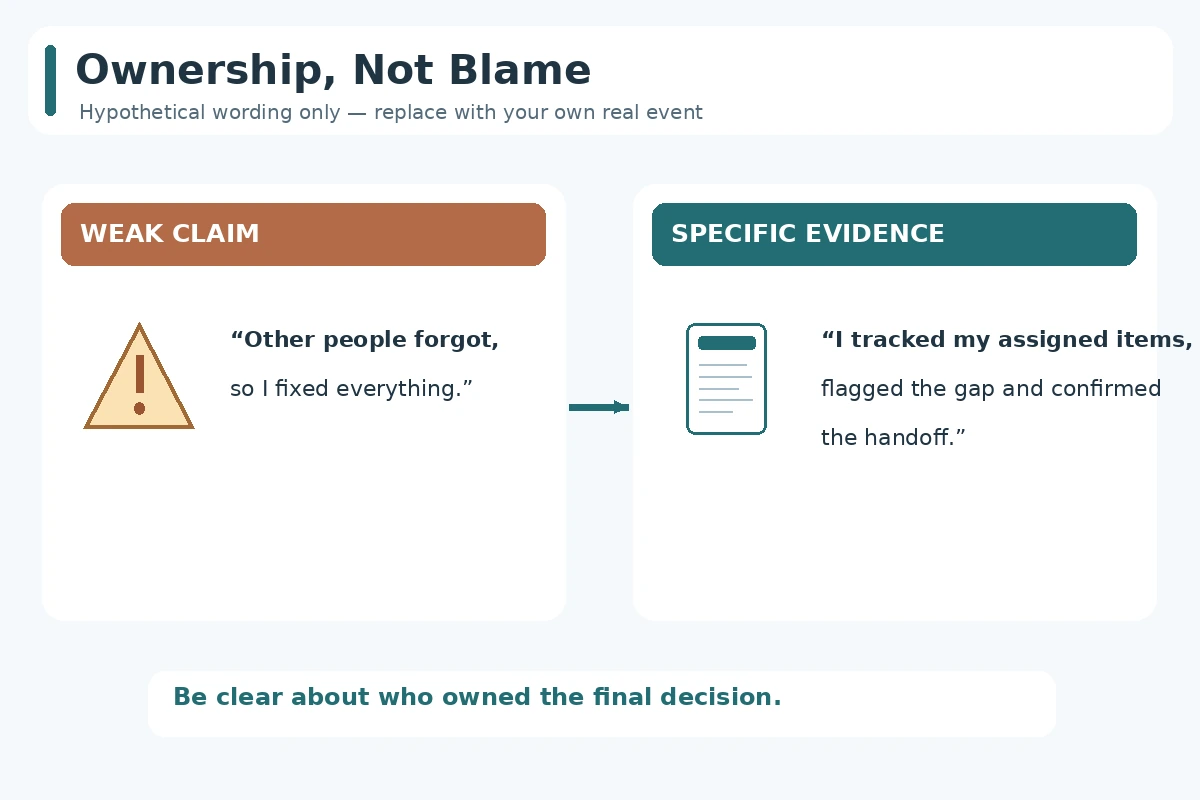
Compare Ownership With Blame or Heroics
An unhelpful answer says, “Other people forgot, so I fixed everything myself.” It assigns blame, obscures roles, and raises concerns about supervision. A stronger answer acknowledges dependencies: “When a required document had not arrived, I flagged the missing item, sent a reminder through the agreed channel, and revised my own preparation while the owner resolved it.” The difference is not modesty for its own sake; it gives the interviewer a process they can verify.
Do not present rule-breaking, unsupported overtime claims, or unilateral approvals as proof of ownership. If the only correct step was to escalate an exception, describe that step as a responsible decision. Responsible follow-through may mean reporting an incomplete item accurately rather than claiming you finished it. Be ready for follow-ups: Who defined success? When did you alert the owner? What could you have done sooner?
Practice Four Variations Without Memorizing a Script
Try four prompts using different real stories: a task delivered as promised, an assignment delayed by another dependency, a handoff to another team, and a commitment whose scope needed clarification. Give yourself one minute to outline each story and then speak it naturally. Rehearse the nouns and decisions rather than a fixed speech. If you used a tracker, be prepared to explain what fields were tracked and who could view it.
Compare the examples to the NACE professionalism and teamwork competencies, which include responsibility and dependable workplace behavior. Treat competencies as prompts for reflection, not guarantees of a hiring outcome. If you have only one strong example, practice answering several phrasings from it without inventing new incidents or changing who approved a decision.
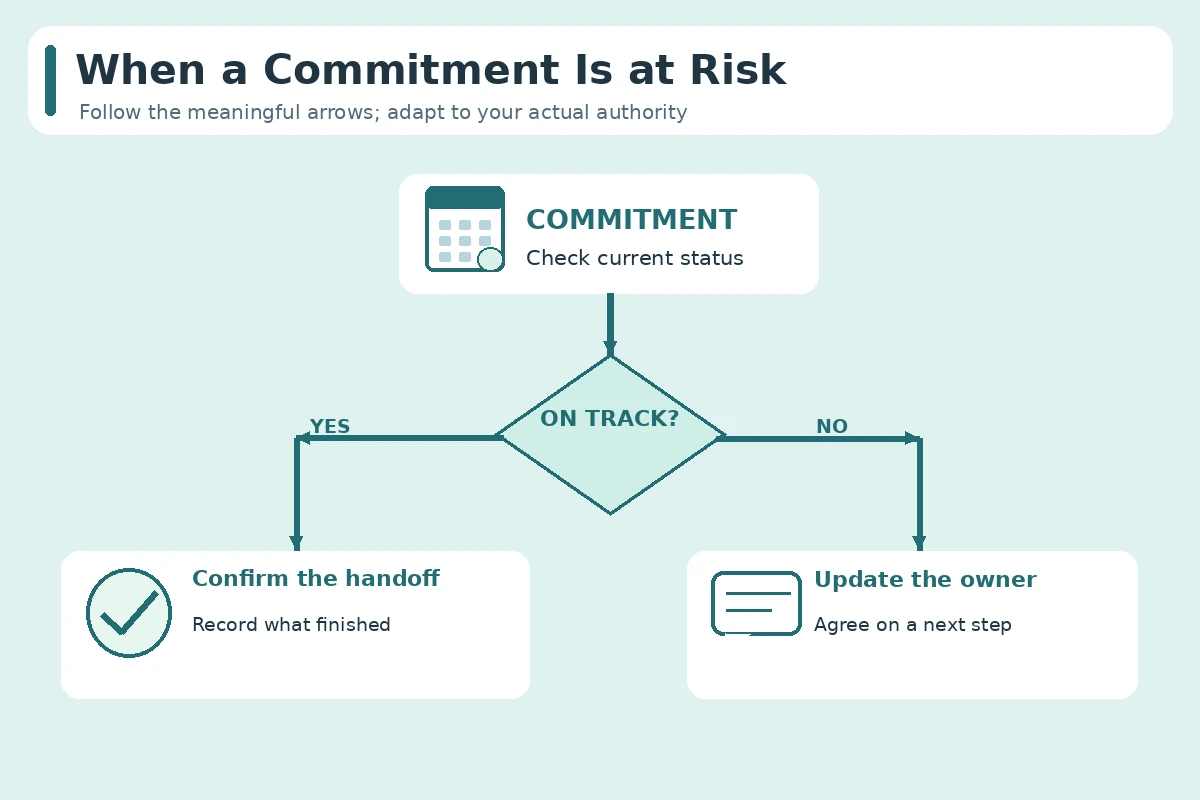
Check the Result and Scope Before Your Interview
Review your final answer for five details: a real obligation, your responsibility, a concrete tracking or checking step, timely communication, and the observed outcome. Remove any metric you cannot defend and any claim that implies a role you did not have. Confidential customer names, private records, and internal screenshots do not belong in a public story. Describe the kind of record without revealing protected information.
Keep the answer conversational and stop when the relevant evidence is clear. A useful ending might be, “I now check open dependencies earlier and give the owner a concise status update.” That is a process improvement rather than a promise that delays never happen. If asked what went wrong, answer plainly; accountability is compatible with reporting an imperfect outcome. Your goal is to make your decision process legible.
How We Research Interview Questions and Examples
We compare the competency definitions and interview design guidance from the U.S. Office of Personnel Management with NACE career-readiness frameworks and use plain-language, role-limited hypothetical examples. We reviewed the available public topic index and live search results on October 27, 2026. Public results do not reveal unpublished WordPress content or guarantee that a slug is free. This is AI-assisted editorial work, not an independent human interview study or promise of hiring success.
Source: U.S. Office of Personnel Management. The OPM competency framework defines accountability and its boundaries.
Source: U.S. Office of Personnel Management. OPM guidance on concrete situation, action and result in structured interview questions.
Source: NACE. NACE career-readiness descriptions for professionalism and teamwork.
Source: U.S. Office of Personnel Management. OPM recognizes volunteer and academic achievements as possible evidence of transferable competence.
Every sample answer is hypothetical. Use only a situation that truly happened to you, respect confidentiality and the limits of your authority, and avoid invented performance numbers. We do not imply endorsement or affiliate relationships. Read the JobAsk affiliate disclosure.
More Interview Preparation Guides
- Ambiguity Behavioral Interview Questions: Clarify Uncertain Instructions
- Leadership Behavioral Interview Questions: Show Influence and Real Scope
- Behavioral Interview Questions: Match Common Prompts to Real Evidence
- Attention to Detail Interview Questions: Explain Checks and Error Prevention
- Adaptability Behavioral Interview Questions: Explain a Changed Plan
No. A completed commitment with clear tracking, communication and handoff can demonstrate ownership.
Yes, if you distinguish your assigned contribution from the tasks owned by classmates or a project lead.
Explain what was completed, what was still open, whom you informed, and what you would improve. Do not invent a win.
Describe only the follow-up or coordination you actually had authority to perform; do not imply formal supervisory power you lacked.
Use enough time to explain the responsibility, actions, communication and real outcome without repeating your resume.