
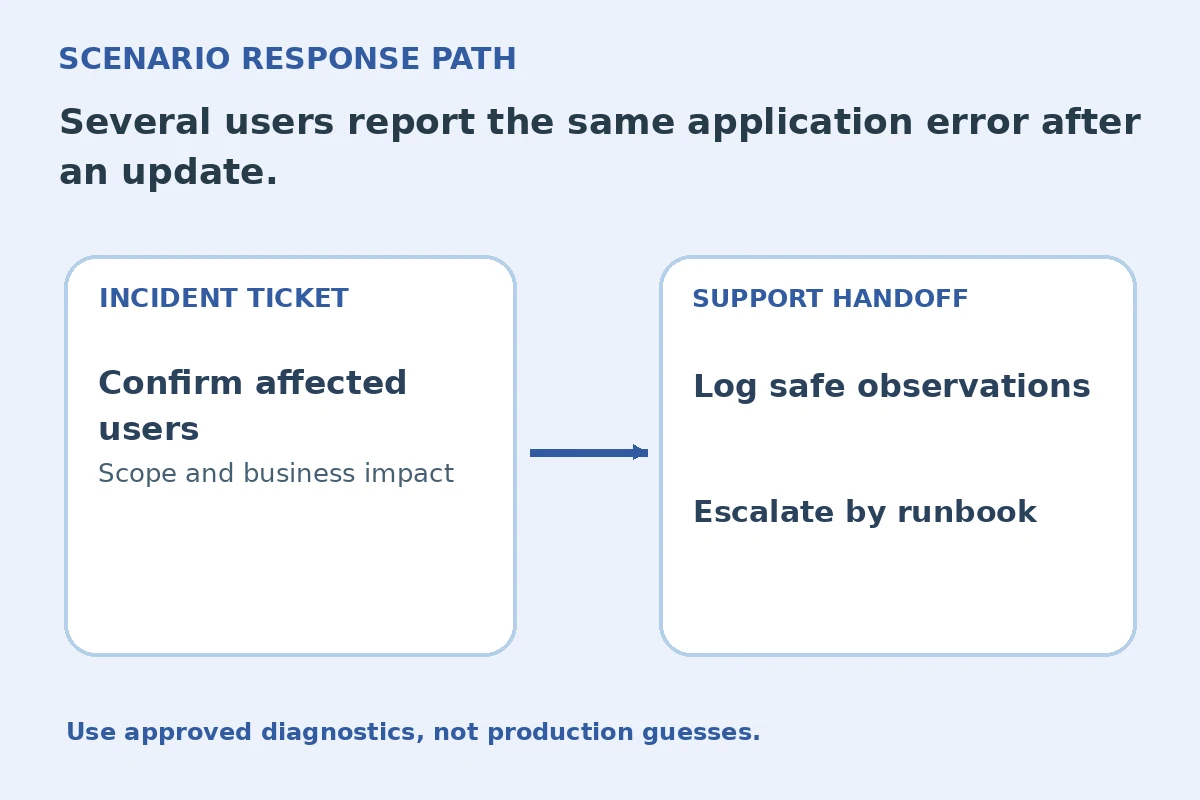
For application support scenario interview questions, interviewers may describe an unfamiliar event and ask what you would do next. A useful answer begins with the real-world risk, identifies the records or facts you can verify, and explains who has authority over the next decision. For example: Several users report the same application error after an update. You do not need to invent the employer’s policies, assume an outcome, or claim powers outside the advertised position. Use this practical framework: confirm affected users, log safe observations, and escalate by runbook. All sample answers below are hypothetical practice examples, not statements about actual employers or candidates. Replace generic claims with the employer’s published procedures, protect confidential information, and ask a follow-up question when the scenario leaves a material fact unknown.
Start by confirming the type of incident
When asked what you would do if an application stopped working, do not begin with a database command. First clarify the service, user population, timing, observable error, known maintenance, and how severely work is affected. A single user unable to sign in may call for different routing from a service-wide outage. Ask whether the role has an incident classification guide and which systems you are authorized to inspect. Interviewers are testing disciplined diagnosis and communication, not whether you can guess the root cause with no evidence.
Scenario: many users see an error after deployment
Suppose support receives several related error reports after a release. Check the service status, known change record, incident queue, and available authorized monitoring. Record affected functions and the first known time, without exposing customer data. If impact triggers a defined severity threshold, notify the owner under the incident process. A strong candidate resists independently rolling back production unless explicitly delegated that authority. Explain that you would keep the incident timeline and direct users to the approved status channel, avoiding unsupported predictions about a recovery time.
Scenario: one account fails while others work
If only one user is affected, verify the error, account status through permitted tools, client environment, and whether the same workflow works for others. Do not ask for the user’s password or suggest circumventing access controls. Use the documented recovery path, request the minimum necessary information, and record what was tested. If the issue concerns permissions, escalate to the identity or application owner rather than silently granting additional privileges. That distinction shows your interviewer you understand both service restoration and the security consequences of a shortcut.
Scenario: the customer demands an immediate fix
A frustrated user may ask for a precise time even though engineering has not approved one. A good answer acknowledges the business impact, states what is known, names the next communication channel, and explains that technical owners are assessing the issue. Do not invent an ETA or claim a fix is deployed because a status page looks reassuring. If the person has a critical workflow, ask whether there is an authorized workaround. Separate the customer’s urgency from your technical authority, and document the commitment you actually made.
Scenario: logs contain personal or secret information
A ticket may include access tokens, addresses, health details, or client records. Describe minimizing exposure, applying the organization’s redaction and retention rules, and restricting who can read evidence. Never paste full secrets into chat or an open ticket to speed investigation. When a symptom suggests a potential security incident rather than an ordinary defect, route it through the security reporting process. NIST’s current guidance concerns cybersecurity incident response; do not misstate it as a mandatory repair procedure for every harmless application error.

Explain severity without inventing fixed thresholds
A candidate should identify breadth of impact, critical business functions, available alternatives, and possible data integrity or security effects. Those factors usually inform urgency, but every organization has its own incident-severity definitions. Do not say that five complaints automatically make a major incident. Discuss comparing evidence with the documented severity table and involving the designated incident manager or on-call team. This phrasing works across internal enterprise applications, SaaS support, and customer-facing platforms without pretending they share the same alert policy.
| Question to ask yourself | Evidence or action to describe |
|---|---|
| What is the immediate issue? | Confirm affected users: Scope and business impact |
| What can I verify? | Log safe observations: Errors, times, prior changes |
| Who owns the next action? | Escalate by runbook: Assigned incident owner |
Build a useful escalation handoff
A good support handoff names the service, the user-visible symptom, known onset, environment, steps to reproduce if safe, what was checked, and any observed scope or change correlation. It separates what is confirmed from what is suspected. Include an incident or ticket reference if one exists; never manufacture one in an interview story. Avoid attaching confidential screenshots or raw credentials. An engineering team benefits from a concise account of tested hypotheses and observed impact far more than a message saying only that the app is broken.
Choose safe troubleshooting over improvisation
Support staff may restart a client application, use approved diagnostics, or guide a user through documented steps, depending on access and role. A production rollback, data repair, firewall change, or deletion can have substantial effects and should not be presented as a first reaction. Ask about the approved runbook, change authorization, and backup or recovery responsibilities. When you discuss a hypothetical workaround, identify how you would verify it has been approved and communicate its limitations. The interviewer should see that you value service continuity without breaking the controls that protect it.

Practice concise communications during an outage
Rehearse a two-sentence status update: the observed service effect and the next authorized update path. For example, “We are investigating reports that the reporting screen is failing for some users. The incident owner is coordinating the next update through the service-status channel.” This is an illustrative statement, not a claim that an actual outage exists. Avoid listing unverified causes or asking affected users to expose private logs. The strongest interview answer makes uncertainty understandable while demonstrating that you will follow up reliably.
Ask what an application support engineer owns
Before accepting a role, find out which incidents first-line support can resolve, which changes require engineering approval, whether there is on-call coverage, and what tools are approved for diagnosis. Clarify whether security alerts have a separate response team. This protects against exaggerating the position in an interview: a junior analyst can describe strong triage and handoffs without claiming to lead a major incident. Match your final answer to the advertised position and show how you would learn a new application’s runbooks before making changes.
How We Research Application Support Interview Scenarios
JobAsk reviewed the following primary occupational and agency sources on November 17, 2026: BLS describes diagnosis, recording user issues, and escalation of major or recurring technical problems by support specialists. NIST SP 800-61 Rev. 3 (2025) provides current security-incident response guidance and supersedes Revision 2. NIST summarizes current incident-response roles, coordination and planning after SP 800-61 Rev. 3 superseded Revision 2. They explain broad responsibilities and information-handling boundaries, not any particular employer’s selection criteria or the outcome of a real interview. Hypothetical questions and answers are editorial teaching examples. Follow the actual employer’s written procedures, training and legal obligations. We do not claim that an answer ensures hiring. See our affiliate disclosure for relationship transparency.
More Interview Preparation Guides
Only if that action is specifically authorized by the role and runbook; otherwise explain evidence capture and escalation to the appropriate owner.
Establish user impact, scope, timing, and whether there is an existing incident or change before choosing a troubleshooting action.
Say what is observed, what you would test safely, and whom you would involve; do not present a guess as confirmed.
Do not invent one. Use timing approved by the incident owner or explain when the next communication is expected.
No. Its current SP 800-61 Rev. 3 addresses cybersecurity incident response; ordinary support incidents follow the employer’s own service process.