
To apply for event planning jobs online, choose an actual role level—event assistant, coordinator or planner—then match the posting to logistics you can document. A task log, event run of show, vendor contact plan or attendee-flow checklist is more useful than an unsupported claim that you ‘organized a major event.’ The Bureau of Labor Statistics describes planning work that can involve venues, providers, transportation and event-day coordination. Your application should show which decisions you made and which decisions belonged to a client or supervisor. This guide covers the application process, not a current vacancy list or a promise of eligibility. Openings, application windows, eligibility criteria and hiring contacts can change. Always let the live employer announcement control what you submit. The illustrated examples are hypothetical unless they describe general official guidance, and must be replaced by your own truthful evidence.
Find the correct official application route for the work
Search for positions using both ‘event coordinator’ and ‘event assistant,’ but read the duties rather than assuming they mean the same thing. One posting may focus on registration and room resets; another may ask for proposal development, budgets or vendor negotiations. Compare the venue, employer, travel expectations, evenings or weekend schedules, and event types. A hotel conference role can differ from nonprofit fundraising or a corporate meeting. Avoid claiming you meet a role’s stated years of independent planning experience because you helped at one student festival.
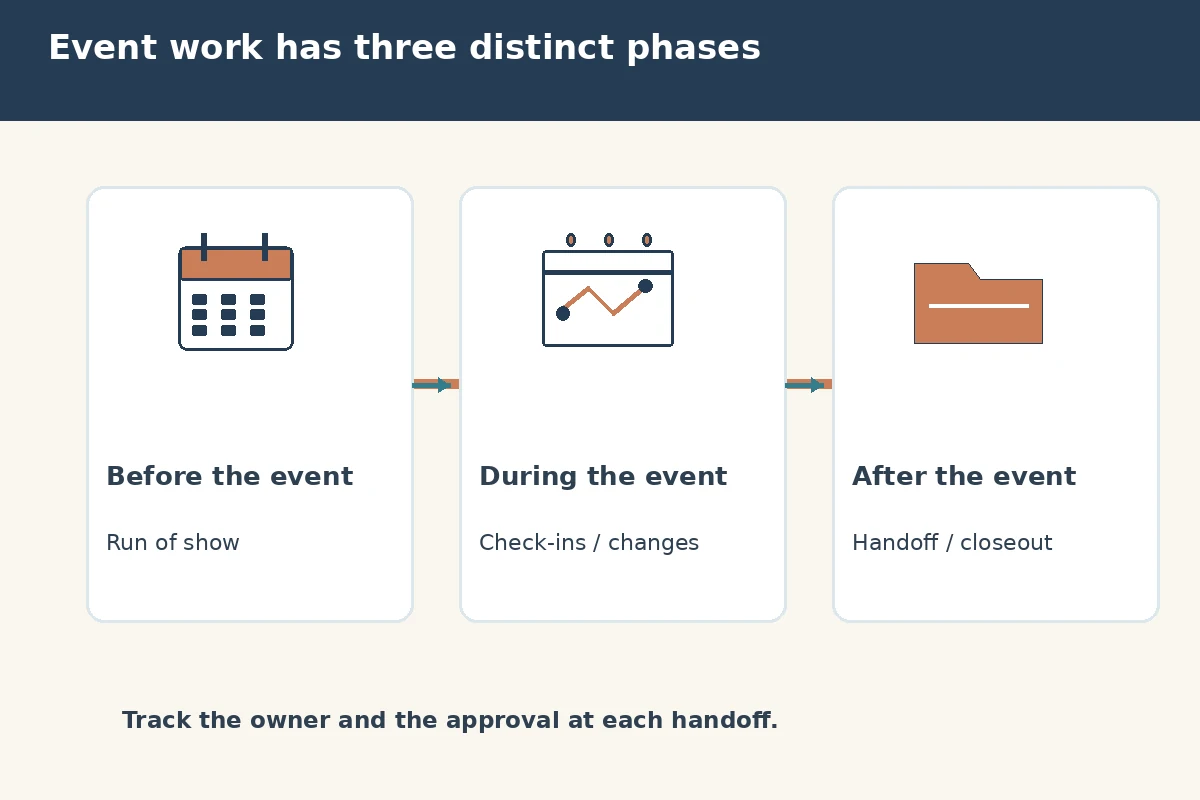
Read the online announcement for three sorts of work: preparation, event-day delivery and closeout. Preparation includes schedules, attendee lists, room layouts and vendor confirmations; delivery may include registration, signage, service changes and escalation; closeout can include invoices, feedback summaries and equipment handoffs. Identify exactly which components you have performed. If the ad requires signed contracts, authorized payment approval or supervisory experience, don’t answer ‘yes’ based solely on maintaining a spreadsheet or watching someone else negotiate.
Choose role evidence that can survive an interview
Choose a real event example and reconstruct the workflow with sanitized information. A hypothetical student welcome session might include a schedule with setup and doors-open milestones, an action-owner list and a handoff to the venue coordinator. Explain whether you created the plan, followed an approved plan or helped update it. Name one legitimate constraint, such as a delayed speaker arrival, and the escalation you performed. Remove names and private participant information; no employer needs a public download of volunteer registration records to assess organizational skill.
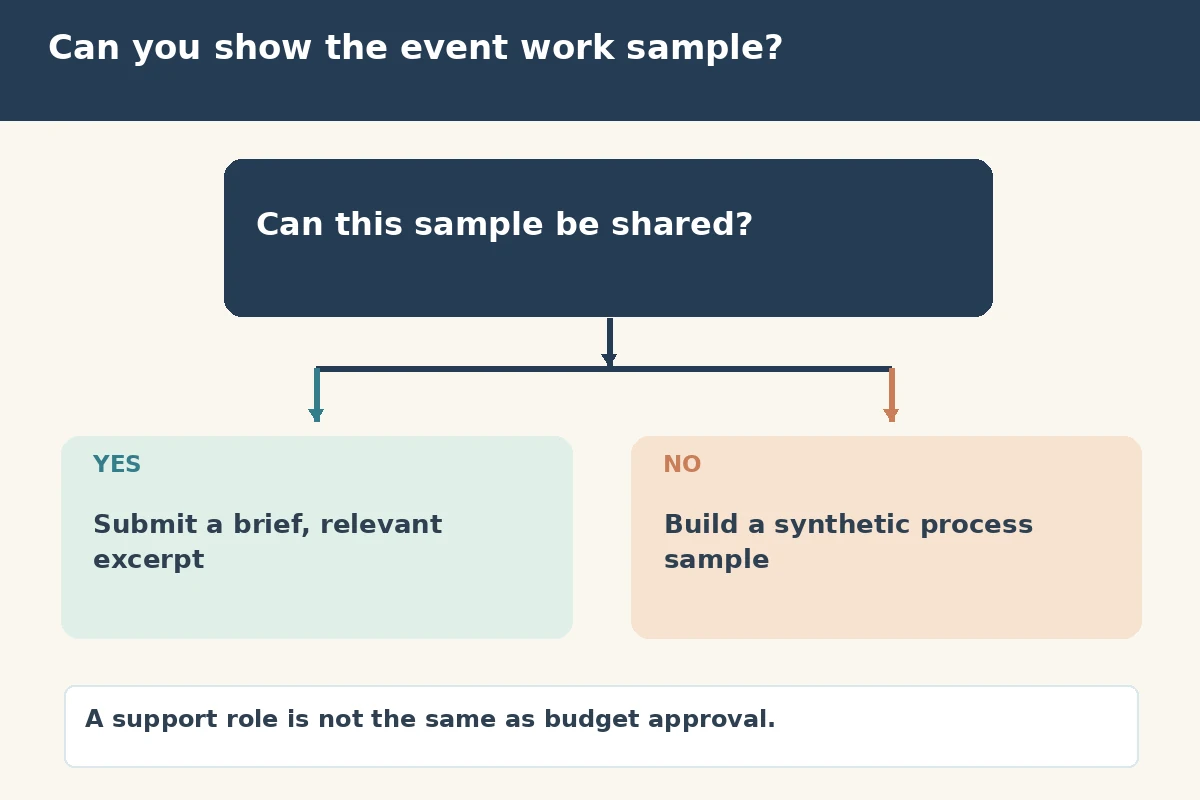
A resume should highlight measurable scope only when that scope is documented: number of sessions, type of audience, duration or tasks actually owned. The employer may request a portfolio or writing sample; if it does, send a concise mock run of show or a permitted summary that demonstrates clear timing, responsible owners and a contingency contact. Do not attach third-party proposals, client contracts or event budgets without rights. A cover letter can connect one verified coordination example to an identified duty without implying that you made executive decisions or guaranteed attendance.
Turn actual experience into a clear application example
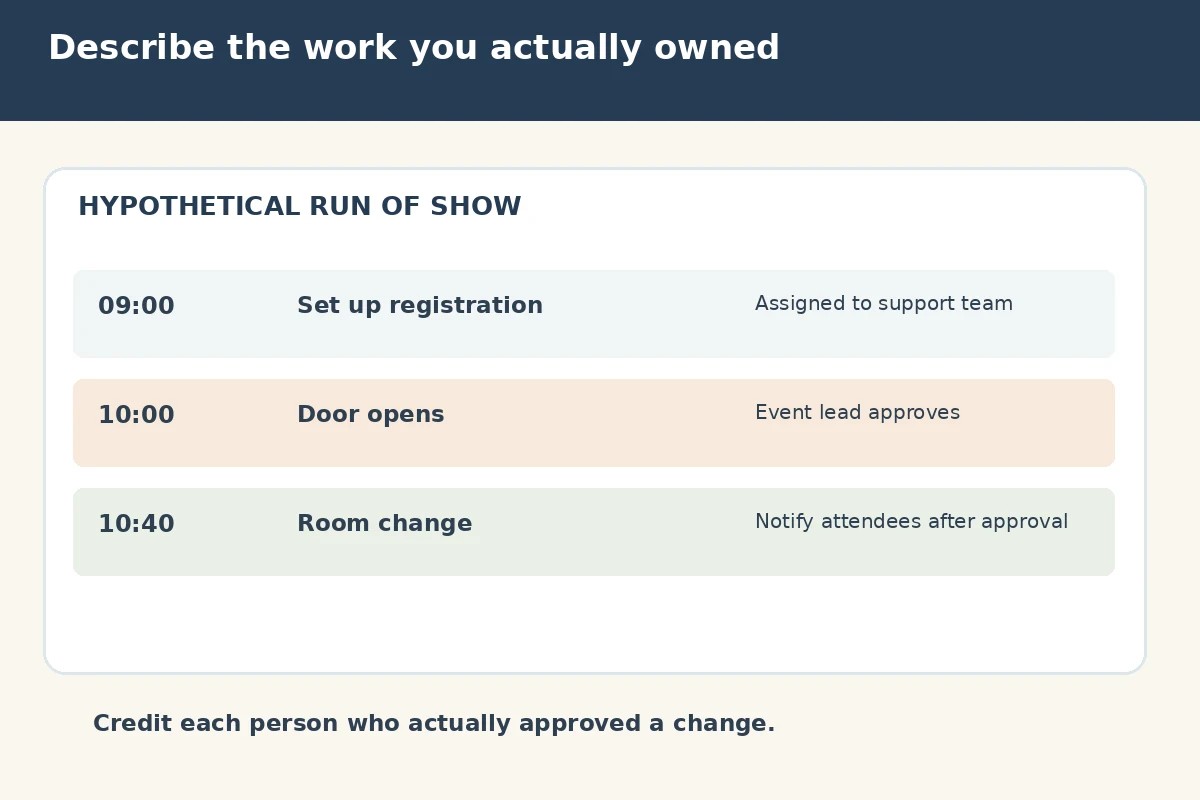
Hypothetical application example: ‘Prepared a volunteer check-in schedule, updated signage after a room change approved by the event lead, and relayed the revised location to registration staff.’ That is more defensible than ‘managed an entire conference’ if you were helping on site. Another person may have produced a vendor status table under a coordinator’s direction; they can describe the handoff and verification process without claiming to negotiate or sign the supplier agreement. Choose the version that a supervisor could confirm from actual records.
A useful experience example has a setting, an action you personally completed, and the checkpoint that kept the work accurate. The example above is hypothetical, not a claim about your employment. Replace it with your own work, school or volunteer experience, and verify dates, employer names, permission to share materials and tools you actually used. Avoid fabricated metrics; a credible handoff or correction is often more informative than a made-up performance percentage.
| Check | Evidence to use | Claim to avoid |
|---|---|---|
| Route | Correct employer and vacancy page | Search result alone proves legitimacy |
| Role fit | Specific true task and level | One title fits every role |
| Documents | Announcement-required files | Guessing credentials or eligibility |
| Submission | Actual receipt / portal status | Saved draft equals application |
Finish each online screen and verify real submission
Before completing the online portal, check whether the vacancy calls for links, PDFs, a resume-only submission or answers to screening questions. If it asks about budget ownership, separate collecting expense receipts from authorizing spend. If it asks about on-site availability, consider commute and scheduled weekend work realistically. Test any portfolio link in a private browser window and remove restricted details. Save a separate application record for each organization: event type, job level, worksite, documents sent and the next expected action.
Event work often operates under strict handoffs: a coordinator may request a vendor update but not approve contract terms, a volunteer may direct guests to a posted area but not change crowd-safety procedures, and an assistant may record an invoice without authorizing payment. Those boundaries make good interview examples because they show judgment. Avoid unsafe claims about crowd control, emergency operations, rigging, equipment or food handling if you lack the required training and authority. Do not include private guest lists or sponsor correspondence as downloadable samples.
Fix the most consequential mistakes before the deadline
Some applications inflate a college event into a professional convention, describe a group project as solo planning, or confuse attendance with an outcome personally delivered. Others send attractive slides without a clear explanation of what was approved. A hiring manager can more easily evaluate an annotated schedule with a changed-session note and decision owner. Check names of venues, dates and tools: a screenshot from a training example should be labeled hypothetical rather than implying work for a real conference. Explain your evidence in plain English, not event-industry acronyms alone.
Adjust the approach for role type, location, and schedule
For conference-center work, show room turnaround schedules and registration coordination; for nonprofit events, emphasize volunteer communication and responsible escalation; for weddings or private occasions, emphasize client preferences without exposing private details. A corporate meeting role may value briefing notes and vendor follow-up. Change your selected sample to fit the actual role, not just the title. A newcomer may be a good fit for an assistant opening while lacking the requirements for independently contracting suppliers or approving a full event budget.
Keep a useful receipt and an accurate follow-up record
Once submitted, check that any file upload or portfolio link was recorded and save the application’s confirmation. If a recruiter requests a work sample, ask for the expected format and provide only authorized materials. Do not promise client contacts or vendor introductions as part of your application. When preparing for an interview, practice explaining a single event change: what triggered it, who had decision authority, how you informed affected people and what you documented afterward. That account is more useful than a general statement about thriving under pressure.
Make the last review concrete: confirm that the position title and employer match, every required file opens correctly, screening answers match your resume, and no outdated draft is mistaken for a submitted application. Write down when you submitted and through which official portal. Keep personal identification documents out of casual email threads and never pay a stranger to unlock a job offer. These checks cannot guarantee a response; they make the record more accurate and easier to follow up.
How We Research and Verify Online Application Guidance
We checked official agency, occupational and consumer-protection materials on November 16, 2026: BLS describes event planners’ coordination of venues, transportation, vendors, participant experience and bills.. O*NET documents tasks and work activities of meeting, convention and event planners.. FTC explains how to verify the recruiting organization and avoid fake job advertisements.. We compared these topics with both published and draft titles in the supplied WordPress list, the original JobAsk READY candidate queue, and recent batch subjects. Public search and a title comparison cannot guarantee that an unpublished slug is free. Examples are hypothetical, employer requirements must be rechecked in the current vacancy, and we make no claim of hiring outcomes or paid endorsements. The affiliate disclosure describes site policies.
Related Job Search Guides
Yes, where the posting permits it. Describe your real duties, named handoffs and supervisor decisions rather than treating volunteer assistance as sole event ownership.
Only when requested or permitted. Use a synthetic or authorized sample and remove private names, schedules and client information.
Not necessarily. Employers use titles differently; read duties, budget authority, vendor responsibility and experience requirements.
State accurately that you tracked quotes, documented receipts or supported communications if that is true. Do not claim payment authorization.
Role level, location and work hours, logistics examples, permission to share samples and the employer’s required application format.