
To apply for a USDA Forest Service job online, find the actual vacancy through the agency’s careers pages and USAJOBS, check the appointment type and requirements, and complete both the USAJOBS package and any required agency steps. Seasonal positions are not all summer jobs, and a park ranger title does not describe every Forest Service employee. The most useful application starts with the specific announcement’s worksite, duties, dates and qualifications, rather than a general search for ‘forest jobs near me.’ This guide covers the application process, not a current vacancy list or a promise of eligibility. Openings, application windows, eligibility criteria and hiring contacts can change. Always let the live employer announcement control what you submit. The illustrated examples are hypothetical unless they describe general official guidance, and must be replaced by your own truthful evidence.
Find the correct official application route for the work
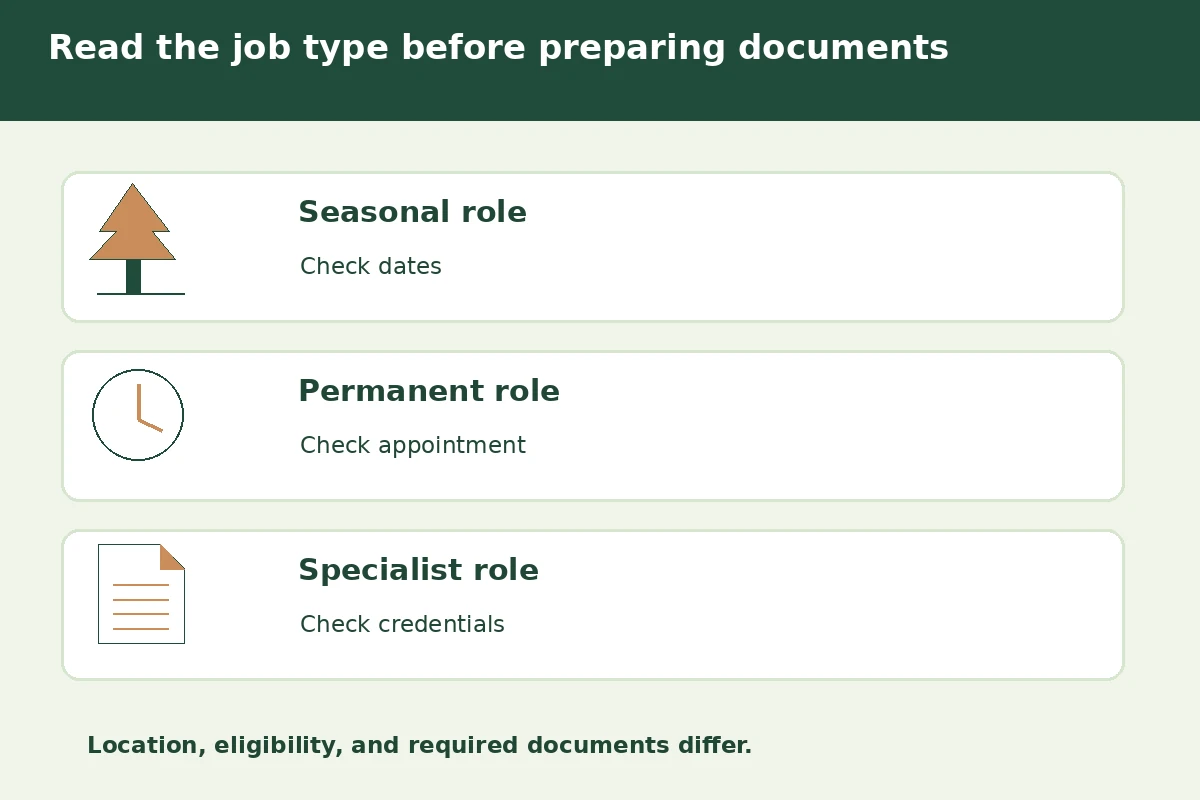
Search the Forest Service’s official career resources, then filter USAJOBS by the agency, occupational keywords and locations you can realistically reach. Compare a seasonal opening with permanent and permanent-seasonal opportunities; their schedules and eligibility can differ. Administrative work, visitor support, trail maintenance, recreation operations and scientific roles are not equivalent. A trainee or helper vacancy may require a different background than a specialized professional position. Do not presume a prescribed hiring month: announcements and closing dates change, so use the live notice.
Read the announcement from top to bottom. Capture the position title, series or grade where shown, duty station, work schedule, appointment type, application window and ‘Who May Apply’ eligibility. The ‘Qualifications’, ‘Required Documents’ and ‘How to Apply’ sections determine whether you can submit a valid application. If a posting refers to field conditions, equipment, a driving license or a credential, respond to that exact language. Seasonal work may have dates or on-call expectations that are incompatible with school or another job; verify rather than guessing.
Choose role evidence that can survive an interview
For a recreation or trails support role, transferable experience could include maintaining a work log, following a supervisor’s safety briefing, guiding visitors to posted information, or documenting an equipment issue. Describe only tasks actually performed, with details about frequency and review. For example, public volunteer cleanup is not the same as independently operating a chain saw or supervising a wildland crew. If your project involved trail observations, say who approved access, how you recorded findings and whether a trained worker handled hazardous conditions.
USAJOBS tells applicants to prepare a profile, select a resume, attach documents, review the package and continue to the hiring agency. The ‘Required Documents’ section specifies what is mandatory for each vacancy. A federal application may require details not emphasized in a private-sector resume; follow the announcement and current instructions rather than pasting a decorative one-page template everywhere. Never fabricate a certification, degree, veterans’ preference, government status or specialized work hours. If a requirement is unclear, use the contact information in the announcement before the deadline.
Turn actual experience into a clear application example
Hypothetical truthful example for a volunteer who has helped at a public recreation area: ‘Recorded visitor questions during staffed events, checked trail-sign locations against an approved map, and passed maintenance concerns to the site coordinator.’ This is not evidence of law enforcement duties, independent land management, fire qualifications or federal employment. A stronger supporting detail might identify a checklist, shift log or approved handoff procedure. If you worked only during one weekend, state that period rather than implying a summer’s worth of field work.
A useful experience example has a setting, an action you personally completed, and the checkpoint that kept the work accurate. The example above is hypothetical, not a claim about your employment. Replace it with your own work, school or volunteer experience, and verify dates, employer names, permission to share materials and tools you actually used. Avoid fabricated metrics; a credible handoff or correction is often more informative than a made-up performance percentage.
| Check | Evidence to use | Claim to avoid |
|---|---|---|
| Route | Correct employer and vacancy page | Search result alone proves legitimacy |
| Role fit | Specific true task and level | One title fits every role |
| Documents | Announcement-required files | Guessing credentials or eligibility |
| Submission | Actual receipt / portal status | Saved draft equals application |
Finish each online screen and verify real submission
Keep the vacancy open as you enter your application. After attaching the resume and listed documents in USAJOBS, continue when prompted to the agency-specific system and finish its questions or assessment requirements. The USAJOBS Help Center warns that clicking through to an agency may not be the final step. Return to the application record to verify the status shown. A job saved in search results or a drafted document is not a submitted application. Do not wait until the closing-minute cutoff to discover a missing upload.
Forest Service work can involve environments and tools with real hazards. An application should never imply that volunteering, watching an online demonstration or possessing general outdoor enthusiasm qualifies you for a regulated, safety-sensitive or trained task. Read the specific job’s physical conditions and required credentials, and describe the scope of supervised work precisely. Do not claim that you can substitute personal gear for agency-issued protective equipment or perform specialized work without approved training. Relevant reliability and communication experience is often worth describing without overstating technical authority.

Fix the most consequential mistakes before the deadline
Typical mistakes include assuming every Forest Service vacancy has the same seasonal schedule, selecting an announcement restricted to an eligibility group you do not belong to, or uploading a generic resume that omits the specialized experience requested. A location name may refer to a wide district rather than a single visitor center. An old recruitment flyer may point to information that has since changed. Save a dated copy of the actual announcement and verify the agency handoff; if an error is found, use the stated correction or contact process, not an invented second identity.
Adjust the approach for role type, location, and schedule
If your interests include research, look at the educational and data requirements for the specific scientific series; if you prefer visitor services, examine visitor-contact and scheduling expectations. For a permanent-seasonal appointment, do not automatically substitute the obligations of a temporary summer job. For positions requiring a driving license, personal vehicles or travel, rely on written terms, not assumptions from another state or an old posting. The point of filtering is to invest your application time in positions where your documented experience and logistics really fit.

Keep a useful receipt and an accurate follow-up record
Once the portal indicates a completed submission, retain the announcement number, date and any receipt. If an agency emails a request for more information, verify the message through the official vacancy contact or account. Do not assume a referral or an application status means an interview is guaranteed. A new season may require a new application to a new announcement; the archive of your own materials is useful, but prior submission does not reserve a spot. Keep your resume facts consistent when updating for new roles.
Make the last review concrete: confirm that the position title and employer match, every required file opens correctly, screening answers match your resume, and no outdated draft is mistaken for a submitted application. Write down when you submitted and through which official portal. Keep personal identification documents out of casual email threads and never pay a stranger to unlock a job offer. These checks cannot guarantee a response; they make the record more accurate and easier to follow up.
How We Research and Verify Online Application Guidance
We checked official agency, occupational and consumer-protection materials on November 16, 2026: USDA Forest Service maintains official employment and career information.. USAJOBS explains resume, document and agency application steps.. Required documents depend on the job and appear in each USAJOBS announcement.. FTC guidance explains common job scams and why applicants should verify listings before sharing data.. We compared these topics with both published and draft titles in the supplied WordPress list, the original JobAsk READY candidate queue, and recent batch subjects. Public search and a title comparison cannot guarantee that an unpublished slug is free. Examples are hypothetical, employer requirements must be rechecked in the current vacancy, and we make no claim of hiring outcomes or paid endorsements. The affiliate disclosure describes site policies.
Related Job Search Guides
Yes. USDA Forest Service vacancies are commonly posted through USAJOBS; check the official agency careers pages for the current routes.
No. Opportunities include different appointment types. Read the actual vacancy announcement rather than assuming summer-only employment.
Not necessarily. Complete the required documents, questionnaire and any agency-side steps named in the posting.
Describe actual volunteer duties and training truthfully, but do not present them as certifications or independent authority to perform hazardous work.
The vacancy’s eligibility, qualifications, worksite, closing date and required documents govern whether your application is complete and appropriate.