
An online temp agency application usually tells a staffing business what kinds of assignments you can do; it is not itself acceptance of a specific job. Before entering your details, verify the agency’s official website, identify the types of employers or tasks it recruits for, and read what registration authorizes. Some agencies handle short placements, ongoing temporary assignments or temp-to-hire opportunities. These phrases describe possible arrangements, not guaranteed conversion to permanent employment. Your goal is to provide accurate availability and experience while keeping control of which opportunities you agree to consider.
First distinguish the parties. A staffing agency may recruit, communicate with the worker and handle certain administrative or payroll functions, while a client organization directs work at a particular site. The exact responsibilities vary by agreement and circumstance, so never assume the client is the legal employer or that all agencies use the same model. The application may request permission to submit your profile to relevant clients. Read that language carefully, especially if you have applied directly to an employer and want to avoid unapproved duplicate submissions.
Identify the Agency and Client Roles
Open the real agency application through a domain you independently confirmed. Check contact details, location, office address and how the agency describes its current opportunities. The FTC warns that fake recruiters can impersonate real firms and ask for upfront fees or sensitive financial information. Do not follow an unverified text message into a personal-information form merely because it mentions a recognized client brand. If a recruiter contacts you unexpectedly, call the agency at a number from its official site and ask whether the person and assignment are genuine.
Make a practical availability profile before you start typing. Record the days and hours you can reliably work, commuting radius, transport constraints, the earliest realistic start date and any scheduled commitments. If you can work mornings but not overnights, do not mark both just to receive more calls. Some forms ask whether you can travel to more than one worksite or accept shifts at short notice. Answer for your actual situation. Your preferences may change, so record how to update the agency rather than silently declining repeated mismatched assignments.

Record Honest Schedule and Skill Limits
Describe transferable tasks without manufacturing certifications. An applicant with retail stockroom work can mention receiving shipments, matching item numbers and following inventory procedures. That experience does not automatically establish forklift authorization, specialized warehouse safety training or the ability to operate restricted equipment. A clerical applicant may describe data-entry accuracy and scheduling, but should not claim access to confidential client databases from a personal project. Real specificity gives a recruiter something useful to match against assignment requirements.
A hypothetical applicant wants daytime administrative assignments within a reasonable commute. The agency’s official portal asks for previous roles, preferred schedule, skills and permission to contact the applicant. The candidate lists actual office reception and scheduling work, leaves a night-shift option unchecked and asks which companies may receive the résumé. When offered a possible client assignment, they ask about the site, duties, hours, supervision and pay terms before accepting. They do not treat “profile completed” as a binding employment offer or a promise of hours.

Understand Sharing and Assignment Terms
Before agreeing to a particular assignment, compare the recruiter’s verbal description with written terms. Verify the client or worksite, start and end expectations, hours, compensation information, reporting location, safety instructions, pay cycle and who answers questions about time records. Do not send confidential past employer material as proof of experience. If the task requires training or a credential you do not have, raise that immediately. Agency registration cannot replace job-specific orientation or permissions at a worksite.
Personal information needs extra care. Registration forms may legitimately collect contact and employment history details, while verified later hiring stages may require additional identity and payroll information. Timing and secure channels matter. Never send a scan of an identity document, banking information or account credentials to a person you cannot verify. Read what information may be shared with client companies, and use the agency’s published process to ask for clarification. Consent to be contacted about jobs is not necessarily blanket consent for every disclosure.
| What you found | Useful next action | Avoid assuming |
|---|---|---|
| Agency registration submitted | Store profile and contact record | A client offered you a job |
| Client assignment proposed | Verify site, shifts, pay and scope | All duties and hours are guaranteed |
| Recruiter requests sensitive data | Verify identity and secure process | Unexpected messages are authoritative |
Keep Registrations Separate From Offers
Keep a record of agency registrations separately from actual applications and placements. For each agency, note the verified URL, registration date, profile version, roles and shift preferences. For a proposed assignment, record the client, recruiter, job reference, written terms and your response. This prevents a common confusion in job searches: counting five staffing profiles as five employer job applications. If an agency has not contacted you, a calm update about verified availability may be more useful than repeated duplicate registrations.
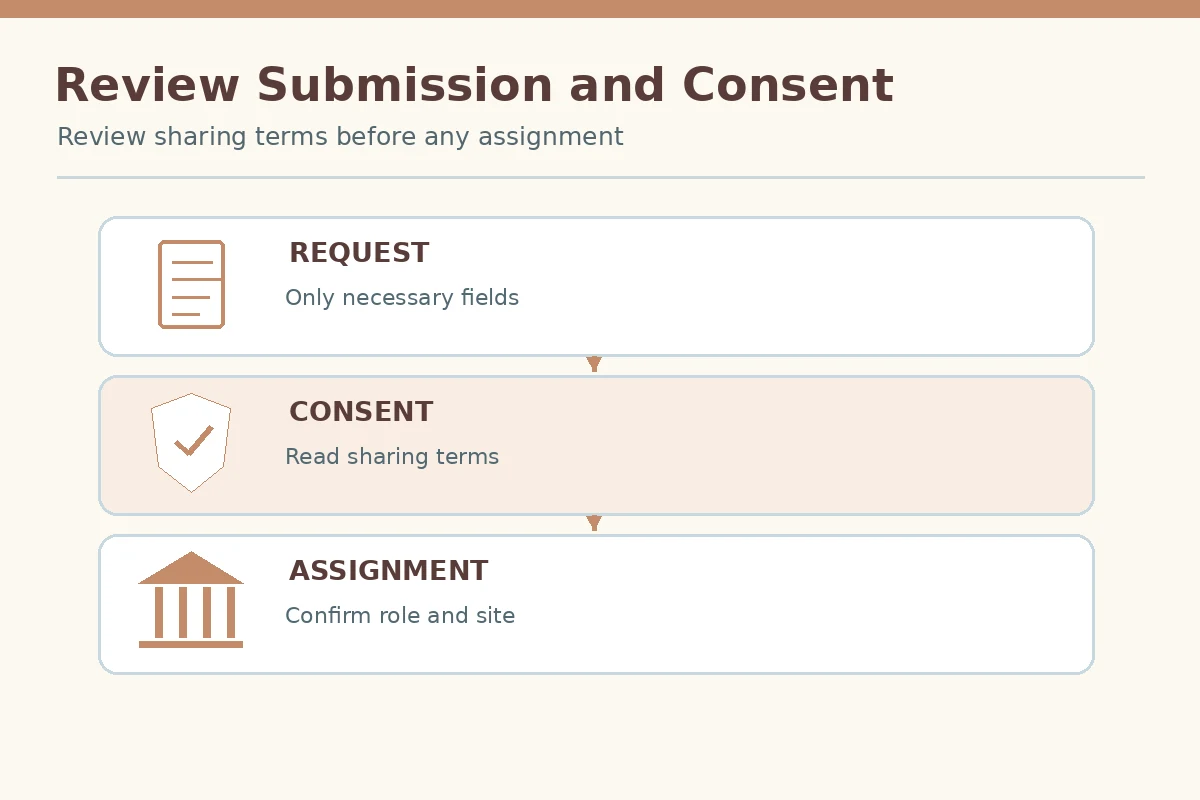
When deciding whether to proceed, look for clarity and control: do you know who is contacting you, what position is actually available, what your information will be used for, and how to accept or decline an assignment? If the recruiter cannot explain duties or insists on payment before revealing basic information, stop and verify. A responsible application is accurate, secure and limited to work you can genuinely perform; it does not rely on promises of immediate placement or guaranteed permanent hiring.
Review Any Specific Work Assignment
There is a difference between presenting yourself to a recruiter and giving blanket authorization for an unknown assignment. If the registration says your profile may be shared, read the stated purpose and any options. Ask how your details will be handled when a recruiter finds a client fit and how you will be notified. This question is especially important if several agencies recruit for similar employers and you do not want conflicting representations of your interest. Keep messages professional and specific rather than assuming that every contact means a real job has already opened.
One useful personal checklist has four fields: role family, skills supported by evidence, time and travel limits, and questions you need answered before accepting. For a warehouse assignment, you may need to ask about lifting expectations, supervision and equipment training. For front-desk assignments, ask about visitor volume, computer systems and handling private records. Do not imply that registration alone authorizes you to use specialized equipment or view a client’s confidential data. Only after the actual assignment is explained can you determine whether it fits your experience and current availability.
How We Research and Check Sources
The external references below were checked on 2026-11-14 for the limited points identified in this guide. consumer.ftc.gov the FTC says legitimate placement firms usually are paid by employers and recommends independent verification of recruiters. www.ftc.gov the FTC identifies signs of fake recruiting and up-front placement-payment scams. www.irs.gov the IRS explains that employment classification depends on the facts of the working relationship rather than a job label alone. The sample candidates, proposals and procedures in this article are illustrative, not reports of real vacancies, guaranteed eligibility, or assurances of hiring. Check the original employer, sponsor, institution or platform instructions and any applicable local requirements before you submit. See the affiliate disclosure for our editorial transparency.
Related Job Search Guides
No. Registration establishes candidate information; a specific assignment requires separate details and an offer or agreement.
No. Use the shifts and travel range you can reliably meet, then update the agency if they change.
Review the agency’s disclosed process and ask which clients may receive your information; do not assume universal permission.
The FTC warns that legitimate placement firms typically are employer-paid and advance-fee job promises are a serious red flag.
Ask the verified agency for written assignment terms identifying payroll and on-site reporting responsibilities for the actual placement.