
Applying for freelance jobs online is different from submitting a resume for an employee opening. A prospective client is usually asking whether you can deliver a defined piece of work under agreed conditions, not merely whether your past job titles match a role. Begin by verifying the client and project, understanding the desired deliverable, and checking payment and revision terms before you spend time preparing a proposal. A marketplace listing, direct project brief and recurring contract can each use a different process. Do not assume that a profile created on a platform means you have been contracted.
Read the project description as a scope document. Identify what the buyer actually wants: a two-page edited document, a tested website component, a set of annotated images or a short research summary. Look for an audience, requested format, deadline, available reference material and approval process. If the job simply says “easy work, excellent pay, start now,” that is not enough to estimate scope or legitimacy. A strong application starts with three questions: what will be delivered, who reviews it and what happens if the requested output changes.
Define the Deliverable Before Bidding
Check whether the project fits experience you can demonstrate. If you have edited student publications, show a permitted before-and-after excerpt or describe the type of correction without publishing someone else’s confidential draft. If you have completed a software project, identify your own code and tests rather than claiming ownership of a team product. A hypothetical proof sample should be clearly labeled as demonstration work. Portfolio links may contain private clients, protected data or employer intellectual property, so confirm that you have permission before sharing files.
An effective freelance proposal is short and specific. It should restate one genuine problem in the brief, give a directly relevant example, outline what you would deliver and ask one clarification that affects time or quality. For example: “I can review the supplied English-language help pages for consistency and return an annotated document. I have revised instructional text for a student project. Does your team need comments in Word or a clean replacement file?” This is a hypothetical proposal, not a record of paid experience or an offer to work for a particular buyer.

Show Relevant and Authorized Work Samples
Upwork describes one platform flow in which a freelancer creates a profile, searches for projects, submits a proposal and receives a contract if selected. Do not extrapolate that workflow to every platform or imply that every proposal earns a response. A direct client may use email and a separate agreement instead. Record the channel, project identifier, message history and any platform rules that apply. When a client asks to move communication or payment off a platform, check the platform’s current terms and the actual risks before agreeing.
A hypothetical web-content freelancer is offered a “quick update” to a company site. The initial message mentions five pages but not whether the work includes design, accessibility review or publishing. The applicant asks for the content, platform and review limit, then proposes a deliverable consisting of five updated draft pages and one round of corrections. They do not promise search rankings, guaranteed conversions or security certification. They wait for a clear agreement before requesting account access or modifying a production website.

Clarify Client and Platform Terms
Consider the economics and responsibilities of the agreement without pretending that one label settles employment status. The IRS explains that worker classification depends on behavioral control, financial control and the relationship as a whole. A contract calling you a freelancer does not automatically resolve every legal or tax question. Before accepting, ask about deliverables, ownership, payment method, when approval occurs, expenses and who supplies tools or licenses. If these details are unclear, request clarification rather than making assumptions about benefits, invoices or tax treatment.
Watch for fraud patterns. The FTC describes fake side-gig offers that pressure applicants, promise unusually easy money or demand payment up front. Never send financial login details, buy gift cards, or transfer money to unlock a supposed payment. A platform may have genuine published service fees, but those are not equivalent to an unknown person demanding a deposit for a guaranteed task. Verify the client through channels independent of an unsolicited message and pause if the work involves suspicious account transfers, reviews or package reshipping.
| What you found | Useful next action | Avoid assuming |
|---|---|---|
| Brief defines output and reviewer | Write a scoped evidence-based proposal | A profile equals a contract |
| Client requests sensitive access | Confirm legitimacy and necessary permissions | Send passwords before terms are clear |
| Work terms remain unclear | Ask about revision, approval and payment | Promise an unlimited project |
Protect Access and Payment Information
After a client selects you, record milestones that both sides can observe. For a document-editing project, those might be receipt of source files, delivery of an annotated draft, a defined review window and final approval. The dates and payment triggers should come from an actual agreement, not from a generic template. If the brief changes, put the revised scope in writing before doing more work. This protects both quality and expectations. Do not claim that a dispute can always be resolved through a marketplace without reading its policies.
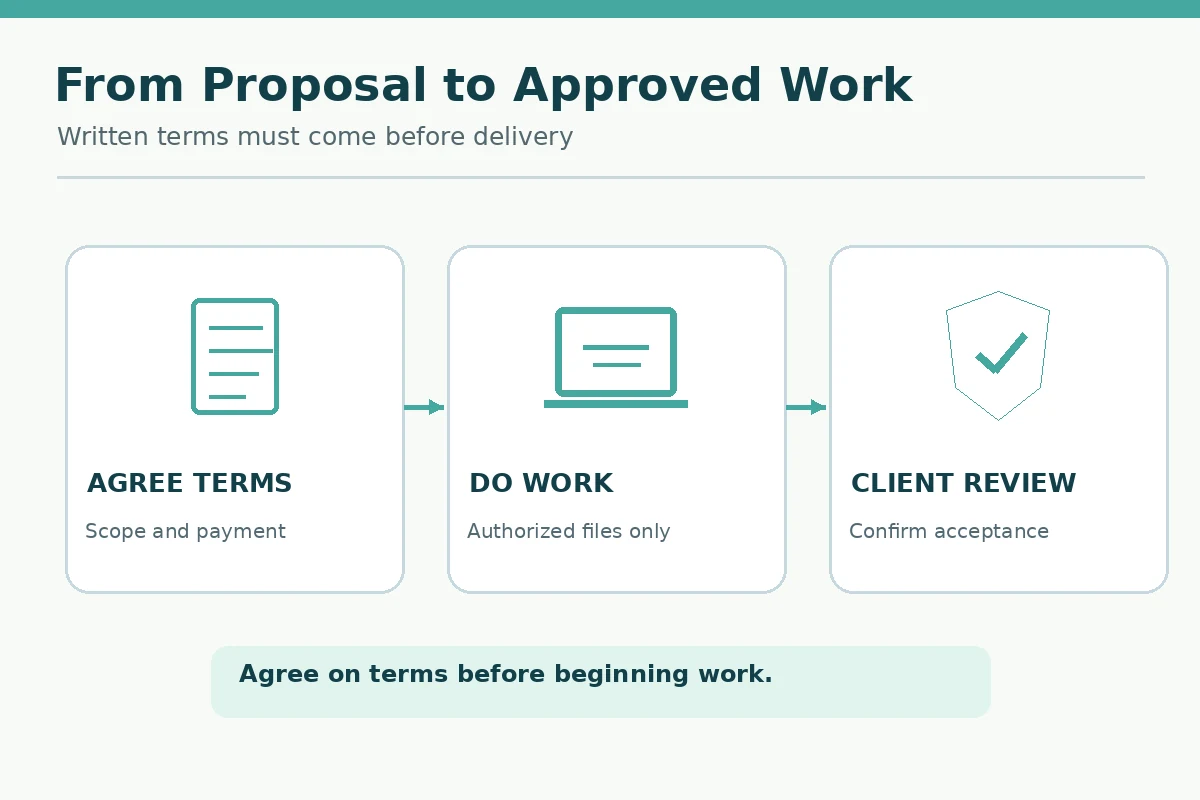
The final application check is practical: is the client identifiable, can you explain the requested work in one sentence, are your samples authorized, is the timeline possible and are the review and payment terms clear? Save the final proposal and the version of the brief you responded to. If you cannot answer those questions, a clarification request may be better than a premature quote. The point is to submit an honest, manageable proposal for a real deliverable, not to maximize the number of bids regardless of fit.
Check Before You Send a Proposal
A client-facing proposal is not the place to invent professional history. If your closest example is a college design project, label it as a school project and describe your own role in defining the layout, revising mockups and documenting feedback. If a client wants evidence of paid contracts and you do not have it, do not substitute a fictional testimonial. Instead explain the relevant process you have used and how you would handle review for this particular deliverable. A small, honest sample of your own work can communicate more than an exaggerated list of tools.
Before final submission, look at the terms from the buyer’s perspective and from your own. Is a revision round defined? Who owns source files? What happens when an approval is delayed? How will work be delivered securely? The answers should come from the actual offer or a negotiated written agreement, not from a promise that an online platform automatically protects every transaction. Avoid uploading client datasets to personal cloud storage without permission. A freelancer who asks these questions before bidding is helping prevent scope misunderstandings, even if that means declining some requests.
How We Research and Check Sources
The external references below were checked on 2026-11-14 for the limited points identified in this guide. www.upwork.com upwork describes a proposal-and-contract sequence as an example of a platform workflow, not a guarantee of work. consumer.ftc.gov the FTC warns about fake gig offers, urgent requests and payment-before-work scams. www.irs.gov the IRS explains that worker classification depends on control, finances and the overall relationship, not a label alone. The sample candidates, proposals and procedures in this article are illustrative, not reports of real vacancies, guaranteed eligibility, or assurances of hiring. Check the original employer, sponsor, institution or platform instructions and any applicable local requirements before you submit. See the affiliate disclosure for our editorial transparency.
Related Job Search Guides
Not always. Follow the client or platform instructions and prioritize genuine relevant work samples and clear deliverables.
A short understanding of the need, relevant proof, a bounded deliverable and any crucial question about scope.
Only if your agreement and permissions allow it; otherwise use your own authorized or clearly hypothetical work.
No. The IRS considers the actual working relationship; seek qualified guidance for a personal classification question.
Generally clarify the work agreement, permissions, review and payment terms before performing tasks for a new client.