
Architecture job boards can place junior designers, BIM specialists, project coordinators, and licensed architects in the same result list. Use the AIA Career Center to discover openings, but sort each role by the actual work, portfolio evidence, and legal license requirement before applying. In the United States, becoming licensed as an architect is a jurisdiction-specific process; a software skill or an architecture degree alone does not make someone a licensed architect. The method below keeps your search accurate and your portfolio relevant.
Separate design production from licensed responsibility
Search titles such as architectural designer, BIM coordinator, drafting technician, design technology specialist, project architect, and architect. These names can overlap in everyday conversation but describe different responsibilities within individual firms. Read whether the person will develop drawings under supervision, coordinate model standards, communicate with consultants, or take responsibility for documents requiring a licensed professional. Look for a clearly stated requirement for registration, licensure, or license eligibility.
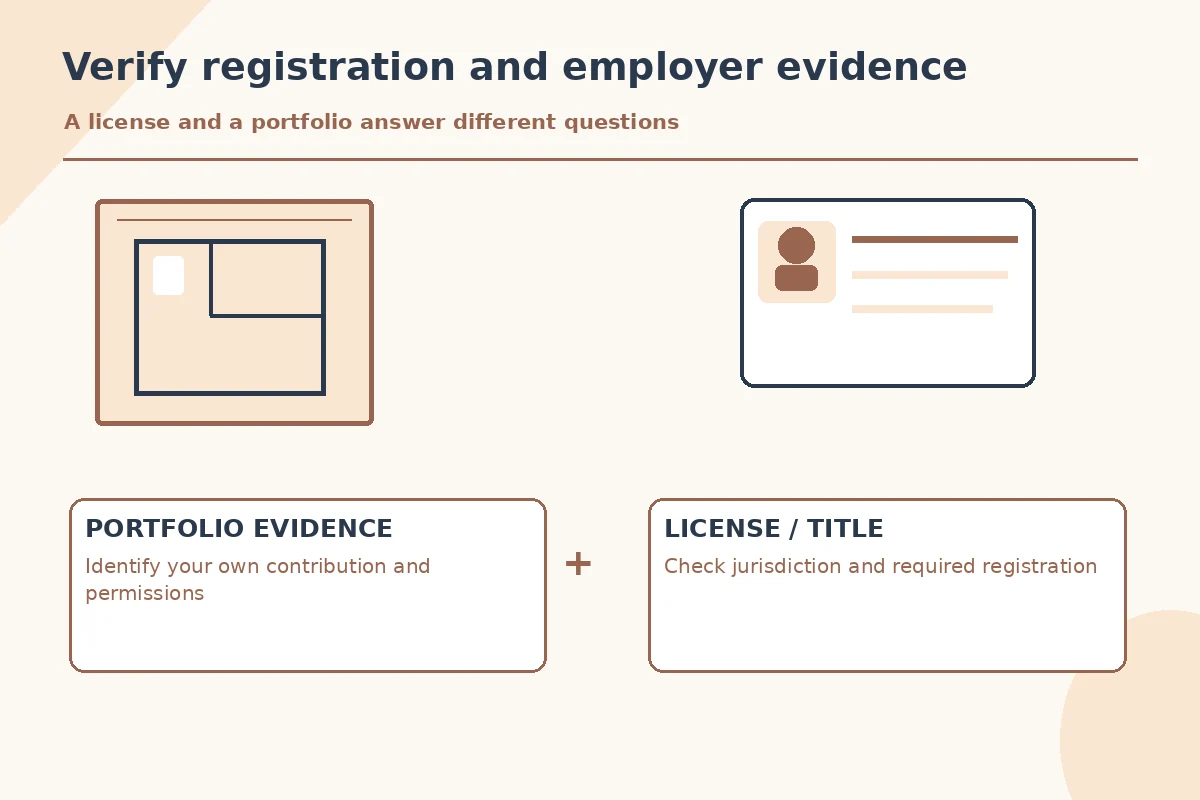
NCARB explains that licenses are issued by individual US state and territorial boards, not by NCARB itself. If you do not hold the required license, do not present yourself as a licensed architect. This does not prevent you from exploring appropriately supervised design or BIM positions, where an employer’s hiring criteria may differ. Check exactly what the job title implies in the jurisdiction and how the firm describes supervision and sign-off.

Use AIA listings as a map of employer requirements
The AIA Career Center has searchable openings that include architecture and adjacent positions. Start with the function and location, then apply filters or search words such as “Revit,” “building information,” “project coordinator,” or “architectural designer.” Do not assume that a title marked “junior” is an entry-level internship; read the years of experience, portfolio requirements, and expected coordination tasks. Saved results are leads, not proof that an opening remains active.
Open each likely employer’s official career page. Compare the exact title, worksite, hybrid expectations, software versions requested, degree or experience requirements, and submission channel. Some architecture firms accept a portfolio through a specific file upload, while others link to a candidate portal. If the board only offers an email address, verify that it belongs to the real company before sending files or personal details.
Choose portfolio samples to match a specific job
For a design production position, a concise portfolio might show concept development, plans, diagrams, and the decisions you personally made. For a BIM coordination role, focus on model organization, documentation workflow, coordination changes, and the tools you actually used. For project support, show schedules, meeting notes, drawing indexes, or issue trackers only if you created them and have permission to share them. A large portfolio is not automatically better than a focused, truthful one.
Annotate team work carefully: “student group project — responsible for circulation diagrams and model coordination” is more accurate than suggesting sole authorship of an entire building. Do not share confidential client drawings, protected project data, or copyrighted firm material without approval. If you cannot publish work, explain the type of work you did, your actual contribution, and the restrictions. Confirm permitted formats and file-size limits before uploading.

Compare a designer posting with a licensed role
Imagine two hypothetical vacancies. One asks for an architectural designer to prepare documentation under a project lead and maintain a shared BIM model. Another asks for a licensed project architect responsible for professional decisions and oversight. Even if both list the same CAD platform, the second has an additional credential and responsibility threshold. Use a four-part comparison: qualifications, work authorization, portfolio evidence, and applicant route.
Do not treat the title “architect” as a synonym for “good with design software.” If a job posting says “license required” and you are still completing your pathway, note that requirement and find the correct level instead. If it says “licensure in progress,” ask the firm how it handles the path, supervision, and professional development. These employer details supplement, rather than replace, the applicable state board’s standards.
| Role lane | Typical work to check | Evidence to verify |
|---|---|---|
| Architectural designer | Drawings, concepts, documented revisions | Show individual design contributions |
| BIM / design technology | Model standards, coordination records | Show truthful tool and workflow use |
| Licensed architect | Professional responsibility and review | Confirm jurisdictional active license |
Tailor resume evidence to the firm’s project work
Use the employer’s published project types to prioritize relevant accomplishments. A firm focused on renovations may value existing-conditions documentation, coordination with consultants, and constraint management; a firm with extensive building information workflows may ask about version control and model conventions. Describe your actual project contribution and how it was reviewed. Avoid inventing construction outcomes or design approval that you were not responsible for.
For a portfolio page, title the work accurately, state whether it was academic or professional, identify your role, name tools only when you used them, and provide legible drawings. Do not claim that your student concept met a building code or received permit approval unless that is documented. A precise explanation of trade-offs and feedback is more informative than attractive but unsupported metrics.
Verify the employer and retain an application record
Record job title, job number, employer URL, license requirement, portfolio request, deadline, and submission confirmation. If the AIA board link points to a third-party hiring system, compare the domain and employer branding with the official company site. Follow any employer instruction to remove personal data from portfolio work or share a short sample first. Keep a copy of the materials you actually submitted.
Do not pay a recruiter to “unlock” an architecture interview or share confidential project files through an unverified chat link. The FTC warns about impersonated employers and payment-for-job scams. If the position seems real but the portal is inconsistent, contact the firm using the phone number or email published on its official site. A careful selection and verification process saves more time than treating every design-related listing as a perfect match.
How We Research These Job Boards and Role Requirements
We checked the following primary professional and government sources on November 7, 2026. Each link supports a specific distinction used above; job listings, application deadlines, and professional requirements can change, so confirm the current employer posting and regulator before acting. The examples are illustrative and do not describe actual vacancies: careercenter.aia.org (AIA Career Center lists architecture-related roles including design, BIM, and licensed architect positions.) www.ncarb.org (NCARB explains that architect licensure is issued by each US jurisdiction and is required to use the architect title.) www.ncarb.org (NCARB provides a directory of the state and territorial boards that issue architecture licenses.) consumer.ftc.gov (FTC advises job seekers to verify employers and decline pay-to-get-hired schemes.).
No affiliate placements or paid rankings are used in this comparison. Our affiliate disclosure explains how commercial relationships are disclosed. A featured career center is an example of a source to inspect, not an endorsement or a promise that a particular vacancy is available.
Related Job Search Guides
Start with the AIA Career Center and architecture firms’ own career pages. Search by the actual task or design specialty rather than only by the word architect.
Some design and BIM support positions may be appropriate. An opening that requires a licensed architect needs the correct jurisdictional credential; check NCARB and the state board.
No. Software evidence supports particular technical work; professional architect licensure is a separate legal process.
Only with the proper permission. State your exact contribution and avoid disclosing confidential drawings or client information.
Keep the employer URL, requisition, license requirement, work location, file instructions, deadline, and confirmation so you can distinguish one application from another.