
Do not accept hours that your current work already occupies. To accept this particular type of job offer responsibly, check the written terms against actual work conditions, ask targeted questions, and confirm the result through the employer’s official channel. This guide gives you a practical review tool for accepting a second job offer without assuming that an informal conversation creates a permanent guarantee. Examples are hypothetical and should be adapted to your real offer.
Check the offer against practical working conditions
Start with the employer’s written offer, the job posting, and any notes from interviews. Identify the legal employer, job title, start date, main location, and contact for questions. Record the offer deadline so you can request clarification in time. Read important policies instead of relying on general assumptions or a recruiter’s shorthand. A short set of factual questions is usually more useful than a broad request to explain every benefit.
For this role, put these four items in a review sheet: current hours, new hours, travel buffer, policies. Mark each one CONFIRMED, NEEDS ANSWER, or DOES NOT APPLY. If the offer document and hiring discussion contradict each other, send one email listing the discrepancy. Do not answer with a final, unconditional yes while assuming that the employer will interpret an unstated condition in your favor.
Put both actual schedules on one calendar
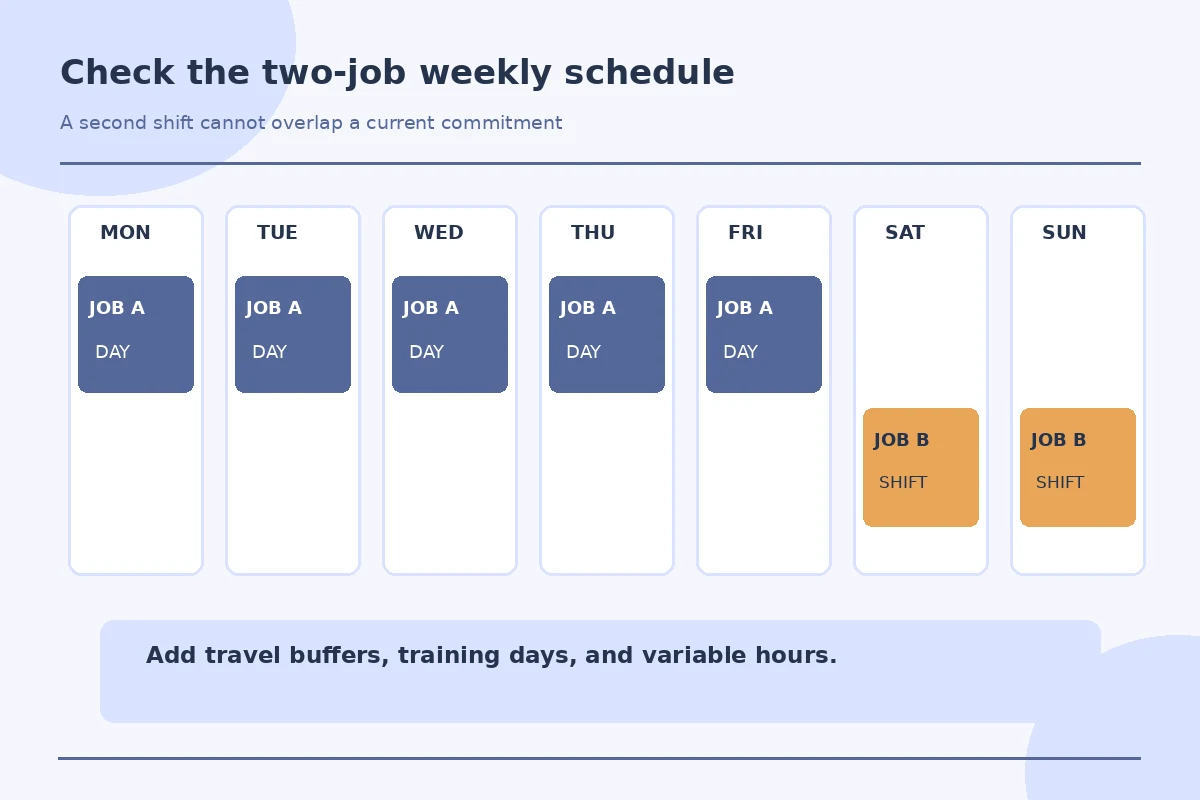
Accepting a second job is not just adding a new number of weekly hours. Write the recurring start and end times of the first job, expected hours of the second, commute between sites, travel home, and any required setup or closing duties. Then look for overlaps and too-short transitions. If one job posts a schedule weekly, use the latest real roster plus the employer’s stated scheduling policy; do not assume a fixed pattern because that would be convenient.
Mark commitments you cannot change in one color, negotiable shifts in another, and unknown hours separately. A new employer can only evaluate your availability if you state it truthfully. Say “I am available Saturdays after 10 a.m.” when that is the actual limit. Do not claim around-the-clock availability to gain an offer. Avoid invented productivity claims that working two jobs will never affect fatigue, concentration, or travel safety.
Read outside-work, conflicts, and confidentiality rules
Different employers have different restrictions. Some request disclosure of outside work, prohibit conflicts of interest, limit use of company equipment, or specify confidentiality expectations. Review policies you have actually received and ask HR how to report outside employment if required. Do not assume a particular prohibition is automatically lawful or automatically unenforceable everywhere. Questions involving contracts, government ethics, licensing, or state labor law may need individualized advice.
Keep each employer’s information, accounts, time records, and devices separate. A second job in the same industry may raise questions about competing duties or customer information; a job in an unrelated field may still cause schedule overlap. Do not use the first employer’s software or paid hours to perform work for the second. If an existing agreement includes a noncompete or disclosure clause, do not attempt to resolve it based on a generic article. Ask an appropriate professional for advice if needed.
Confirm availability beyond published shifts
An offer may state “weekends” but require a training weekday, occasional holiday cover, emergency call-ins, or variable hours. Ask about orientation dates and how far ahead shifts are posted. If a supervisor mentions “flexible support,” request an example of what the team expects in a busy week. A small schedule variation can matter much more when both jobs already occupy narrow windows.
Build a scenario for one unusually busy week, not only the easy average week. Include transit, meals, time to sleep, and any caregiving commitments. You do not need to disclose intimate personal details to an employer to state a firm availability boundary. A useful question is: “Will required training be available on weekends, or is weekday attendance mandatory?” Get the answer before accepting if the training schedule cannot fit.

Check payroll and withholding separately from job duties
Each employer usually handles its own payroll records. If you will earn wages from two jobs at the same time, the IRS says withholding may need adjustment; Form W-4 includes a multiple-jobs step and the IRS provides a withholding estimator. Review current official instructions rather than guessing a fixed withholding percentage. This article is not individualized tax advice and does not tell you which boxes to select without your income and filing circumstances.
Ask the new employer how onboarding and direct deposit are handled through the official secure system. Do not supply a bank number to an unverified recruiter. Also check practical costs: the commute, uniform, training time, parking, and any worksite change. Money saved on an additional shift can be offset by expenses, so use actual information from both jobs rather than projections based on advertised earnings. Never give one employer a detailed copy of the other’s confidential payroll records unless there is a legitimate and appropriate reason.
| Area | What to verify | Useful question |
|---|---|---|
| Current hours | Fixed and variable shifts | Are the new shifts fixed, rotating, or assigned at short notice? |
| New hours | Actual required coverage | Is availability outside scheduled shifts required? |
| Travel buffer | Transit and rest | Does either employer have an outside-employment or conflict policy? |
| Policies | Outside work and confidentiality | Who should I notify if an existing commitment affects a shift? |
The table is a working aid, not a standardized employment form. Replace its descriptions with the particular employer’s documents, and do not assume an unknown term is favorable. If a question affects compensation, a legal obligation, required credentials, or a protected employment right, ask HR for the applicable policy and obtain qualified advice when necessary. Keep the conversation factual and avoid inventing claims about what the law guarantees.
Accept with an accurate statement of availability
Once you have clear hours and any necessary outside-work disclosures, reply through the official channel. You can accept while referring to the stated schedule, but do not add a hidden condition that the employer has never acknowledged. If your availability is a material part of the offer, make sure the hiring team confirmed it in writing. A concise acceptance names the job, start date, and the specific schedule you agreed to.
Hypothetical wording: “I am pleased to accept the weekend guest services role beginning June 20, with the Saturday and Sunday hours confirmed in your email.” Do not use these dates unless they match your offer. If weekday training is required and your current job cannot accommodate it, first ask whether an alternative exists. If the answer is no, the offer may not be workable. A respectful, early response avoids leaving both employers to discover a conflict after scheduling.
Illustrative clarification email: Subject: Second Position Offer — Confirming Availability Before Acceptance. Hello Hiring Team, thank you for offering me the Weekend Guest Services Associate role. Before I accept, I would like to confirm that the regular schedule is Saturday and Sunday from 9 a.m. to 3 p.m., without a required weekday on-call rotation. I have an existing weekday work commitment and want to make sure the position’s availability expectations fit. If that schedule is correct, I can confirm acceptance by your stated deadline. Thank you. This sample is not a message sent by a real applicant and contains no verified employer promise. If you already have clear written terms, simplify it into a brief acceptance instead of unnecessarily reopening agreed points.
Monitor the first month without creating secrecy
Keep separate shift confirmations for each employer and note changes as soon as they appear. If one scheduler asks for an extra shift that collides with another commitment, decline or request a swap through the normal process, without inventing excuses. Follow documented policies about overtime, reporting conflicts, and outside work. Do not ask coworkers to falsify a time record or quietly cover an unapproved absence.
After the first few weeks, review the calendar against what you agreed to. If both jobs regularly require more unscheduled coverage than was discussed, ask a manager about the longer-term pattern. If fatigue or travel creates a safety problem, prioritize safe choices. A second offer only makes sense if you can meet each role’s actual responsibilities, not merely fit two titles onto the same resume.

How We Research Job Offer Decisions
JobAsk compared this intent with the WordPress title list provided for the project, read the existing production plan, and reviewed primary public guidance relevant to the specific scenario. Official publications explain some general practices and federal standards; they do not replace the employer’s own terms or professional advice for an individual dispute. The suggested questions, email wording, and diagrams are editorial examples, not verified hiring outcomes. The site’s affiliate disclosure explains editorial and commercial relationships.
Source: www.irs.gov — IRS Publication 505 describes how employees with simultaneous jobs may need to account for multiple wage sources when setting income-tax withholding.
Source: www.irs.gov — The IRS withholding estimator explains how to handle W-4 adjustments when a household has more than one job.
Source: consumer.ftc.gov — The FTC explains how to verify recruiters and recognize requests for sensitive financial information in fake job offers.
Related Workplace Guides
Review your applicable contract and employer policy. Some roles require disclosure; do not assume a universal rule covers every job.
You can choose to, but a variable roster creates real overlap risk. Ask how shifts are assigned and whether your availability limits will be honored.
It can. The IRS provides a multiple-jobs step and withholding estimator; follow current instructions for your own circumstances.
Share the availability you can reliably offer. You generally do not need to send confidential company schedules or payroll details.
Ask whether another approved training slot exists before accepting. Do not promise to attend a session you cannot make.