
Start with the real career routes
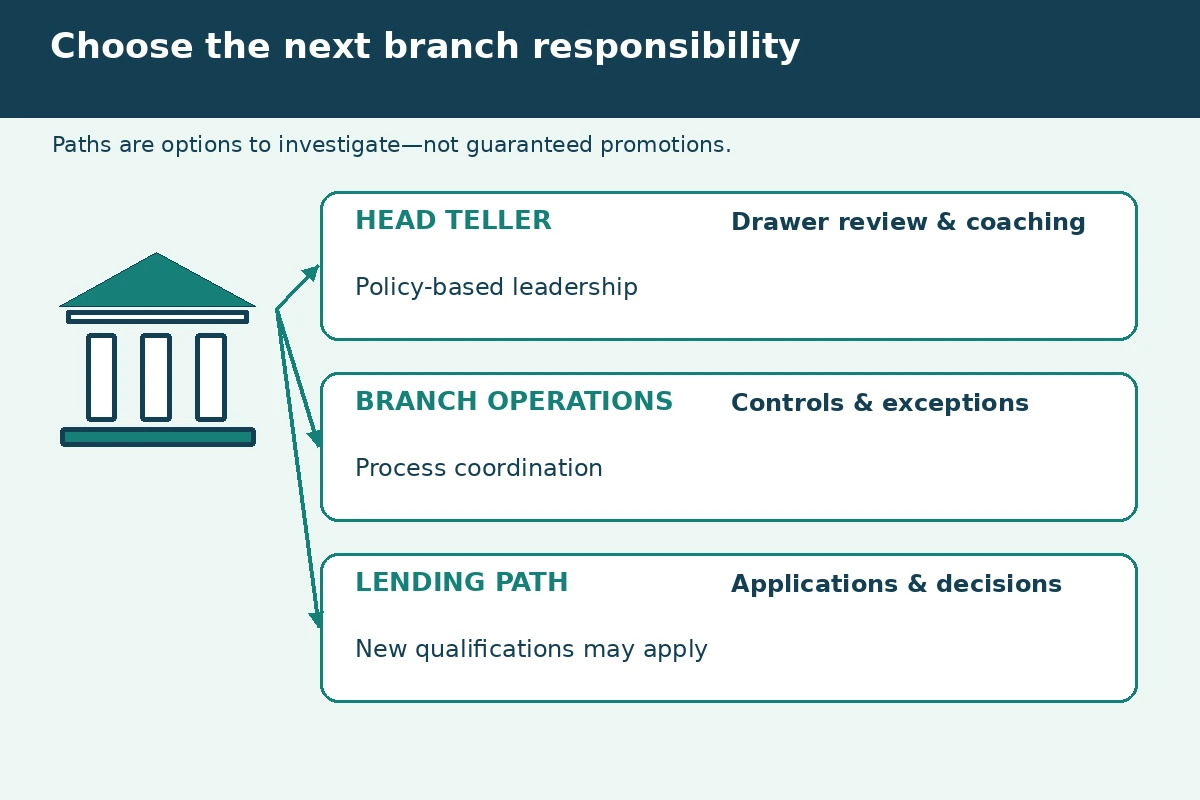
Bank teller career advancement is not one fixed ladder. An experienced teller may pursue a head teller position, a branch operations assignment, a customer-facing banker role, or a longer route toward lending. The most useful first step is to compare the duties of the target role—not just the title—with your current work. BLS identifies head tellers as experienced tellers who add coordination and some supervisory tasks. It also notes that tellers sometimes move to loan officer and sales jobs. Those are possibilities, not guaranteed promotions or interchangeable qualifications.
Head teller work is more than transaction speed
A head teller may coordinate teller coverage, help newer colleagues, manage certain branch cash procedures and handle difficult account discrepancies under the bank’s policies. Demonstrate that you can identify a mismatch, document what you checked and escalate to the right person without improvising a financial decision. Ask whether the bank wants coaching, cash-control familiarity, schedule coverage or other assignments. If you helped train a new employee, describe exactly what you demonstrated and who evaluated the trainee. Informal help at the counter is useful evidence, but it is not the same as formal supervision.
Branch operations calls for a different evidence set
A teller interested in branch operations should learn how the institution documents exceptions, protects customer information and separates preparation from approval. Exposure to audit-ready records and consistent handoffs may matter more than a large volume of deposits. Ask for a controlled shadowing assignment where permitted, such as reviewing a closing checklist with a supervisor. Do not claim that you released funds, waived controls or changed customer records outside your access. Each bank uses its own procedures, so generic internet descriptions cannot substitute for the actual internal job posting.
Loan roles are not simply advanced teller duties
Loan officers evaluate, authorize or recommend action on applications; tellers who refer an interested customer do not perform those same functions. BLS reports that loan officers typically need a bachelor’s degree and on-the-job training, and that mortgage loan officers must be licensed. Requirements differ by position and jurisdiction. If you want this route, study the specific job requirements and ask what education, authorized experience or licensing is needed. A branch service role involving product explanations may be a sensible adjacent move, but it does not itself establish lending authority.
Build a defensible advancement record
For several weeks, keep a private, noncustomer-specific log of responsibilities that you can verify: balancing at the required checkpoint, documenting a discrepancy, assisting with a policy explanation, or helping someone follow a routine. Use counts only when accurate and shareable. A line such as “explained daily cash-close steps to a new teller under lead-teller guidance” is stronger than “managed the branch.” Customer account numbers, personal financial data and internal security procedures should never appear in a public portfolio. Ask which evidence a supervisor is authorized to confirm.
Compare readiness against an actual posting
Read a current internal opening or a public description for the exact job title. Divide requirements into tasks you have done, tasks you have seen but not performed, and tasks that need new qualifications. For example, teller balancing may demonstrate precision, while staff scheduling may be an untested management skill. If a position requires a license or formal authority, do not treat a training video as equivalence. Ask an internal recruiter whether an interim branch service or operations role would provide relevant supervised experience.
| Evidence area | Proof you can describe | Boundary to check |
|---|---|---|
| Daily accuracy | Balanced drawer records | Only your own verified results |
| Process help | Documented exception handoffs | Do not claim final approval |
| Peer support | Training notes and feedback | Confirm assigned authority |
Ask for one controlled stretch assignment
A useful request to a manager is specific: “I want to understand the head teller role. Could I help document the end-of-day checklist or shadow the approved exception process, with an assigned reviewer?” The manager can tell you what is possible, how customer privacy will be maintained and which duties cannot be delegated. Record what the assignment taught you, including errors you caught and how you escalated them. A stretch assignment is a way to gather evidence and learn, not an entitlement to additional pay or a promotion.

Prepare the conversation about your next role
Bring the job description, three examples of dependable work, and one skill gap you want to close. Ask: “What would make me a credible candidate for this role in this branch?” Then request a measurable practice opportunity and a date to revisit the discussion. Avoid framing the conversation as a demand based only on tenure or the number of transactions handled. If the bank does not have a vacancy, discuss cross-training, a different branch or a lateral move that fits your goals.
Track process quality without inventing numbers
If you have access to approved performance reports, learn whether they include cash variances, timely escalation, training completion or documented customer issue resolution. Context matters: raw transaction volume says little about complexity or risk. Do not invent an accuracy percentage, quote confidential operating thresholds, or disclose a colleague’s performance. Write a short narrative of the action and its verified effect instead. Your strongest examples may be about preserving controls during a busy shift rather than chasing a heroic statistic.
Avoid title inflation and unauthorized promises
Calling yourself a branch manager because you helped open the lobby will harm your credibility. The same applies to implying you negotiated credit terms or approved a customer product when you only referred a question. Keep titles, duties and decision rights aligned with payroll records and supervision. If you want a lending route, check licensing and education early rather than relying on assumed on-the-job equivalence. Career advancement should widen responsibility only when the organization has actually granted it.

A one-page branch readiness sheet
Create a one-page summary with three columns: the target duty, a verifiable example of your present work, and the gap to close. For a head teller position, your example could be a documented handoff at cash close; your gap could be formal coaching and coverage coordination. For a branch operations job, focus on controlled exception tracking rather than raw transaction counts. For a lending path, list education, licensing and role-specific training separately. Take the sheet to your supervisor and ask which examples are credible. Keep confidential bank procedures and customer information out of the document. A realistic development plan can include a lateral assignment rather than immediate promotion.
Create a short, realistic action plan
Choose one of the three paths, save the target posting, inventory your transferable teller work, and identify a qualification or leadership gap. Arrange an appropriate supervisor conversation, request one safe shadowing or training task, and document the result without personal data. Reassess the plan when the next vacancy appears. If the branch cannot provide a viable route, compare neighboring institutions and related roles based on real requirements—not a claim that every experienced teller will be promoted.
How We Research and Check Career Advancement Guidance
We reviewed these occupational and professional sources on November 16, 2026: BLS defines teller and head teller responsibilities and mentions advancement to other bank roles. BLS explains loan officer duties, typical entry education and mortgage-loan licensing. O*NET outlines supervision, coaching and quality review in administrative support work. Roles, approvals and qualifications depend on the employer and jurisdiction. Illustrative scenarios are not reports of real candidates. Read our affiliate disclosure.
Explore Related Career Guides
Requirements vary by institution. Focus on the posted role, reliable cash controls, training experience and any stated education requirements; do not assume an automatic promotion.
It can be a new career route rather than a simple promotion. Loan officers have different duties and qualifications; mortgage lending can include licensing requirements.
Request supervised exposure to daily balancing, documented exceptions, peer onboarding and branch procedures where the employer authorizes it.
Not unless you were authorized and actually made the decision. Referring interest or collecting information is distinct from approval.
Ask which skills the next position demands, who can assess them and when a realistic opportunity or lateral assignment may arise.